

Description
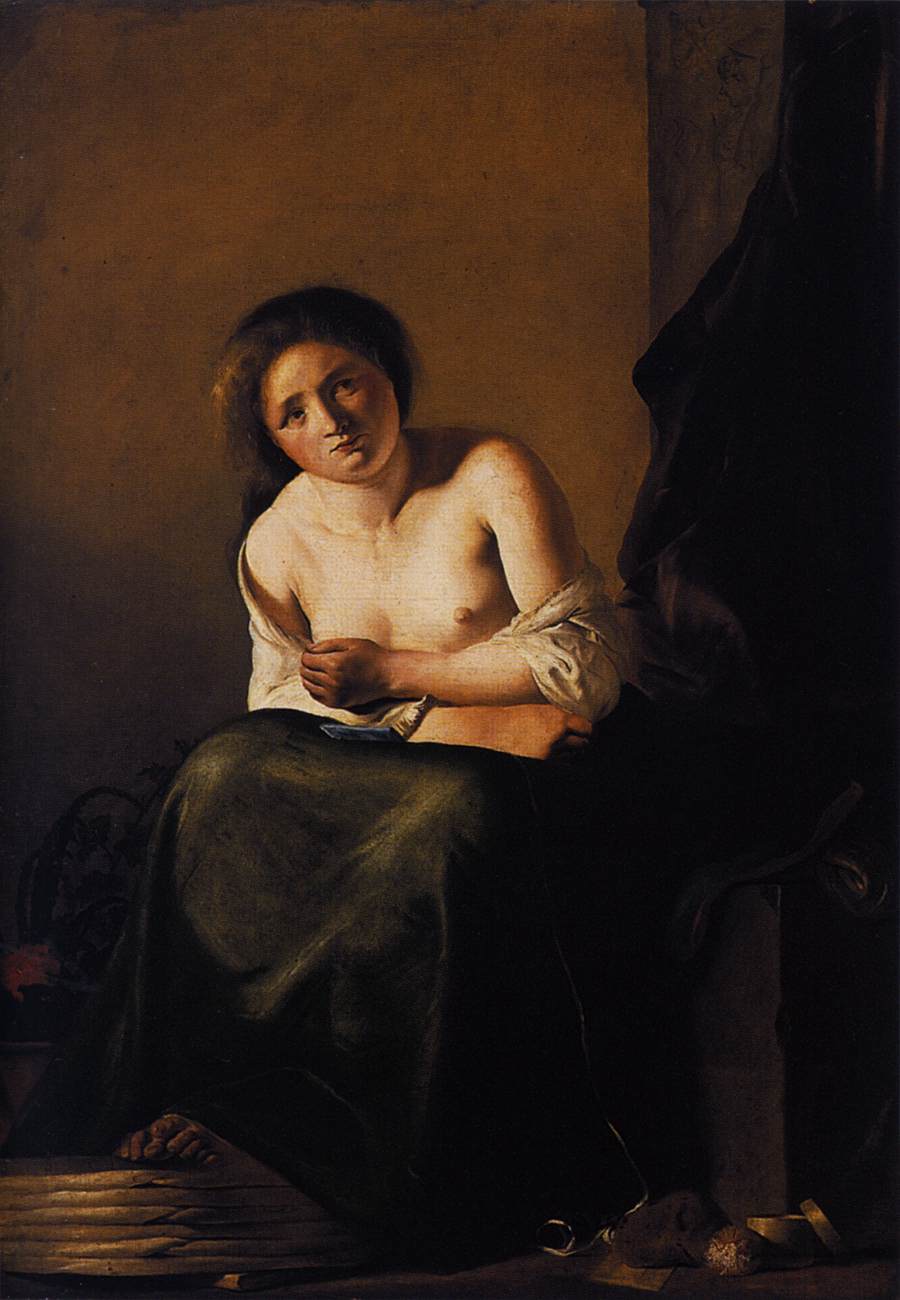
The painting depicts Ariadne seated at the center of a shadowy interior. The young woman, with dark hair, looks toward the viewer, her arms crossed over her bare torso. A light shirt hangs open around her arms and waist, forming folds that contrast with the loose, very dark green or black garment covering her legs. A large mass of fabric and shadow stretches to one side; in the background, a brown wall and a wooden surface define an enclosed, almost theatrical space. A bare foot peeks out in the lower-left corner. Everything is subordinated to the figure’s silent presence.
Ariadne belongs to the world of Greek mythology and the story of the Cretan labyrinth. The daughter of Minos, she helps Theseus find the way out by giving him the thread that allows him to return after confronting the Minotaur. Here, the tale takes on a later, more intimate tone: that of the young woman abandoned on Naxos, separated from the man she had accompanied and vulnerable to a fate she no longer controls. The scene does not need to depict the labyrinth or the thread literally to evoke this episode; it focuses the narrative on the emotional state of an isolated figure, suspended between waiting, loss and introspection.
The partial nudity and fallen garments make the body a sign of fragility, while Ariadne’s closed posture protects and contains her intimacy. The light shirt, still around her arms, preserves the visual trace of an interrupted action and creates a delicate counterpoint to the darkness surrounding her. The dark mass on the right acts as a visual barrier: it constricts the space and makes the figure seem even more alone. The light on her skin does not idealize the scene but makes it psychologically intense. The contrast between what is exposed and what is concealed transforms mythological abandonment into a close, silent experience.
The vertical composition organizes the gaze around a carefully defined human axis: the head and shoulders draw the eye first, and from there the crossed arms lead the gaze toward the folds below. The diagonals of the shirt and dark garment introduce a measured sense of movement into an essentially still scene. The ochre-brown tones of the background and the blackish green of the clothing create a somber palette, interrupted by the ivory of the fabric and the warm tones of the skin. The frontal light sets the torso apart from the shadows, while the wooden floor provides a tangible, modest foundation. Depth comes less from perspective than from the succession of light and dark planes.
In Paulus Bor’s work, this intensity is consistent with the tenebrism of the 17th-century Dutch milieu and its interest in isolated figures, mythological subjects, and dramatic lighting. The painting turns a classical story into an inner drama: the protagonist appears not as a triumphant heroine, but as a human presence caught between light and shadow. It is worth noting how each element—the direct gaze, the crossed arms, the discarded shirt, and the dark void surrounding her—reinforces the same sense of desolation. The chiaroscuro does more than illuminate Ariadne; it makes visible the silence that defines her story.
Have questions about our oil painting reproductions? See our frequently asked questions.