

Description
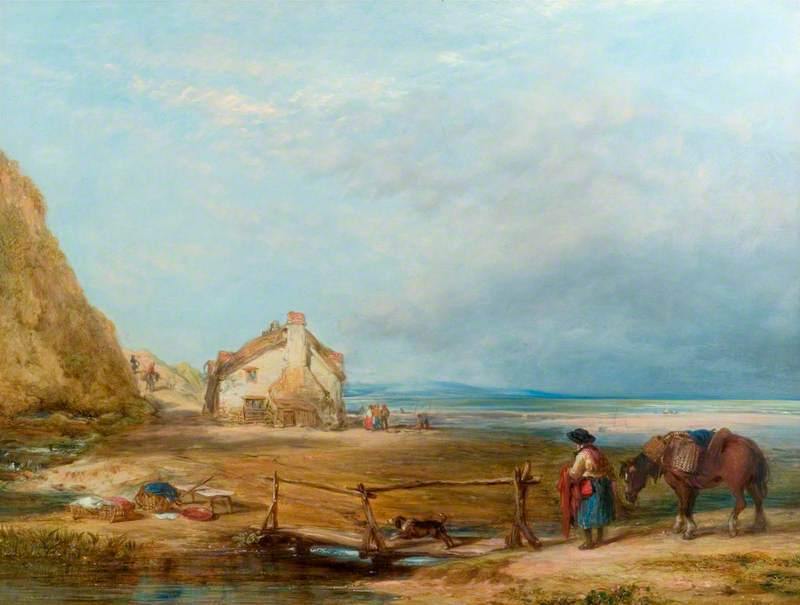
The painting depicts a rural coastal landscape in Devonshire, open beneath a broad, overcast sky. Beside the shore stands a light-coloured house with a sloping roof, accompanied by the rocky, overgrown slope that fills the left edge. In front, a stretch of sand and mud crossed by puddles, ruts and small channels of water extends across the scene. In the foreground, a rustic wooden fence runs horizontally across the scene, leading the eye towards a figure wearing a hat, a reddish garment and a blue skirt, standing beside a brown animal laden with bundles or tack. Near the house, several small figures extend the human activity between the house, the beach and the sea.
The title places this observation in Devonshire, the historic name of the English county of Devon, in southwest England. The work does not depict a historical, religious or legendary episode, but a genre scene set within a coastal landscape. The isolated dwelling, damp terrain and presence of a pack animal evoke a community accustomed to working in direct contact with the coast. The sea is not merely a backdrop: it defines the horizon of those who inhabit this place and underscores the open, exposed and changeable nature of the surroundings.
The foreground figure provides the composition’s narrative focus. The laden animal connects the landscape with work, transport and everyday life, while the fence creates a threshold between the viewer and the terrain where activity unfolds. This low barrier does not entirely divide the spaces; rather, it marks the passage from the muddy ground towards the house and the sea. Dwarfed by the cliff and sky, the house suggests a relationship of coexistence between human scale and expansive nature. The low horizon and dense clouds heighten the sense of dampness, spaciousness and shifting atmospheric conditions.
The composition is organized around a clear balance between solid forms and open spaces. The cliff and house enclose the left side, while the sea and sky open up the background to the right. In contrast, the figure and animal add visual weight closer to the viewer, enlivening the tranquil surface of the landscape. The fence acts as a guiding line: its irregular posts and rails lead the eye across the lower plane and create a rhythmic transition between the viewer and the coast. Ochres, browns, muted greens, and beige sands blend with the grayish blues of the sea and sky; the red and blue accents in the clothing stand out without disrupting the scene’s restrained harmony. The diffused light avoids sharp contrasts and allows depth to develop gradually, from the objects on the shore to the horizon.
In this work by William Collins, we recognize the artist’s interest in the British landscape, rural life, and genre scenes, with particular attention to atmospheric effects. The modest activity of a person leading a laden animal thus becomes the human focus within a much broader coastal expanse. The house, fence, and figures do not compete with the sea, but instead make it legible as a lived-in space: each element connects work, habitation, and nature. The strength of The Sands of the Solent, Devonshire lies precisely in this union of everyday narrative and coastal expansiveness, where an apparently simple scene gains rhythm, depth, and resonance through its visual construction.
Have questions about our oil painting reproductions? See our frequently asked questions.