

Description
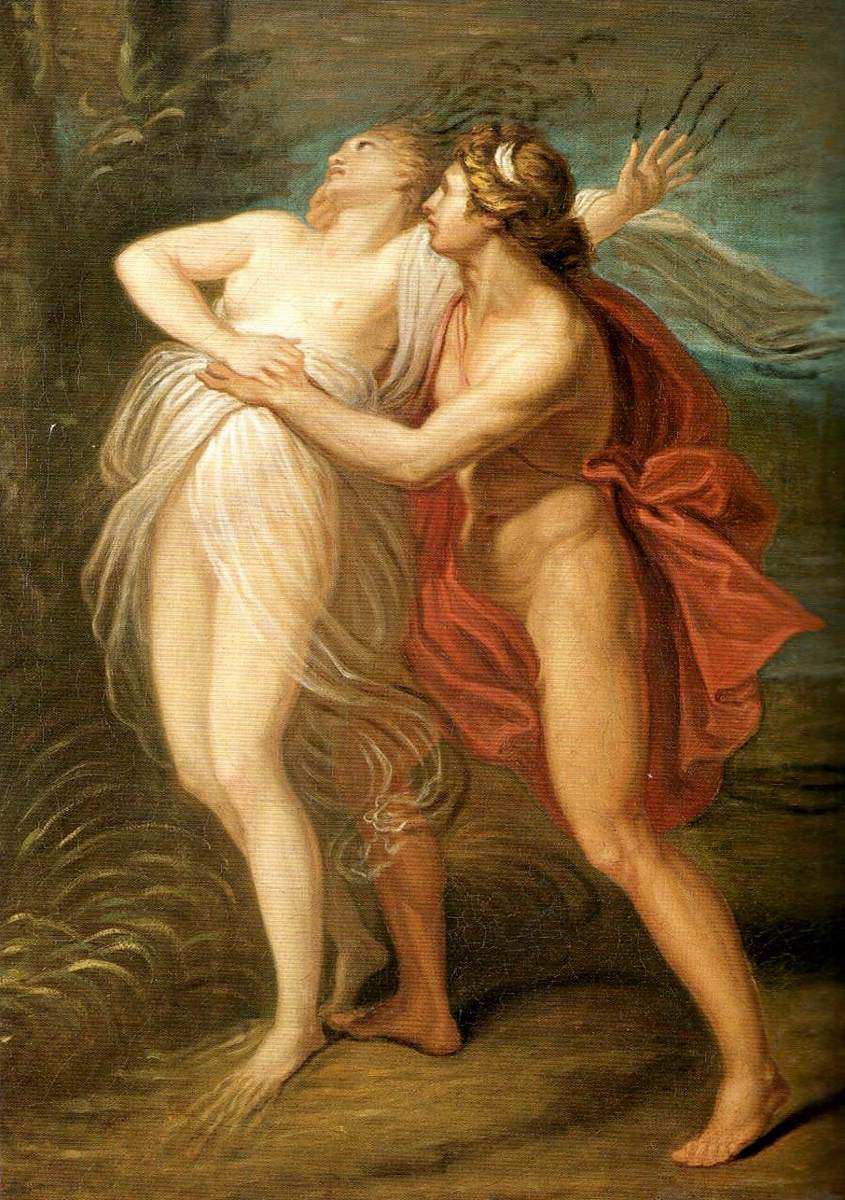
The painting shows Apollo and Daphne at the moment of greatest tension in their encounter. Two human figures occupy the foreground and are entwined at the center of the composition: the figure on the left, wrapped in a sweeping white cloth, tilts her face upward, while the figure on the right, surrounded by red and earthy drapery, turns toward her and raises an arm with an open hand. Their overlapping forearms and hands form the heart of the scene. Dark, undulating surfaces stretch beneath their bodies, amid a landscape of shadowy vegetation, a greenish-blue sky, and barely illuminated landforms.
The episode comes from one of the best-known stories in Greco-Roman mythology. Apollo pursues Daphne, who tries to escape him and ultimately calls for help to preserve her freedom. In response, Daphne is transformed into a laurel tree; from then on, the laurel is associated with Apollo. The painting concentrates this narrative in the moment of pursuit and imminent metamorphosis, without turning it into a static or merely illustrative scene. The physical closeness of the figures makes the conflict between desire and flight visible, while the upward direction of their gestures keeps the action unresolved.
The drapery serves a deeper purpose than simply covering the bodies. The white cloth amplifies Daphne’s presence and seems to extend her movement, as if the figure were being drawn toward another form of existence. The reds and browns surrounding Apollo bring a warmer, more enveloping energy, contrasting with the ivory brightness on the opposite side. The raised arm and the expansive forms around the figures reinforce a reading of transformation and resistance. The undulating, plant-filled background turns the setting into a liminal space, fitting for a story in which human identity is on the verge of change.
The vertical structure guides the eye along an ascending diagonal that begins in the lower-left area, crosses the intertwined bodies, and culminates in the hand extended toward the upper right. This dynamic line is balanced by the vertical folds of the white fabric and the gathered folds of the red drapery, which introduce broken, undulating rhythms. Warm light falls chiefly on the skin and fabrics, making the figures emerge from the dark background. Ochres, browns, deep greens, and greenish blues create a compact depth that is more dramatic than descriptive; the landscape surrounds the figures without competing with them.
In this work by Andrea Appiani, the mythological subject is conveyed through a combination of visible anatomy, interlinked gestures, and fabrics of considerable sculptural force. The scene does not depend on any single attribute: its meaning emerges from the relationship between the bodies, the direction of the hands, the darkness of the setting, and the spreading drapery. It is worth observing how the composition transforms a pursuit into an image suspended between contact and separation. In this balance, Apollo and Daphne appear united by movement at the very moment the story signals that they can no longer remain in the same form.
Have questions about our oil painting reproductions? See our frequently asked questions.