

Description
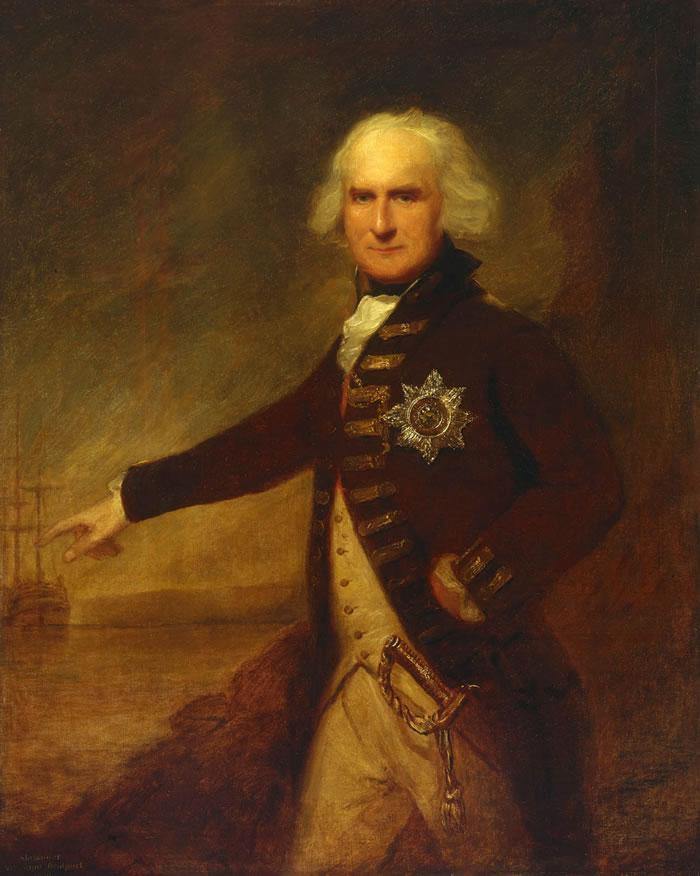
The painting depicts Admiral Alexander Hood standing in a three-quarter frontal pose that occupies almost the full height of the composition. The sitter wears a dark, high-collared uniform embellished with several rows of gold fastenings, over a light-colored buttoned waistcoat. A large, star-shaped insignia stands out on his chest, while the sword, angled beside his body and accompanied by a decorative chain, completes his ceremonial presence. His left arm extends toward the landscape, palm open, as if pointing to a horizon beyond the immediate setting. Behind the figure unfolds a background of brown, ochre, and gold tones, with a hazy sky and a distant band that visually extends the scene.
As a historical portrait, the work places Alexander Hood within the British tradition of depicting officers and public figures. Hood was an officer and admiral in the Royal Navy, and here his identity is conveyed through the visible signs of rank: his uniform, insignia, sword, and erect bearing. This is not merely an individual likeness, but a public image crafted to associate the sitter with institutional authority, service, and military dignity. The landscape broadens this biographical setting without becoming an independent narrative scene: it serves as an open space that complements the commander's figure and connects his presence with the land and the maritime horizon.
The gleaming insignia carries much of the portrait’s visual meaning. Its star-shaped form and metallic sheen introduce a mark of honor that draws the eye to the chest and underscores the sitter’s status. The sword reinforces this sense of authority, while also adding a diagonal line that breaks the figure’s vertical rigidity. The extended gesture establishes a dialogue between the figure and the landscape: the hand directs attention to the left, while the face and decoration keep the center of gravity on the sitter. The military attributes thus do not appear as isolated accessories, but as elements that turn the portrait into a visual statement of rank and command.
The composition is organized around a dominant vertical axis formed by the admiral’s silhouette, which contrasts with the breadth of the horizontal background. Warm light falls on the face, powdered hair, extended hand, and insignia, creating a sequence of bright accents against the dark uniform. Black and brown tones lend the figure weight and stability, while the ochres and creams of the sky and waistcoat introduce chromatic relief. The landscape, rendered in a more atmospheric manner, creates depth without competing with the sitter. The diagonal of the sword and the direction of the arm bring restrained movement to an essentially solemn and stable scene.
In the tradition associated with Lemuel Francis Abbott, this portrait stands out for the attention devoted to official dress and for the way it turns the attributes of power into a clear pictorial structure. The visible surface combines descriptive precision in the hair, buttons, and metalwork with a more vaporous background, giving the figure an almost theatrical presence. It is worth noting how the outstretched hand, insignia, and sword form a visual path that brings together personal authority, institutional rank, and the horizon. The result is a portrait in which Alexander Hood is not merely depicted, but carefully positioned between the solemnity of his uniform and the symbolic breadth of the landscape.
Have questions about our oil painting reproductions? See our frequently asked questions.