




Description
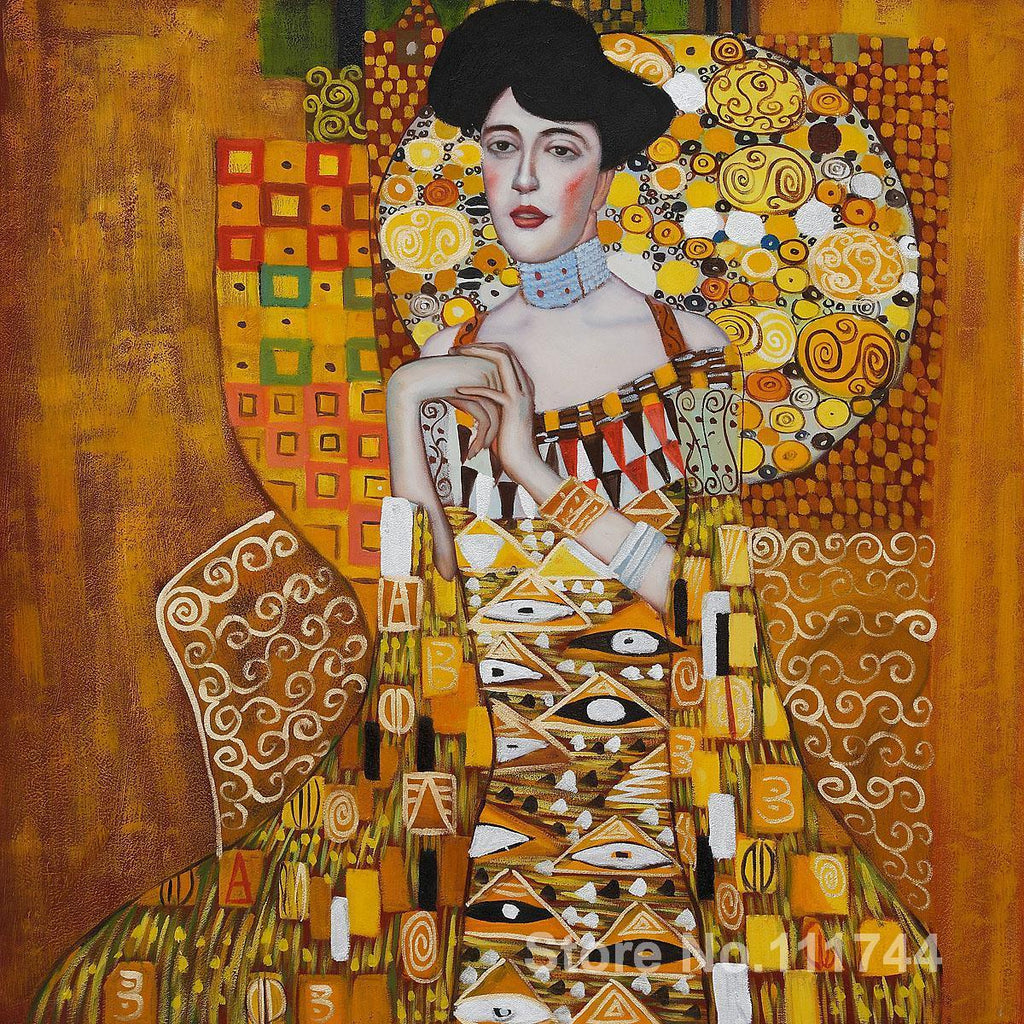
The painting depicts Adele Bloch-Bauer facing forward, transformed into a monumental presence within a radiant, densely ornamented surface. The figure occupies the center and is positioned slightly to the right; her serene face, dark hair swept up, hands crossed in front of her torso and pale choker focus the portrait’s human dimension. Her dress extends to the lower edge and is covered with bands, squares, triangles, vertical bars and almond-shaped forms resembling eyes. Behind her head and shoulders unfolds a constellation of discs, circles and spirals, while a broad golden field gives breathing room to the left side of the composition.
Portrait of Adele Bloch-Bauer I belongs to Gustav Klimt’s artistic idiom and exemplifies the transformation of an individual portrait into a sumptuous, almost iconic apparition. The sitter’s identity is asserted through the precision of her face and hands, but the rest of her figure is integrated into a decorative universe that partially erases the distinction between body, dress and background. The work is part of Klimt’s Golden Period, associated with gold surfaces and elaborate ornamentation. Thus, the depiction does more than describe a woman: it presents her ceremonial presence as a solemn, elegant and carefully idealized figure.
The enveloping gold reinforces a reading of luxury, solemnity, and ceremonial distance without reducing the painting to a single symbol. Circles and spirals organize the space into an enveloping, almost architectural pattern that surrounds the sitter and separates her from the open golden field. On the dress, the repeated almond-shaped forms function as ornamental motifs, drawing the eye repeatedly and creating an almost textile-like vibration. The contrast between the lightness of the face and hands, rendered in a more naturalistic style, and the geometric abstraction of the attire focuses attention on what makes Adele recognizable. The human figure remains present, though absorbed into a surface of extraordinary visual richness.
The vertical, frontal composition creates a sense of ceremonial stability. The head establishes the first focal point, and from there the gaze descends along the necklace, arms, and long column of the dress. The more open, golden area on the left serves as a counterpoint to the ornamental density surrounding the figure. Squares, rectangles, bands, and small accents of blue, red, white, and black introduce rhythmic pauses amid the predominance of ochres and golds. The fine lines and filaments in the lower section extend the movement downward, while the concentric discs create a circular cadence around the head. Conventional depth gives way to an almost flat surface, where each pattern competes for attention without compromising the unity of the whole.
In this work, Gustav Klimt brings together hieratic frontality, a contrast between figuration and decoration, an abundance of gold, and a surface articulated by geometric patterns. The result is a portrait in which Adele Bloch-Bauer’s individuality does not disappear, but instead takes on a monumental dimension as it is set within an almost iconic ornamental composition. Notice how the face and hands serve as anchors of humanity against the expanding abstraction of the dress; then follow the network of circles, bands, and repeated forms to understand how space becomes part of the identity being portrayed. The work derives its power precisely from this tension between person and ornament, between intimate presence and golden spectacle.
Have questions about our oil painting reproductions? See our frequently asked questions.