

Description
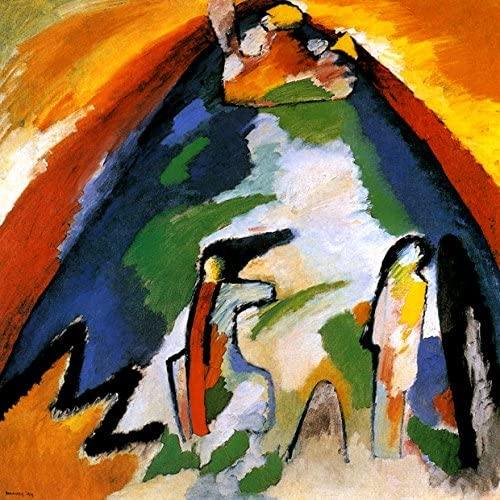
The painting A Mountain presents an abstract evocation of mountainous terrain as a vertical, intense, concentrated presence. An elongated structure rises at the center, with a triangular or arched outline, built from deep blues and blacks. Around it spreads an enveloping field of oranges, yellows, and earthy reds, while its interior brings together green patches, blue areas, luminous whites, ochres, and overlapping forms. At the top, an irregular grouping of dark, light, and warm marks lends density to the composition; below, several vertical forms introduce pauses, contrasts, and shifts in rhythm. The paintwork keeps its edges open and focuses attention on the central axis.
The work does not depict a naturalistic landscape or develop a conventional narrative scene. The mountain appears as a pictorial idea: an ascending axis that organizes the space and concentrates the painting’s energy. Its presence is built through color, texture, and tension between open areas and compact zones. This approach places the painting within a broad understanding of abstraction, in which a recognizable motif is transformed into an autonomous structure capable of suggesting depth, elevation, and strength without relying on topographical details. The landscape is reduced to an essential visual experience, shaped by relationships of mass, direction, and contrast.
Chromatic contrast underpins much of its visual meaning. The warm perimeter, composed of oranges, yellows, and earthy reds, creates a sense of intensity and expansion around the dark core. Against this fiery surround, the whites and pale blues in the lower center introduce a luminous opening, as if the central mass contained different planes of depth. The greens and blues provide a cooler counterpoint, while the black forms act as anchors that reinforce the mountain’s stability and weight. The structure thus asserts itself as a solid presence surrounded by a shifting field of energy, in which the inner light balances the density of the contours.
The square composition is dominated by a vertical axis that guides the eye from the cluster of marks at the top to the forms gathered in the lower area. The thick, layered brushwork prevents a flat reading: the colors occupy distinct planes, although their boundaries remain deliberately open. Diagonals, broken contours, and narrow forms create movement within a relatively stable central architecture. The eye shifts between the darkness of the arch, the brightness of the central area, and the warm vibration of the edges. This visual circulation turns the mountain into a dynamic construction, closer to an experience of ascent and concentration than to a depiction of a specific place. The verticality is reinforced by the repetition of strokes that draw the space taut from top to bottom.
In the context of Wassily Kandinsky’s work, the painting approaches an understanding of abstraction based on the expressive use of color and the tension between geometric and organic forms. Here, the brushwork does more than cover a surface: it establishes rhythm, depth, and direction. The mountain is transformed into a pictorial architecture of color and material, where a dark axis emerges from a warm field and lighter areas open up the center, creating a sense of space. The title guides the viewer’s interpretation without constraining it: the work need not imitate a summit to convey its upward thrust. The eye ultimately settles on the tension between the gravity of the dark core and the luminous expansion surrounding it.
Have questions about our oil painting reproductions? See our frequently asked questions.