

Description
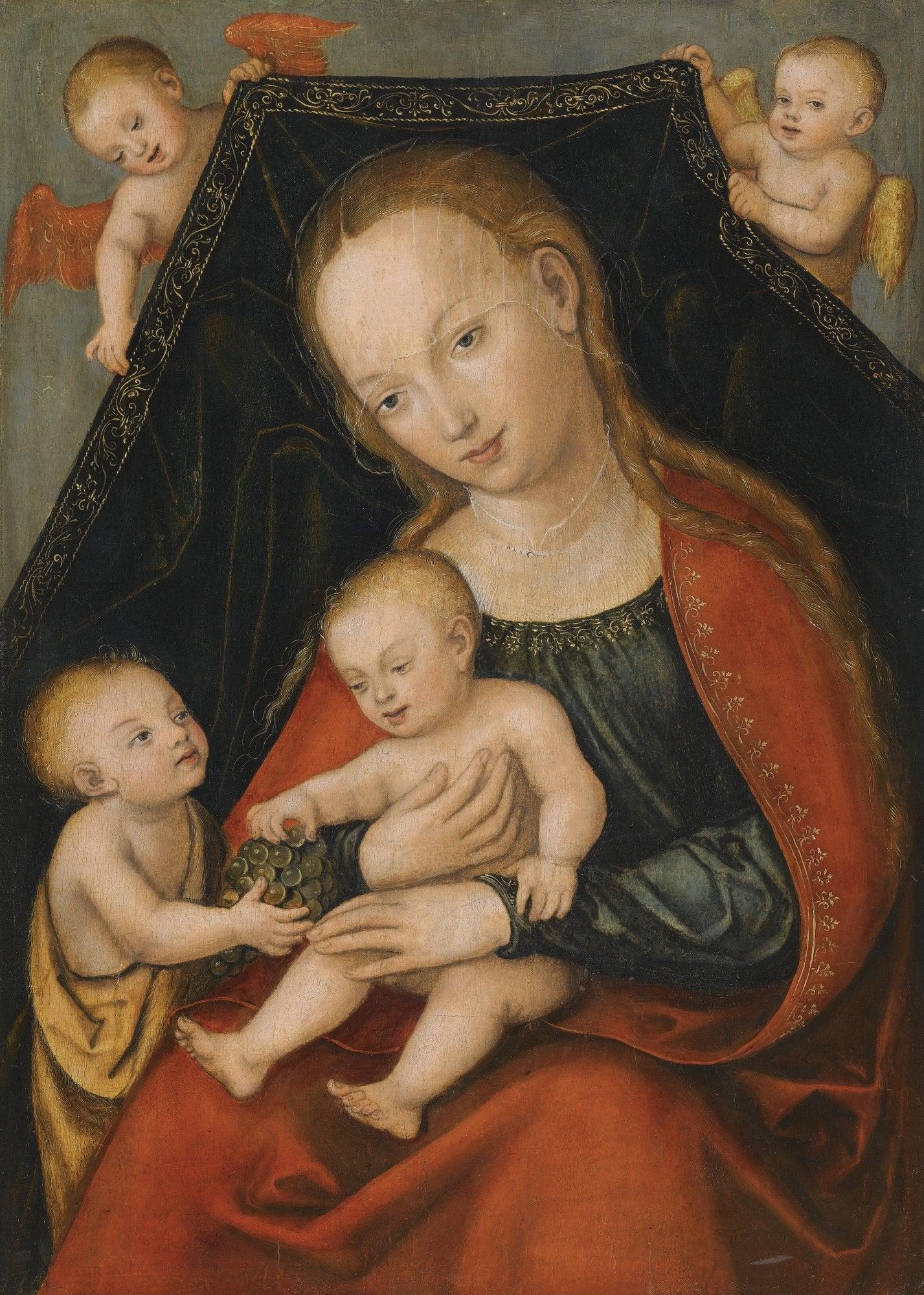
The painting shows the Virgin seated and holding the Christ Child in her arms, in a scene of devotional intimacy accompanied by the infant Saint John the Baptist and two angels. Mary occupies the center and right side of the composition, enveloped in a red mantle with a gold border over a dark garment. The naked Child, reclining horizontally, forms the emotional focus of the scene. In the lower left, the infant Saint John the Baptist looks upward as he holds a bunch of grapes. Above them, two winged infants hold up a large, ornately decorated black curtain that opens like a canopy. The red drapery spread across the lower part completes an enclosed, theatrical and carefully arranged space.
The work presents one of the central themes of Christian devotional painting: the Virgin and Child, shown here in the company of Saint John the Baptist and angelic figures. The presence of the two holy children transforms the image into a sacred gathering with a serene, familial character, closer to intimate contemplation than to a complex narrative scene. Saint John the Baptist often appears beside Jesus during childhood in works of this kind, while the angels emphasize the celestial dimension of the encounter. The figures’ physical closeness focuses attention on Mary’s protective bond and on the relationship between the two children.
Each element contributes to the iconographic reading. The Virgin’s red mantle lends an air of dignity and visual energy around the Child’s body, while the dark drapery serves as a solemn frame for the sacred group. The two angels, positioned above, reinforce the idea of adoration and protection, and their elevated position establishes a spiritual hierarchy without fully separating them from the earthly scene. The bunch of grapes introduces a fruit motif that may suggest Christological or Eucharistic resonances, as well as offering a tangible counterpoint to the child’s nakedness. Taken together, these attributes transform an apparently simple gathering into an image charged with religious meaning.
The formal construction relies on strong contrasts. The black drapery forms a kind of visual triangle behind Mary and directs the gaze toward her face and the Child’s fair body. Against this dark mass, the crimson and orange-red tones of the fabrics create an intense band of color running through the center and lower portion of the composition. The skin tones stand out against the smooth, gray-green background, which contains no landscape, giving the figures an almost theatrical presence. The vertical composition brings together several rhythms: the downward fall of the folds, the diagonal of the Child’s body, Saint John’s upward gesture, and the spread of the wings in the upper area. The visible lines and marks on the surface add a texture that forms part of the painting’s material character without distracting from its figurative structure.
This work by Lucas Cranach the Elder reflects a devotional tradition of the Northern Renaissance, characterized by defined contours, intense colors, meticulous attention to textiles, and a focus on the action within a clearly delineated group of figures. The richness of the golden trim, the dark folds, and the contrast between the muted background and the red drapery show how material details reinforce the spiritual dimension. It is especially worth following the path of the viewer’s gaze: it begins at Mary’s face, moves to the Child, shifts toward Saint John, and then rises to the angels holding the canopy. In this way, the religious subject and the arrangement of colors work together to transform a scene of maternal affection into an image of sacred, theatrical presence.
Have questions about our oil painting reproductions? See our frequently asked questions.