

Description
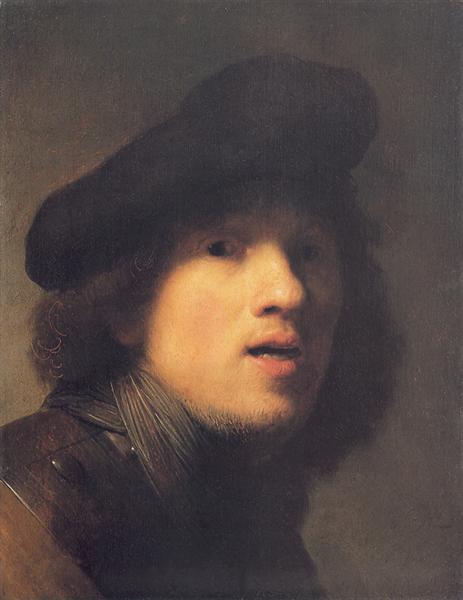
The "Self -portrait with Gorjal and Bina" of Rembrandt, painted in 1629, is presented as a vibrant testimony of the artist's mastery in the creation of introspective portraits that transcend their time. In this work, the spectator is received by the immense and enigmatic presence of Rembrandt himself, who through art is revealed in a deep reflection on his identity and his place in the world of art and society. The chiaroscuro technique, an unmistakable characteristic in its work, is used masterfully to create a dramatic game of lights and shadows that brings a notable three -dimensionality to the artist's face.
The composition focuses almost exclusively on the figure of Rembrandt. His expression is serene, but at the same time loaded with a subtlety that invites the viewer to a deeper contemplation. The choice of a direct look, framed by the lush hair that falls on his shoulders, suggests both confidence and vulnerability. El Gorjal, a type of shell that seems to suggest a warrior past or a life marked by the fight, is firmly located in his chest, complementing the beret that kisses the upper part of his head, giving the portrait an air of nobility and dignity . These elements are not only ornamental, but are part of the visual narrative that Rembrandt builds, reinforcing the idea of an artist who has forged his own path in a often adverse world.
The color in this work is of remarkable wealth. The dominant dark tones create an almost theatrical atmosphere, allowing the nuances of the artist's skin and the reflexes in the hair stand out with an almost supernatural luminosity. This use of color, together with the texture, highlights Rembrandt's ability to capture the essence of the human being, enriching the experience of those who contemplate his work. In this painting, the palette is relatively limited, but precise, which shows that the true strength of Rembrandt lies not in the variety of colors, but in its ability to use these tones effectively to communicate emotion and character.
This self -portrait also invites reflection on the artist's status in seventeenth -century society. At a time when the painter's existence was largely defined by his commissions and the need to fit into social standards, Rembrandt, through his self-representation, claims his place not only as a creator, but as a Witness of your own time. This work is in a context of multiple self -portraits that Rembrandt made throughout his life, offering an evolutionary look to its personal and artistic growth, where each portrait is a chapter in the narrative of its existence.
Particularly in the "Self -portrait with Gorjal and Bina", there is an evolution in his style and technique compared to his first works, where the features were more idealized. Here, there is an acceptance of reality, an honest revelation of his being. This portrait, in addition to being visually captivating, raises questions about self -image, identity and perception in art, aspects that would continue to be relevant throughout the centuries.
In conclusion, "self -portrait with Gorjal and Bina" is not only a visual representation of Rembrandt, but a reflection on art and creation. The complexity of the work, added to the richness of the use of color and technical ability, places this painting as a fundamental piece not only in the work of the master of the Baroque, but in the history of art in general. Rembrandt offers us, through this self -portrait, an intimate window towards its world, one that, although distant over time, resonates with the universal search for identity and humanity.
KUADROS ©, a famous paint on your wall.
Hand-made oil painting reproductions, with the quality of professional artists and the distinctive seal of KUADROS ©.
Reproduction service paintings With a guarantee of satisfaction. If you are not completely satisfied with the replica of your painting, we refund your money 100%.