

Description
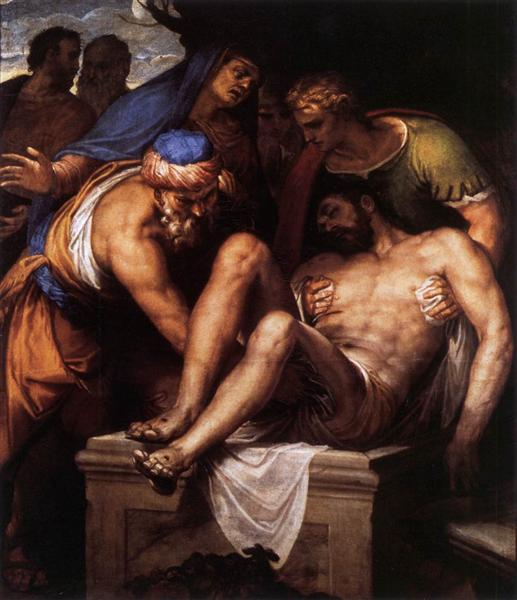
The work "Deposition of Christ" by Paolo Veronese, made in 1549, is a sublime manifestation of the Italian Renaissance, standing out for its dynamic composition and its chromatic splendor. Veronese, one of the great masters From Venetian painting, it is recognized for its ability to merge the religious narrative with a vibrant and theatrical style. In this painting, the artist addresses the crucial moment of the disclavation of Christ, which, in the context of Christianity, symbolizes redemption and sacrifice.
The composition of the work is particularly notable for its diagonal structure, which guides the viewer's gaze through the scene. Christ, who occupies a central place, is sustained by a group of figures, which seem immersed in an intimate act of devotion and regret. The movement of these figures, together with the action of removing the body of Christ of the Cross, suggests a moment full of emotion and tension, capturing the harsh reality of the loss. Veronese manages to evoke a sense of urgency while, at the same time, it maintains a visual order that allows each figure to fulfill its function without disregarding the whole.
The use of color in the work is one of the most prominent aspects. The combined palette of rich shades of red, green and blue creates a vibrant contrast that not only highlights the figure of Christ, but also adds an emotional depth to the scene. The warm tones of clothes and the glow in the flesh of Christ are mixed subtly, illustrating Veronese's technical mastery in the application of color and light. In addition, the delicate nuances and the shadows achieved grant volume and corporation to the figures present.
In iconographic terms, the characters surrounding Christ are not mere background figures; Each of them is endowed with an emotional weight that contributes to the narrative of the painting. The figure to the left, which looks over the body of Christ, shows a face of deep duel. In the background, the silhouettes of other characters observe the scene with an air of gravity, which suggests the impact of this loss on the broader context of the community. Through these details, Veronese not only portrays a moment of sadness, but also invites reflection on sacrifice and hope.
The "deposition of Christ" is located in an artistic context in which Veronese's work is distinguished from that of his contemporaries. Its style is characterized by the use of bright color and the great representation of figures, in contrast to the sobriety of others masters of the Renaissance, as Caravaggio, whose work often explored songs with a more dark and dramatic approach. Veronese clings to a more optimistic and celebratory perspective, letting beauty and grace coexist with suffering.
This work not only reflects Veronese's technical mastery, but also enrolls within the Baroque traditions that would later bloom, where emotion becomes a fundamental vehicle for the transmission of the spiritual message. Through its focus on light, movement and color, Veronese manages to not only capture the human experience of loss, but also to celebrate the highest meaning of the crucifixion.
In conclusion, "Deposition of Christ" is a splendid testimony of Paolo Veronese's ability to merge the religious narrative with a powerful aesthetic expression. Through meticulous attention to the composition, color and emotionality of its characters, the work invites viewers to immerse themselves in the drama of the scene, offered with an exquisiteness that still deeply resonates in the history of art.
KUADROS ©, a famous paint on your wall.
Hand-made oil painting reproductions, with the quality of professional artists and the distinctive seal of KUADROS ©.
Reproduction service paintings With a guarantee of satisfaction. If you are not completely satisfied with the replica of your painting, we refund your money 100%.