The Magician of the Impossible: A Glimpse into Salvador Dalí’s Mind
Salvador Dalí’s mind was a whirlwind of dreamlike images, obsessions, and a deep fascination with the irrational. From childhood, he showed an extraordinary sensitivity to the world around him, interpreting it through a unique and often disturbing prism. This childhood, marked by significant events and an unconventional education, laid the foundations for his future artistic vision. The early loss of an older brother, who bore the same name, and being raised under the influence of a devout mother, played crucial roles in shaping his complex personality and in the emergence of his recurring themes of duality, death, and rebirth.
A Childhood Marked by Vision

Born in Figueres, Catalonia, in 1904, Salvador Dalí Domènech experienced a deep connection with the landscape and traditions of his homeland from a very young age. His first forays into art, guided by his father, a notary, and his uncle, also an artist, soon revealed an innate talent and a boundless imagination. Unlike other children, Dalí was prone to intense visual experiences and visions that he captured with astonishing precocity. The wild nature of the Costa Brava, with its rocky formations and stormy sea, became a recurring setting in his work, infusing his landscapes with an almost mythical character. This early exposure to natural beauty and local narratives fueled an imagination that would soon transcend the limits of the visible, exploring the boundaries between the conscious and the unconscious.
The First Steps Toward Recognition
Dalí's academic training, although sometimes contentious, was fundamental to the development of his refined technique. He studied at the Royal Academy of Fine Arts of San Fernando in Madrid, where he experimented with various styles and met figures who would later become important in the Spanish art scene, such as Federico García Lorca and Luis Buñuel. However, his rebellious spirit and disdain for academic rules earned him expulsions and constant friction with educational authorities. Even so, his first solo exhibitions in galleries in Barcelona and Madrid in the late 1920s began to attract the attention of critics and collectors. It was during this period that Dalí consolidated his style, beginning to fuse his astonishing technical skill with the emerging ideas of Surrealism, a movement he would soon adopt and radically transform.
The Birth of a Movement: Surrealism and the Escape from Logic
Surrealism, as an artistic and literary movement, emerged in interwar Europe as a powerful response to the devastation of the First World War and to the rationality that, in the eyes of its founders, had led to such catastrophe. It advocated the exploration of the subconscious, dreams, and the irrational as ways to access a deeper and more liberating reality. André Breton, a central figure in the movement, sought to free the mind from the constraints of logic and bourgeois morality, promoting psychic automatism and free association of ideas. Surrealism invited the dismantling of conventional structures of thought, making way for a universe of unexpected images and poetic associations.
Breton's Influence and the Surrealist Manifesto
André Breton, a French poet and essayist, was the main ideologue and catalyst of Surrealism. In 1924, he published the "First Manifesto of Surrealism," where he defined the movement as "pure psychic automatism, by which one proposes to express, verbally, in writing, or by any other means, the actual functioning of thought. Dictation of thought, in the absence of any control exercised by reason, beyond any aesthetic or moral concern." This manifesto laid the theoretical foundations of the movement, promoting techniques such as automatic writing, exquisite corpse, and the exploration of dreams. Breton's influence was crucial in attracting a generation of artists and writers seeking to break with artistic conventions and explore new forms of expression. Breton admired Dalí's work, although their relationship was marked by tension, especially when Dalí broke away from the group's orthodoxy.
Dalí: The Surrealist with a Method of His Own
Although Salvador Dalí fully embraced the principles of Surrealism, he soon developed his own "paranoiac-critical method." This method, which he himself described as a "spontaneous perception of irrationality and the dialectic of misinterpretation," allowed him to tap into his own obsessions and delusions and then capture them on canvas with almost photographic precision. Unlike other Surrealists who prioritized pure automatism, Dalí used his own paranoia, fears, and desires as fuel to create sharp, detailed images of a turbulent inner world. His method consisted of actively cultivating states of controlled hallucination and fixing those fleeting images with rigorous technique, thus creating an impossible realism that left the viewer perplexed. This duality between delirium and technical precision is one of the most distinctive features of his work and set him apart from many of his contemporaries.
Dalinian Icons: Gears of a Dreamlike Universe
Salvador Dalí's pictorial universe is populated by a series of recurring images that have become his distinctive hallmarks, true icons that instantly evoke his style and his particular vision of the world. These symbolic figures, often loaded with multiple meanings, function as gears in the complex machinery of his dreams and obsessions. The famous "soft watches," the elephants with ethereal legs, or the egg as the genesis of life, are just a few examples of how Dalí transformed everyday objects into powerful symbols of his inner cosmos, inviting reflection on the fleeting nature of time, the fragility of existence, and the distortion of reality.
The Soft Watches: The Fluidity of Time and Memory

Possibly Dalí's most iconic image is that of the melting clocks, first appearing prominently in his 1931 masterpiece, "The Persistence of Memory." These "soft watches" challenge our linear and rigid conception of time, instead suggesting its fluid, malleable, and subjective nature. Dalí associated this image with Einstein's theory of relativity, but its meaning goes beyond the scientific. For the artist, the melted clocks symbolize the relativity of memory, how recollections can be distorted, diluted, or even disappear over time. They also allude to the fleeting nature of life and the feeling that time is slipping through our fingers, influencing our perception and experience of reality. The ubiquity of these clocks in his works underscores Dalí's obsession with temporality and its impact on the human psyche.
The Long-Legged Elephants: The Distortion of Reality

Another recurring element in Dalí’s iconography is elephants with extraordinarily long and thin legs, often carrying obelisks or heavy structures on their backs. This image evokes a feeling of weightlessness and precarious balance, defying the laws of physics and logic. Elephants, traditionally symbols of strength and solidity, are presented here stripped of their earthly weight, their slender legs seeming on the verge of giving way under the load. Dalí uses this distortion to explore the fragility of power, the tension between the apparent and the real, and the ability of the irrational to subvert perception. These dreamlike creatures often march through desolate landscapes, adding to the atmosphere of reverie and unease that characterizes many of his compositions, and reflecting on the heaviness of the burdens the human mind can bear.
The Egg: Symbol of Life, Birth, and Cosmogony

The egg is another fundamental motif in Dalí’s work, charged with meanings ranging from life and birth to cosmogony and perfection. For Dalí, the egg represented the beginning of existence, purity, and the promise of life gestating within. He often presents it as a central element in his compositions, sometimes floating in space, other times embedded in surreal landscapes, or even as a portal to other worlds. The egg also alluded to his obsession with Gala, his muse and wife, whom he saw as the center of his universe. The oval shape of the egg, simple yet complex, became a perfect canvas for exploring the duality of life and death, the earthly and the celestial, the seed of all creation.
Technique in the Service of Delirium: Dalí’s Brush
Far from being a mere executor of fantastical ideas, Salvador Dalí was a master of pictorial technique, whose craftsmanship was as formidable as his imagination. His mastery of the brush not only allowed him to capture his most delirious visions with astonishing clarity, but also served to deceive the viewer, creating a realism so convincing that it made the unreality of the scenes depicted even more striking. The photographic precision of his strokes, combined with a masterful use of color and light, generated an atmosphere of strangeness and fascination that invited deep and prolonged contemplation of his works, like those explored in the detail of Flemish painting.
Photographic Precision: Deceptive Realism
One of the most remarkable features of Dalí's art is its astonishing technical precision, which often borders on photographic perfection. Using academic techniques inherited from the great masters, Dalí was able to depict his dreamlike landscapes, distorted figures, and symbolic objects with painstaking detail and striking sharpness. This precision, however, was not aimed at mere imitation of reality, but quite the opposite: it sought to make the most improbable scenes seem believable. By presenting the irrational with the appearance of the real, Dalí created a visual paradox that unsettled the viewer, forcing them to question the boundaries between fantasy and reality. This duality between dreamlike content and hyperrealist form is a key element of his emotional and conceptual impact.
The Combination of Materials and Techniques
Dalí did not limit himself to the traditional techniques of oil painting; he constantly explored new ways to enrich his visual language. While oil was his preferred medium for its versatility and the richness of its nuances, he also experimented with other techniques and materials to achieve specific effects. At times, he incorporated collage, found objects, or experimented with the use of latex, materials that allowed him to create unusual textures and give a tactile dimension to his creations. His interest in science also led him to research and apply principles of optics and physics in his work, seeking to recreate striking visual phenomena. His boldness in experimentation and his willingness to fuse the academic with the innovative allowed him to expand the expressive possibilities of painting, taking his surrealism to new frontiers.
The master Use of Color and Light
Dalí's mastery of color and light in his work is fundamental to creating the enveloping and unsettling atmosphere that characterizes his canvases. He used a rich and vibrant palette, often contrasted with deep and dramatic shadows, evoking the influence of artists such as Caravaggio. The light in his paintings is not merely descriptive; it is an active element that shapes forms, creates volumes, and generates an aura of mystery and transcendence. Dalí was an expert at creating luminous effects that seemed to emerge from within the objects or that fell selectively on the key elements of the composition, intensifying the sense of unreality and dreaminess. His skies often take on impossible hues, and his landscapes are bathed in an unreal light that accentuates the dreamlike nature of his scenes.
Masterpieces That Defy Understanding
Salvador Dalí not only painted dreams, but dismantled and reconstructed them with a logic of his own, creating works that continue to challenge conventional interpretations. His ability to fuse the irrational with impeccable painting technique invited the viewer to enter a universe where the laws of physics and reason dissolved. When observing his paintings, one is confronted with a labyrinth of personal symbols and universal archetypes, where the representation of reality is subverted in striking ways. The choice of themes, often drawn from his own daydreams or from Freud’s psychoanalytic theories, allowed him to explore the depths of the human psyche, expressing fears, desires, and obsessions with disconcerting frankness. The meticulous execution of these dreamlike visions, with details of almost photographic precision, created a fascinating tension between content and form, forcing the public to question the very nature of perception and truth. This duality between the illogical nature of the subject and the logical nature of the technique is, perhaps, the key to understanding the enduring fascination exerted by Dalí’s art.
The Persistence of Memory: The Mental Landscape of Time

Dalí’s most iconic canvas, The Persistence of Memory (1931), masterfully encapsulates his fascination with time and memory. The famous soft, melted, and malleable watches hang from branches and inanimate surfaces in a desolate landscape that evokes the coast of Portlligat, Catalonia. This powerful image has become synonymous with the relativity of time, suggesting that our perception of its passage is subjective and fluid, not rigid or linear. Influenced by Einstein’s theory of relativity, Dalí sought to portray a psychological time, one that is distorted in dreams or in moments of intense emotion. The arid and desolate landscape contributes to the sense of timelessness, while the amorphous, soft figure in the center of the painting, often interpreted as a distorted self-portrait of the artist himself, suggests the fragility of the subconscious and identity. The work invites reflection on how memory distorts and shapes our present experience, and how time, far from being a constant, is a mental construct subject to subjectivity.
Swans Reflecting Elephants: Duality and Paranoia

Dalí frequently employed the double image technique or the paranoiac-critical effect, an artistic creation method that he himself developed. It consisted of inducing a hallucinatory or paranoid state in order to observe and represent multiple interpretations of a single image. A paradigmatic example is his work Swans Reflecting Elephants (1937). In this painting, the apparent innocence of swans swimming in a pond is transformed, through the reflection in the water, into the imposing and threatening figure of elephants with long trunks. Dalí used this visual ambiguity to explore the duality inherent in reality and in the human psyche, where the familiar can become terrifying and the apparent conceals deep meanings. This ability to see one world within another, to reveal what is hidden beneath the surface, is central to his work, reflecting a deep unease before the deceptive nature of perception and the complex layers of reality.
The Temptation of Saint Anthony: Fear and Desire Confronted

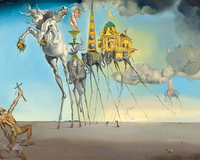
In The Temptation of Saint Anthony (1946), Dalí addresses universal themes such as fear, desire, and faith through an apocalyptic, dreamlike composition. The figure of Saint Anthony, stripped bare and exposed, faces a procession of ghostly, grotesque creatures emerging from the desert. Leading this horde is a naked horse with extremely long legs, symbolizing lust and carnal desire, carrying an erotic obelisk on its back. It is followed by other deformed creatures, such as an elephant with insect legs, representing lust, violence, and other primal impulses that lurk around the soul. The harsh, arid landscape heightens the saint’s loneliness and vulnerability. Dalí uses these symbolic figures, charged with religious and psychological connotations, to explore the inner struggle between virtue and sin, between spiritual renunciation and the overwhelming force of instinct. The work is a visual testament to the constant battle waged in the human conscience against the forces of evil and temptation.
Dalí Beyond the Canvas: Film, Fashion, and Sculpture
Salvador Dalí’s restless mind transcended the traditional boundaries of painting, encompassing various creative fields with the same surreal intensity. His artistic vision extended to film, fashion, design, and sculpture, demonstrating astonishing versatility and an inexhaustible thirst for experimentation. In each of these areas, Dalí applied his unique perspective, challenging conventions and fusing the illogical with aesthetics in surprising ways. He collaborated with some of the most influential directors of his time, designed jewelry and furniture pieces, and experimented with three-dimensionality through sculptures that seemed to materialize his paintings. These multidisciplinary forays not only expanded his artistic legacy but also demonstrated how surrealism could infiltrate and transform different aspects of visual and material culture. The integration of his dreams and obsessions into everyday objects and experiences allowed him to bring his dreamlike universe to a broader audience, consolidating his status as a total artist.
Cinematic Collaborations: A World of Moving Images
Dalí’s forays into the world of film reveal his deep interest in the audiovisual medium as a vehicle for expressing his surrealist ideas. His most notable collaborations include the short film An Andalusian Dog (1929) and the feature film The Golden Age (1930), both directed by Luis Buñuel. In An Andalusian Dog, Dalí and Buñuel created a masterpiece of surrealist cinema, characterized by striking and seemingly disconnected images, such as the famous eye-slicing with a razor blade. These sequences sought to unsettle the viewer and evoke visceral reactions, reflecting the irrational nature of the subconscious. Later, Dalí would collaborate with Alfred Hitchcock on the dream sequence in the film Spellbound (1945), designing scenes and sequences that captured the anguish and mental confusion of the main character. These cinematic experiences demonstrate Dalí’s ability to translate his visual language into a moving medium, creating dreamlike and nightmare atmospheres that resonated deeply in film history.
Design and Fashion: Objects and Jewelry That Tell Stories
Dalí’s creativity overflowed into the world of design and fashion, where he applied his surrealist imagination to create objects and jewelry of unprecedented originality. Together with his wife Gala, Dalí collaborated with various brands and designers, leaving an indelible mark on the field of design. His jewelry designs, such as the famous "Royal Heart" or the "Mae West" lips, are emblematic examples of how he transformed precious materials into expressions of his obsessions and recurring symbols, infusing each piece with a narrative and symbolic character. Beyond jewelry, Dalí ventured into furniture design, such as the iconic lips sofa inspired by actress Mae West, and into interior design, conceiving spaces that seemed to come straight out of his paintings. A notable example was his collaboration with Elsa Schiaparelli in the 1930s, where they created fashion pieces that fused surrealist art with haute couture, resulting in dresses and accessories that defied the aesthetic conventions of the time and are today invaluable collector’s items.
Sculptures That Capture the Third Dimension of the Dream
Dalí did not limit himself to the two-dimensionality of the canvas; he also explored the three-dimensional representation of his visions through sculpture. These works are extensions of his paintings, transferring the fluidity and irrationality of his dreams into physical space. Using diverse materials such as bronze, resin, and glass, Dalí brought to life figures that seemed to emerge directly from his imagination, often playing with scale and form to create a striking visual impact. Works such as The Elephant (1948), with its disproportionately long and slender legs, or The Cart of Madness, recreate the tension between the solid and the ephemeral, the real and the dreamlike, that characterizes his pictorial work. These sculptures invite viewers to walk around them, to contemplate them from different angles, revealing new facets of Dalinian vision and demonstrating his mastery in giving physical form to the intangible. The texture and volume of these pieces allow for a more immersive experience of his surrealist universe.
The Legacy of a Restless Genius
Salvador Dalí’s impact on the world of art and culture is undeniable and multifaceted, extending far beyond his iconic paintings. His legacy lies not only in the originality of his artistic vision, but also in his boldness to experiment with various disciplines and in his ability to become a fascinating and controversial public figure. Dalí was not just a painter; he was an innovator, a provocateur, and an image strategist who knew how to create a universe of his own that was instantly recognizable. His work continues to inspire new generations of artists, designers, and creators, and his influence can be seen in fashion, film, advertising, and contemporary design. The constant reinvention and the profound exploration of the human subconscious are key aspects of its enduring relevance. The foundation dedicated to preserving his work is a testament to the magnitude of his contribution to the global artistic heritage.
The Enduring Influence on Contemporary Art
Dalinian surrealism, with its focus on the subconscious, dreams, and irrationality, has left an indelible mark on contemporary art. Artists from diverse disciplines continue to explore similar themes, whether through dreamlike imagery, the manipulation of perceived reality, or the exploration of the human psyche. Dalí's boldness in combining disparate elements and creating compositions that defy logic has opened up paths for formal and conceptual experimentation. Later movements and artists have adopted his transgressive spirit, using surrealist iconography to comment on society, politics, or the human condition. Even in abstract or conceptual art, Dalí's influence is evident in the liberation of forms and in the search for expressions beyond the mimetic representation of reality. The constant fascination with his works, which sell for record prices at current auctions, demonstrates his lasting relevance.
Dalí and the World of Design and Pop Culture
Salvador Dalí's figure has surprisingly become part of popular culture, transcending the realm of galleries and museums. His distinctive aesthetic, his eccentricities, and his iconic images have been reproduced and reinterpreted in countless contexts, from advertising to fashion design and music. Dalí's ability to promote himself and build a public image as powerful as his artistic work turned him into a celebrity ahead of his time. Fashion, in particular, has frequently drawn on Dalinian iconography, with designers taking inspiration from his soft watches, his long-legged elephants, or his peculiar mustache. Beyond fashion, his influence extends to music, film, and literature, where his dreamlike universe remains an inexhaustible source of inspiration for creators seeking to explore the limits of imagination. This phenomenon underscores how surrealist art, channeled through the charismatic figure of Dalí, has managed to permeate global culture.
The Gala-Salvador Dalí Foundation: Preserving a Universe
To safeguard and disseminate the legacy of one of the most important artists of the 20th century, the Gala-Salvador Dalí Foundation was created. Established in 1983, this institution's main mission is the preservation and exhibition of the work of the master, as well as the promotion of his ideas and research into his life and legacy. The foundation manages a vast artistic heritage, which includes paintings, drawings, sculptures, jewelry, and design objects, distributed mainly across the museum-theaters in Figueres, the Gala-Dalí Castle in Púbol, and the Salvador Dalí House in Portlligat. These spaces have become essential pilgrimage sites for art lovers from around the world, offering an immersive experience in the Dalinian universe. The Foundation's work is crucial to ensure that future generations can access and understand the depth and complexity of Dalí’s work, keeping the flame of his creative genius alive. The management of the legacy of artists of this stature is an example of how art can be preserved and shared for universal enjoyment.
Alternatives for Capturing the Dalinian Essence and When to Choose Them
Although Salvador Dalí’s original work is beyond the reach of most people, there are various ways to incorporate the magic of Dalinian surrealism into one’s personal surroundings. These alternatives vary in price, authenticity, and experience, allowing each admirer to find the option that best suits their needs and tastes. From faithful reproductions to inspired interpretations, each option offers a window into the fascinating world of Dalí. The choice will depend on the desired level of immersion, the available budget, and the value placed on the aesthetic experience. Exploring these options not only makes it possible to beautify a space, but also keeps alive the connection with one of the most influential artistic movements of the 20th century and one of its greatest exponents. The democratization of art, through these alternatives, brings Dalinian genius into homes around the world.
paintings Oil Reproductions: The Tactile Experience of the Iconic
For those seeking a deep and authentic connection with Dalí’s masterpieces, the Hand-made oil painting reproductions offer an incomparable experience. These replicas, created with techniques and materials similar to those used by the artist himself, capture the texture, color, and detail of the original works. Working with specialized artists, such as those at KUADROS ©, ensures that every brushstroke is meticulously replicated, preserving the essence and atmosphere of the original piece. An oil reproduction of The Persistence of Memory, for example, is not just an image, but a tangible and artistic piece that evokes the same emotional depth and the same mystery as Dalí’s canvas. Choosing a high-quality reproduction makes it possible to admire the artist’s technical mastery up close and feel the presence of his genius in one’s own home, offering an alternative close to the original work, especially when it comes to pieces by artists or movements in the public domain.
Prints and Posters: Affordable Access to His Visions
Prints and posters represent a more affordable and accessible way to bring Dalí’s art into the home or office. These reproductions, although they lack the texture and depth of an oil painting, make it possible to enjoy the visual power and iconic impact of Dalí’s works at a significantly lower cost. They are ideal for those who want to decorate their spaces with recognizable images of surrealism, such as the famous melting clocks or dreamlike figures. The quality of modern prints has improved considerably, offering vibrant colors and sharp details that allow one to appreciate the composition and symbols of the original paintings. A poster of Swans Reflecting Elephants can serve as an interesting focal point, sparking conversations and adding a touch of originality and boldness to any setting. It is an excellent option for students, young professionals, or for those who want to experience different works by Dalí without a major investment.
Art Inspired by Dalí: The Continuity of the Surrealist Spirit
Beyond direct reproductions, there is a vast world of art inspired by Dalí that continues the spirit of surrealism. Contemporary artists, influenced by his conceptual boldness and unique visual language, create works that, while not exact replicas, evoke the same atmosphere of dreaminess, mystery, and provocation. These pieces can take shape in various formats: from paintings and sculptures to digital art and graphic design. Choosing art inspired by Dalí allows you to support emerging artists while keeping the essence of surrealism alive in today’s art scene. For example, an artist who explores the duality of perception or the transformation of everyday objects into dreamlike elements would, in a way, be following in the footsteps left by the Catalan genius. This path offers the opportunity to discover new interpretations of surrealism and to integrate into personal spaces works that, although different, share the spark of overflowing imagination that characterized Dalí. KUADROS ©, a famous painting on your wall. Hand-made oil painting reproductions, with the quality of professional artists and the distinctive seal of KUADROS ©. paintings reproduction service with satisfaction guarantee. If you are not completely satisfied with the replica of your painting, we will refund 100% of your money.
Dalí’s Cultural Impact in the 21st Century
Salvador Dalí’s surrealism continues to resonate strongly in the cultural landscape of the 21st century, transcending his era to influence various artistic disciplines and the collective perception of imagination. His legacy is not limited to painting, but is also manifested in film, fashion, advertising, and even digital design. Dalí’s ability to fuse the dreamlike with the tangible, creating unsettling and fascinating images in equal measure, remains an inexhaustible source of inspiration. His paranoid-critical method, a technique for accessing the subconscious and transferring it to the canvas, offers a model for exploring uninhibited creativity, a concept of great value in a contemporary world that often prioritizes logic and rationality. The exploration of human fears, desires, and obsessions through striking visual metaphors, such as melting clocks or elephants with insect legs, connects directly with the psychological complexity that defines our era. The subversive and often provocative nature of his work invites us to question established reality, a spirit very much in tune with current discussions about truth, perception, and the manipulation of information.
The Relevance of His Themes in Today’s Society
The themes that Dalí explored so vehemently in his canvases find a surprising echo in the concerns and anxieties of 21st-century society. The relationship between reality and dream, the fragility of time, and the persistence of memory are concepts that resonate deeply in an era marked by digital acceleration, virtuality, and the constant redefinition of what is real. Dalinian representations of the distortion of time and space , for example, seem to foreshadow our own experience of a hyperconnected world where distances shrink and temporal hierarchies blur. His obsession with the unconscious, primary impulses, and eroticism also finds parallels in the contemporary interest in psychology, self-knowledge, and the exploration of identity. The exploration of the nature of desire and its often irrational manifestations, a pillar in Dalí's work, remains a fundamental driver of consumer culture and today's media narratives. Even his apocalyptic vision and fascination with science, reflected in works inspired by nuclear physics, anticipate collective concerns about the future of the planet and technology. The figure of the fragmented self in constant transformation, which Dalí captured through metamorphoses and shifting appearances, is a reflection of the fluid and often volatile identity that many experience in the digital age.
Recent Exhibitions and Tributes
Salvador Dalí's legacy remains vibrant through a constant flow of exhibitions and tributes worldwide, demonstrating his enduring fascination. Museums and galleries continue to dedicate retrospectives and themed exhibitions to his work, offering contemporary audiences new perspectives on his genius. These shows often seek to bridge his creations with contemporary art, highlighting how his technical and conceptual innovations remain relevant. For example, recent events have explored Dalí's influence on digital art and immersive experiences, recognizing his role as a precursor in experimenting with new forms of visual expression. Cultural institutions and private collectors collaborate to bring lesser-known works to light or to recontextualize his masterpieces within broader historical and artistic narratives. The popularity of his creations extends beyond museum walls, resonating in collaborations with fashion brands, graphic designers, and filmmakers seeking to evoke his distinctive aesthetic universe. Dalí's presence in popular culture, from references in television series to inspiration for video games, testifies to the ubiquity of his imagery. The continued demand for reproductions of his works, such as painting replicas oil paintings available at the legacy of the masters, underscores the public's desire to own a fragment of that unique genius, demonstrating that his art remains alive and collectible.
Dalí as an Icon of Eccentricity and Boundless Creativity
Salvador Dalí transcended the label of painter to become a cultural icon of eccentricity and overflowing creativity. His life, as carefully staged as his works, became an extension of his art, a perpetual performance that challenged social and artistic conventions. His distinctive mustache, provocative statements, and theatricality turned him into an instantly recognizable public figure, far beyond artistic circles. This facet of his personality not only attracted media attention, but also served to spread surrealism to a wider audience , associating it with a bold and unconventional way of thinking. Dalí showed that creativity is not confined to the studio, but can be a way of life, a philosophy of breaking barriers and exploring the unknown. His ability to reinvent himself and to blend different influences, from science to religion and popular culture, is a testament to his restless mind and insatiable curiosity. In a world that increasingly values originality and differentiation, Dalí's figure stands as a paradigmatic example of how authenticity and boldness can lead to a lasting legacy. His defiant attitude toward convention inspires generations of artists, designers, and thinkers to embrace their own uniqueness and dare to imagine beyond established limits.
KUADROS ©, a famous painting on your wall. Hand-made oil painting reproductions, with the quality of professional artists and the distinctive seal of KUADROS ©. paintings reproduction service with a satisfaction guarantee. If you are not completely satisfied with the replica of your painting, we will refund 100% of your money.