

Description
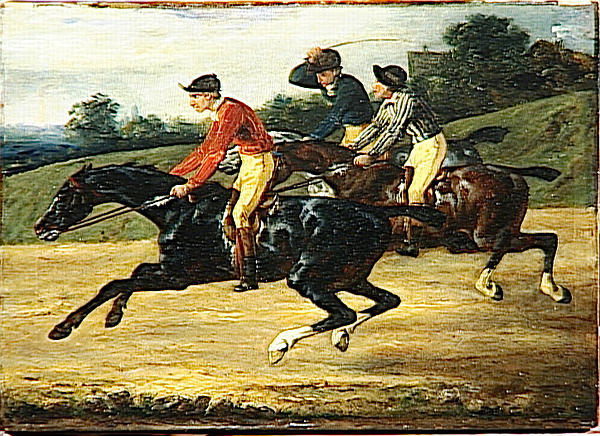
Théodore Géricault, a fundamental figure of French romanticism, enters the celebration of movement and emotionality in his work "The Horse career" (1824). This painting, which is located at the crossroads between neoclassicism and romanticism, captures not only the frantic action of a horse race, but also the passion and palpable energy that emanate from this competition.
Géricault's approach in the composition is intriguing. The horses, in an almost palpable dynamism, are found in the zenith of the action, their bodies twisting in a struggle for supremacy. The riders, equally immersed, exhibit a mixture of concentration and effort, their facial expressions and positions reflecting the tension of the competition. The background of the painting, with its vagueness that suggests a compassionate auditorium, becomes a framework that gives context to the fervor of the protagonists. This choice of composition allows the viewer to immerse the scene and feel the speed and intensity of the event.
The palette used by Géricult is dominated by terrible and rich tones that evoke the reality of the world it represents. Brown, ocher and green not only add depth, but also refer to a natural context that is complemented by the abstractions of moving bodies. The use of the contrast between the light and the shadow gives the work a sense of volume, providing an almost three -dimensional approach to the figures and horses. Each brush blow seems to capture not only the color, but the very essence of the movement, transforming the flat surface into a vibrant space.
Interestingly, "the horse race" resonates with the tradition of other works that explore similar issues, such as the hunting scenes of the barons of the painting of the time, or even the work of other romantics who portrayed the dignity of the horse as a symbol of heroism and indomitable nature. This work stands out for its ability to imbue the movement with a sense of genuine emotion, something that Géricault pursued throughout his career, especially in works such as "The Balsa de la Medusa". In that sense, "the horse race" could be considered a microcosm of Géricault's interest in the dramatic, the epic and the exciting in the life of human beings.
The fact that Géricault dedicated himself to studying horses and his anatomy suggests a deep commitment to the truthfulness and faithful representation of his subjects. This care for detail and observation translates into the technical execution of the work, where each muscle and each movement unfolds precisely. His work not only reflects his individual talent, but also his desire to capture the essence of a culture in which horse races were a source of popular entertainment and a symbol of the aristocracy.
In conclusion, "the horse race" is not merely a representation of a competitive scene, but a testimony of Géricult's mastery in capturing human and animal dynamics. Each element, from the composition to the palette, reveals a deep understanding of movement and emotion, characteristics that place Géricault as one of the great innovatives of his time. The work stands as a bridge between classicism that preceded the explosion of romanticism, and a step towards contemporaneity that still resonates in current art.
KUADROS ©, a famous paint on your wall.
Hand-made oil painting reproductions, with the quality of professional artists and the distinctive seal of KUADROS ©.
Reproduction service paintings With a guarantee of satisfaction. If you are not completely satisfied with the replica of your painting, we refund your money 100%.