Frida Kahlo, an icon of 20th-century Mexican art, transcended the boundaries of the canvas to become a symbol of resistance, passion, and authenticity. Her work, deeply personal and visceral, explores themes such as pain, identity, the body, and death, all imbued with a strong connection to Mexican culture. Beyond her famous self-portraits, Frida Kahlo left us a complex and fascinating symbolic universe that continues to captivate audiences around the world.
On September 17, 1925, a bus on which Frida Kahlo was traveling collided with a tram, an event that would change her life forever. This tragic accident caused multiple fractures in her spine, pelvis, and leg, in addition to other serious injuries. During her long convalescence, Frida began to paint, turning art into a form of escape and self-exploration. This traumatic event not only defined her physical health, but also became the central theme of much of her work. Her paintings became a mirror of her pain, her fears, and her struggle for survival. The decision to capture her personal experience on canvas was crucial to the development of her unique style and her lasting impact on the art world. The accident, far from being an insurmountable obstacle, became the catalyst for her creativity and the basis of her artistic identity. The physical pain that accompanied her throughout her life is manifested in her work as symbols of suffering and resistance, elements that connect her deeply with the viewer.

The Two Fridas - Frida Kahlo
The pain in Frida Kahlo's work is not only a literal representation of her physical wounds, but also a metaphor for her emotional suffering. Her paintings are filled with symbols alluding to anguish, loneliness, and frustration. Thorns, nails, ribbons, and wounded animals are recurrent in her iconography, representing the different ways pain manifested in her life. For example, in "The Broken Column" (1944), Frida portrays herself with her torso bare and a cracked Ionic column in place of her spine, symbolizing the irreparable damage caused by the accident. The nails piercing her body represent the constant pain that tormented her. In "The Two Fridas" (1939), she explores the duality of her identity, showing two versions of herself joined by an exposed heart connected by an artery. This work reflects her suffering over the separation from Diego Rivera and the inner struggle between her Mexican identity and her European heritage. The emotional intensity of her paintings and her brutal honesty make her an exceptionally moving artist.
Mexican culture, with its rich tradition of folk art, rituals, and symbolism, played a fundamental role in shaping Frida Kahlo's artistic identity. Her work is imbued with pre-Hispanic elements, such as Aztec and Maya iconography, as well as references to Catholic religion and traditional Mexican customs. Bright colors, typical costumes, and Day of the Dead altars are recurring elements in her paintings, reflecting her deep love for her country and her commitment to defending her cultural identity. Frida drew inspiration from ex-votos, small paintings offered to saints in gratitude for a favor granted, to create artworks that tell her own story of pain and overcoming adversity. She was also inspired by the work of José Guadalupe Posada. The clothing she wore, the elaborate headdresses, and the traditional jewelry were a statement of her Mexican identity and a form of cultural resistance in the face of foreign influence. This syncretism between the pre-Hispanic, the colonial, and the modern is one of the distinctive features of her work and makes her a key figure in 20th-century Mexican artistic nationalism.
André Breton, the leading figure of the Surrealist movement, was fascinated by Frida Kahlo's work during his visit to Mexico in 1938. Breton saw in her paintings a spontaneous and intuitive manifestation of the principles of Surrealism, such as the liberation of the unconscious, the exploration of the dream world, and the break with rational logic. He invited her to exhibit in Paris and included her in the Surrealist circle, considering her a "surrealist without knowing it." Breton wrote an essay on her work in which he described it as "a bomb wrapped in silk ribbons," highlighting her ability to combine beauty and horror in her paintings. However, Frida's relationship with Surrealism was complex and ambivalent. While she appreciated the recognition and the opportunity to exhibit her work in Europe, she resisted being pigeonholed into a specific artistic movement.
Frida Kahlo's classification as a Surrealist has been the subject of debate among critics and art historians. Although her work shares some characteristics with Surrealism, such as the presence of dreamlike images, personal symbols, and the exploration of the unconscious, it is also distinguished by its strong autobiographical component and its rootedness in Mexican reality. Frida insisted that she did not paint dreams, but her own reality. Unlike the European Surrealists, who sought to escape reality through fantasy and experimentation, Frida used art as a way to confront and process her pain and suffering. While European Surrealism focused on the exploration of the collective unconscious, Frida focused on her own individual experience. This fundamental difference is what has led many to question her belonging to the Surrealist movement and to consider her a unique and unclassifiable artist. Frida herself expressed on several occasions her disagreement with the Surrealist label, stating that her work was simply an honest expression of her life and emotions.
European surrealism, led by André Breton, sought the liberation of the unconscious through the exploration of dreams, automatic writing, and the creation of unexpected and unsettling images. The surrealists were inspired by Sigmund Freud's psychoanalytic theories and by the idea that art could be a way to subvert social and political norms. On the other hand, Frida Kahlo's art was characterized by its strong autobiographical component, its roots in Mexican culture, and its exploration of physical and emotional pain. Unlike the surrealists, who sought to escape reality, Frida used art as a way to confront and process it. Although her work shares some characteristics with surrealism, such as the presence of dreamlike images and personal symbols, it is distinguished by its brutal honesty and lack of intellectual pretension. While European surrealists were concerned with aesthetics and formal experimentation, Frida focused on expressing her emotions and personal experience. This fundamental difference is what makes her a unique and independent artist, beyond labels and classifications. Surrealism, in its European context, was an intellectual and aesthetic exploration; Kahlo's art, a visceral declaration of existence.

The Wounded Deer - Frida Kahlo
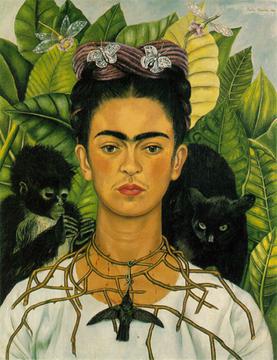
Frida Kahlo used animals as recurring symbols in her work to represent different aspects of her psyche and her relationship with the world. Monkeys, for example, often appear in her self-portraits as symbols of her surrogate children or of her own animal nature. Dogs, especially the xoloitzcuintle, an ancient Mexican dog breed, represented loyalty, companionship, and unconditional love. In "Self-Portrait with Thorn Necklace and Hummingbird" (1940), a black cat lurks behind her, symbolizing bad luck and death, while a monkey offers her a thorn, representing pain and betrayal. Deer, as in "The Wounded Deer" (1946), symbolize vulnerability, fragility, and suffering. The eagle and the snake, symbols of the Mexican national coat of arms, also appear in her work as representations of Mexican identity and the struggle for survival. The choice of these animals is no coincidence, but rather responds to a deep reflection on their symbolic meaning and their relation to Frida's own experience. Each animal in her work is a key element for understanding her complex inner world and her vision of the world.
Plants and flowers hold a prominent place in Frida Kahlo’s work, representing her connection to nature, fertility, and life. Flowers, especially roses, lilies, and sunflowers, symbolize beauty, love, and passion, but also the fragility and transience of life. Plants, such as palm leaves and cacti, represent resilience, strength, and adaptability. In many of her self-portraits, Frida depicts herself surrounded by plants and flowers as a way of reaffirming her connection to nature and her Mexican identity. The roots, which often appear in her paintings, symbolize her rootedness in the earth and in her ancestors. Her inability to have children was a source of great pain for Frida, and plants and flowers are often interpreted as symbols of her desire for motherhood. The exuberance and vitality of nature contrast with the suffering and fragility of her body, creating a powerful visual and emotional effect. The botanical precision with which she painted plants demonstrates her intimate knowledge of the natural world and her deep respect for life.
Frida Kahlo incorporated pre-Hispanic elements into her work as a way to recover and celebrate Mexican identity, as well as to challenge European cultural hegemony. She used symbols and motifs from Aztec and Maya cultures, such as the sun, the moon, the feathered serpent (Quetzalcoatl), and ceremonial masks, to express her pride in her Indigenous heritage and her rejection of cultural colonialism. The vibrant colors and geometric forms of pre-Hispanic art also influenced her painting style. Frida collected pre-Hispanic art and displayed it in her home, La Casa Azul, as a way of preserving and promoting Mexican culture. Her clothing, adorned with jewelry and traditional textiles, was also a statement of her Mexican identity and her commitment to defending her cultural heritage. By incorporating pre-Hispanic elements into her work, Frida not only paid tribute to her ancestors, but also questioned the aesthetic norms and values imposed by Western culture. Her work became a symbol of cultural resistance and a call to value Mexican identity.
The relationship between Frida Kahlo and Diego Rivera was as passionate as it was turbulent, marked by love, admiration, infidelity, and pain. They married in 1929, despite the opposition of Frida’s mother, who described the union as “the marriage between an elephant and a dove,” alluding to the difference in size and age between the two artists. Diego was a renowned muralist, while Frida was a young artist in search of her own voice. Their relationship was plagued by Diego’s infidelities, which caused Frida profound suffering. They divorced in 1939, but remarried a year later, recognizing that they could not live without each other. Despite their differences and conflicts, Frida and Diego shared a deep mutual admiration as artists and a strong political commitment to socialism and the defense of Mexican culture. Their relationship was a constant source of inspiration and pain for both of them, and it was reflected in their respective works. The intensity of their love and suffering became a central theme in Frida Kahlo’s life and art.
Although Frida Kahlo and Diego Rivera had very different artistic styles, they influenced each other throughout their relationship. Diego, with his vast experience as a muralist, encouraged Frida to develop her own style and to explore themes related to Mexican identity and social struggle. Frida, in turn, influenced Diego through her artistic sensitivity, her emotional honesty, and her connection to Mexican popular culture. Diego admired Frida's ability to express her pain and suffering in her paintings, and he considered her an exceptionally talented artist. Frida was inspired by Diego's murals to create larger-scale works and to address political and social themes in her art. They both shared a passion for Mexican culture and a commitment to defending the rights of workers and peasants. Their mutual influence is evident in the iconography and symbolism present in their respective works, as well as in their commitment to representing Mexican reality.
Frida Kahlo's turbulent love life, especially her relationship with Diego Rivera, had a profound impact on her art. The pain, frustration, and anguish she experienced due to Diego's infidelities are reflected in many of her paintings, which explore themes such as love, betrayal, loneliness, and loss. In works such as "The Two Fridas" (1939) and "Diego in My Thoughts" (1943), Frida expresses her pain over her separation from Diego and her inner struggle between love and resentment. Her suffering becomes a central theme in her work, and her paintings become a way to exorcise her demons and process her emotions. The intensity of her love life and her ability to transform pain into beauty make her an exceptionally moving and authentic artist. Her paintings are a testament to her resilience and her ability to overcome adversity, as well as a reflection on the complexity of human relationships and the power of love and pain.
Frida Kahlo's self-portraits are much more than simple representations of her physical appearance; they are windows into her soul, her experiences, and her worldview. An analysis of her facial expressions reveals a deep emotional complexity. Often, Frida portrays herself with a serene face, but with an intense and piercing gaze that conveys pain, determination, and deep introspection. In works such as "The Two Fridas" (1939), the duality of her identity is manifested in the subtle differences in the expression of each Frida, one dressed in European style and the other in traditional Mexican attire. The European Frida shows a broken heart, while the Mexican Frida holds a locket with the image of Diego Rivera, symbolizing her connection to her heritage and her conflicted love. The position of the eyebrows, the tension of the lips, and the direction of the gaze are crucial elements that communicate the artist's emotional state. The viewer is invited to feel empathy and to understand the depth of her suffering and resilience.
Frida Kahlo used clothing and accessories as a powerful statement of identity. Her choice of traditional Mexican clothing, especially the Tehuana dress, was not simply a matter of aesthetics, but an act of cultural and political affirmation. Through her attire, Frida celebrated her Mexican roots and challenged Western beauty standards. The elaborate headdresses, bead necklaces, rebozos, and huipiles not only enhanced her beauty, but also told stories about her heritage and beliefs. In addition to its cultural significance, Frida's clothing also served to conceal her physical disability. After suffering a serious accident at the age of 18, Frida underwent numerous surgeries and lived with chronic pain throughout her life. Her orthopedic corsets, often decorated with artistic motifs, became an extension of her self-image and a symbol of her struggle against adversity. Her art and her life merged into a unique expression of resilience and self-assertion. Her choice of accessories, such as pre-Hispanic earrings or rings with indigenous motifs, also reinforced her identity and her connection to Mexico's history.

The Broken Column - Frida Kahlo
Frida Kahlo's artistic style evolved significantly throughout her life, influenced by her personal experiences, her relationship with Diego Rivera, and her growing interest in surrealism. Initially, her work showed the influence of European art and traditional portraiture, but she soon developed her own style, characterized by personal symbolism, magical realism, and an exploration of pain and identity. Her early self-portraits, such as "Self-Portrait in a Velvet Dress" (1926), reflect a certain innocence and a desire to please Diego Rivera. However, as her life became more complicated and her health deteriorated, her work became bolder and more expressive. The influence of Mexican folk art, with its vibrant colors and symbolic imagery, became increasingly evident in her work. Her involvement in the surrealist movement, although controversial, also influenced her style, allowing her to explore her subconscious and her dreams in her paintings. Works such as "The Broken Column" (1944) and "The Wounded Deer" (1946) are powerful examples of her mature style, where physical and emotional pain are combined with complex symbolism and a striking aesthetic. Frida's style is unmistakable, a blend of realism, surrealism, and Mexican folk art that makes her one of the most original and recognizable artists of the 20th century. We could make a comparison with Tamara de Lempicka, who also captured her personality in her works.

Self-Portrait with Thorn Necklace and Hummingbird - Frida Kahlo
Frida Kahlo’s color palette is an explosion of emotions, a visual language that conveys the intensity of her life and her inner world. The vibrant colors, such as red, yellow, blue, and green, are not chosen at random, but are laden with symbolic meaning. Red, for example, represents blood, passion, pain, and life; yellow, the sun, joy, intelligence, and madness; blue, calm, sadness, distance, and spirituality; and green, nature, hope, fertility, and death. Frida used these colors to express her deepest emotions and to create a dreamlike, surreal atmosphere in her paintings. In works such as "Self-Portrait with Thorn Necklace and Hummingbird" (1940), the combination of contrasting colors, such as the red of blood and the green of the leaves, creates a sense of tension and pain. The use of color is also influenced by Mexican folk art, where bright and saturated colors are common and have a specific cultural meaning. Frida’s palette is, therefore, a synthesis of her personal experience and her cultural heritage, a powerful tool for communicating her worldview. The choice of each color, its intensity, and its combination with other colors contribute to the creation of a complex and emotive visual narrative.
Mexican folk art exerted a profound influence on Frida Kahlo’s color palette. Inspired by the crafts, toys, ex-votos, and traditional festivals of Mexico, Frida adopted a vibrant, colorful palette that contrasted with the more restrained styles of European art. Ex-votos, small paintings that are offered to saints in gratitude for a granted favor, were a particular source of inspiration for Frida. These images, often naive and full of symbolism, provided her with a model for expressing her own personal experiences and her faith in Mexican culture. Bright and saturated colors, such as Mexican pink, turquoise, orange, and purple, became distinctive elements of her work. In addition to colors, Frida also incorporated motifs and symbols from Mexican folk art, such as skulls, animals, flowers, and hearts, which allowed her to connect with her roots and express her cultural identity. The influence of Mexican folk art was not limited to the color palette; it also extended to her narrative style and thematic approach, where the personal and the political are inextricably intertwined. Just like Sorolla, Frida found inspiration in her surroundings.
In Frida Kahlo's work, contrasts and harmonies are interwoven in a constant search for visual balance. The juxtaposition of warm and cool colors, light and shadow, and soft and angular forms creates a visual dynamic that reflects the complexity of her inner world. Frida used contrasts to emphasize pain and anguish, but also to celebrate the beauty and joy of life. In works such as "The Two Fridas," the duality of her identity is manifested in the contrast between the vibrant colors of the Tehuana dress and the more muted colors of the European dress. Harmony, on the other hand, is achieved through the repetition of certain colors and forms, and through the creation of a visual rhythm that guides the viewer's eye. Frida was a master in the use of color to create an emotional atmosphere and to communicate her vision of the world. Her palette was not static, but rather evolved throughout her life, reflecting her mood swings and personal experiences. The search for visual balance was, for Frida, a way to find meaning in her own existence, to reconcile her contradictions, and to express her love of life despite pain and adversity. The way she used light and shadow is similar to the style of Rembrandt.
Frida Kahlo openly challenged the gender stereotypes of her time, both in her life and in her art. In a social context dominated by patriarchy, Frida dared to express her individuality and sexuality in a frank and unashamed way. Her physical appearance, with her thick eyebrows and her faint mustache, challenged the feminine beauty standards of the era. In her self-portraits, Frida depicted herself as she was, without trying to hide her imperfections or conform to social expectations. In addition, Frida questioned traditional gender roles in her personal relationships. Her marriage to Diego Rivera, marked by infidelity and mutual independence, challenged the conventional norms of marriage and family. Frida also identified with the feminist movement and defended women's rights through her art and political activism. Her work, often centered on the female experience, explored themes such as pain, motherhood, sexuality, and identity from a feminist perspective. Frida became a symbol of the struggle against gender oppression and discrimination, and her legacy continues to inspire women around the world.
Frida Kahlo’s work is a powerful affirmation of female identity. Through her self-portraits, Frida explored the complexities of the female experience, from pain and suffering to joy and creativity. Her paintings not only represent her own image, but also reflect the experiences and emotions of many women. Frida dared to address taboo subjects such as female sexuality, motherhood, and abortion with unprecedented honesty and candor. In works such as "My Birth" (1932), Frida depicts her mother’s childbirth from a female perspective, showing pain and suffering, but also the strength and resilience of women. Frida also celebrated the beauty of Mexican women, with their Indigenous features and traditional clothing. By portraying herself with pride and dignity, Frida challenged Western beauty standards and celebrated Mexico’s cultural diversity. Her work became a space for the expression and affirmation of female identity, and her legacy continues to inspire women to embrace their individuality and fight for their rights.
Frida Kahlo’s legacy as an inspiration for contemporary artists is undeniable. Her work, with its personal symbolism, magical realism, and exploration of pain and identity, has influenced generations of artists around the world. Many contemporary artists are inspired by Frida’s courage to address personal and political themes in her work. Her unique style, which combines elements of Mexican folk art, surrealism, and traditional portraiture, has been adopted and adapted by many contemporary artists. In addition, Frida’s life, with her struggle against adversity and her advocacy for female identity, has become a model for many artists. Frida Kahlo is considered a feminist icon and a symbol of cultural resistance, and her legacy continues to inspire artists to create works that challenge social norms and express their own truth. Her influence can be seen in the work of artists across diverse disciplines, from painting and sculpture to photography and film. Frida Kahlo remains a relevant and powerful figure in the world of contemporary art.
Frida Kahlo’s impact extends far beyond the art world, profoundly influencing fashion and popular culture. Her unique style and iconic image have been reinterpreted and celebrated by designers, photographers, and artists around the world. The traditional Mexican clothing Frida wore, especially the Tehuana dress, has become a symbol of cultural identity and political resistance. Her image has been used in advertising campaigns, magazine covers, and consumer products, becoming a pop culture icon. In addition, Frida’s life and work have been the subject of numerous films, documentaries, and plays, contributing to her growing popularity. Her story of personal triumph, her advocacy for female identity, and her fight against oppression have made her a role model for many people. Frida’s influence can be seen in contemporary fashion, with designers drawing inspiration from her designs and colors. Her image has also been used in demonstrations and protests, becoming a symbol of the struggle for social justice and gender equality. Frida Kahlo is, without a doubt, one of the most influential and recognizable artists of the 20th century.
Frida Kahlo’s work continues to be an inexhaustible source of inspiration for new generations of artists. Her unique style, which combines elements of Mexican folk art, surrealism, and traditional portraiture, offers a model for personal expression and the exploration of identity. Many contemporary artists draw inspiration from Frida’s courage to address taboo subjects such as pain, illness, sexuality, and death in their work. Her honest and uncompromising approach has encouraged many artists to break down barriers and create works that challenge social norms. In addition, Frida’s life, with her struggle against adversity and her advocacy for female identity, has become a role model for many artists. Her story of personal triumph and her commitment to social justice have inspired many artists to use their work as a tool for social change. Frida’s influence can be seen in the work of artists from various disciplines, from painting and sculpture to photography and film. Frida Kahlo remains a relevant and powerful figure in the world of contemporary art, and her legacy continues to inspire artists to create works that are authentic, meaningful, and transformative.
The artistic and cultural value of Frida Kahlo’s legacy is incalculable. Her work is not only an expression of her own personal experience, but also reflects the history and culture of Mexico. Frida captured the essence of her country, with its vibrant colors, ancestral symbols, and spirit of resistance. Her work has contributed to the spread of Mexican culture throughout the world and has helped create a more diverse and complex image of Mexico. In addition, Frida’s work has had a significant impact on the development of feminist art. Her exploration of female identity, her questioning of traditional gender roles, and her defense of women’s rights have inspired many artists to create works that challenge social norms and express their own truth. Frida Kahlo is considered a feminist icon and a symbol of the struggle for gender equality. Her legacy continues to inspire women to embrace their individuality and fight for their rights. The artistic and cultural value of Frida Kahlo’s work lies in its ability to connect with people on a deep emotional level and convey a message of hope, resilience, and self-affirmation. Her influence remains alive in the art and culture of the 21st century, ensuring that her legacy will endure for generations.
KUADROS ©, a famous painting on your wall. Hand-made oil painting reproductions, with the quality of professional artists and the distinctive seal of KUADROS ©. Reproduction service of paintings with satisfaction guarantee. If you are not completely satisfied with the replica of your painting, we will refund 100% of your money.
Frida Kahlo’s legacy continues to inspire artists, critics, and art historians. New interpretations of her work constantly emerge, exploring themes such as identity, gender, disability, and the representation of the female body. Feminist studies have played an important role in the revaluation of her work, highlighting her ability to challenge social norms and express her own experience as a woman. Researchers have analyzed in depth the symbolism present in her paintings, uncovering references to pre-Hispanic mythology, traditional Mexican medicine, and her own biography. Psychoanalysis has also been used to interpret her work, exploring her childhood traumas, her romantic relationships, and her struggle against physical and emotional pain.
Although she passed away more than 70 years ago, Frida Kahlo remains an iconic figure and a source of inspiration for people of all ages and cultures. Her image appears on T-shirts, mugs, posters, and all kinds of consumer goods. Her life has been the subject of films, plays, novels, and documentaries. Interest in her art is reflected in the large turnout at exhibitions and the constant demand for reproductions of her paintings. This phenomenon can be attributed to several factors: her dramatic and fascinating biography, her unique and instantly recognizable artistic style, her defense of Mexican identity, and her ability to connect with audiences through her emotions. In addition, her work resonates strongly in a world increasingly concerned with diversity, inclusion, and the representation of minorities.
La Casa Azul, located in the heart of Coyoacán, Mexico City, is without a doubt the most iconic place associated with Frida Kahlo’s life. Turned into a museum, this house offers a deep immersion into her personal and creative world. She was born here, grew up here, and spent much of her life here, first with her family and later with Diego Rivera. La Casa Azul not only displays her paintings, but also her personal belongings, her clothes, her photographs, and her collection of Mexican folk art. The garden, with its lush plants and pre-Hispanic sculptures, is an oasis of peace and beauty. Touring the rooms of La Casa Azul is like traveling back in time and stepping into the mind of one of the most influential artists of the 20th century. A visit requires advance planning, as tickets often sell out weeks in advance.
While La Casa Azul is the focal point of the Frida experience, other places in Mexico City played an important role in her life and artistic career. The Dolores Olmedo Museum houses an important collection of her works, as well as Diego Rivera’s. The National Palace, with Rivera’s murals, provides essential historical and political context for understanding his work. The English Hospital, where she was treated after her serious accident, is a place of memory and pain. Diego Rivera’s studio in San Ángel, although not her home, reflects the artistic and cultural environment in which she moved. Exploring these places helps complete the portrait of Frida Kahlo, placing her life and work in the urban landscape of Mexico City.
Frida Kahlo’s presence is felt throughout Mexico City, from museums and art galleries to the streets and plazas of Coyoacán. Her image has become a symbol of Mexican identity, and her legacy inspires artists, activists, and people from all walks of life. In Coyoacán, you can find murals, sculptures, and craft shops dedicated to her memory. La Casa Azul draws thousands of visitors every year, becoming one of the city’s most popular museums. Frida Kahlo’s work remains relevant in the 21st century, addressing themes such as identity, gender, disability, and the representation of the female body. Her personal story, marked by pain and resilience, continues to inspire people around the world.
Frida Kahlo’s work remains relevant in today’s cultural landscape, influencing artists across various disciplines, from painting and sculpture to fashion, music, and film. Her unique and instantly recognizable style has been appropriated and reinterpreted by designers, photographers, and visual artists. Her image has become an icon of pop culture, appearing on T-shirts, posters, and all kinds of consumer products. Her personal story, marked by pain and resilience, continues to inspire people around the world. Her advocacy for Mexican identity and her fight for gender equality have made her a symbol of resistance and empowerment for minorities. Frida Kahlo’s work remains a testament to the strength of the human spirit and to art’s ability to transcend the barriers of time and space. For example, the “Frida” clothing collection by a Mexican designer that blends traditional elements with contemporary designs has been very successful.
Frida Kahlo’s message remains timeless and relevant today, addressing universal themes such as pain, identity, love, death, and the search for meaning in life. Her work invites us to reflect on our own existence, to accept our imperfections, and to celebrate our individuality. Her ability to express her emotions honestly and viscerally has made her a role model for many people who feel marginalized or misunderstood. Her defense of Mexican identity and her criticism of colonial oppression remain relevant in a globalized and multicultural world. Her fight for gender equality and her affirmation of the female body have made her an icon of feminism. Frida Kahlo’s work reminds us that art can be a powerful tool for transforming the world and for building a fairer and more equal future. Her legacy endures as a beacon of hope and inspiration for present and future generations.
Frida Kahlo’s work continues to inspire and move audiences in the 21st century. From the possibility of bringing her passion into our homes to major exhibitions and new interpretations of her art, her legacy endures and expands. Exploring the places that marked her life in Mexico and celebrating her memory at commemorative events allow us to connect with her timeless message and its relevance today.
KUADROS ©, a famous painting on your wall. Hand-made oil painting reproductions, with the quality of professional artists and the distinctive seal of KUADROS ©. paintings reproduction service with satisfaction guarantee. If you are not completely satisfied with your painting replica, we will refund 100% of your money.