

Description
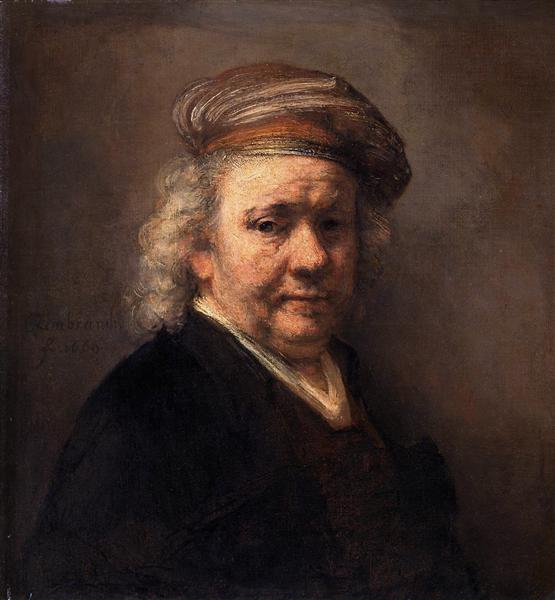
Rembrandt's self -portrait of 1669 is a work that encapsulates the artist's mastery in the exploration of identity and emotional expression through painting. This work is part of the final period of his life, a moment loaded with introspection and personal challenges that are reflected in his style and in the chosen palette. The painting presents a Maduro Rembrandt, who looks at the viewer with an intensity that seems to show his experiences lived, his sorrows and his accumulated wisdom.
In the composition of the work, Rembrandt is in the foreground, surrounded by a dark background that contrasts with the luminosity of his face and clothing. This choice, typical of its style, allows the viewer's attention to focus on the expression and detail of the character. The chiaroscuro technique is masterfully used in this work, where the gently directed light illuminates the factions of its face, accentuating the texture of its skin and the folds of its attire. The use of color, in predominant tones of brown and gold, not only establishes an atmosphere of intimacy, but also evokes the characteristic colors of Rembrandt's work in its late stage, highlighting its ability to create depth and volume.
The self -portrait of 1669 is remarkable for its almost raw honesty. Rembrandt does not seek to beautify its appearance; Instead, it presents a face that, despite the signs of age and fatigue, radiates a dignity and a deep humanity. His eyes are especially evocative: they seem to convey an internal dialogue, a reflection of a soul that has confronted both triumph and suffering. Wrinkles, shadows and subtle variations in their skin tell the story of their life, almost like a visual newspaper.
In the broader context of his work, this self -portrait is one of the many that Rembrandt made throughout his life. Through these self -portraits, the artist not only experiences technique and light, but also embarks on a visual examination of himself, functioning as a mirror of his emotional state and the circumstances of his life. This self -portrait is created in a period in which Rembrandt faced adversity, including personal loss and financial difficulties, adding an additional layer of significance to the work.
The work illustrates transitions in baroque painting and the use of portrait. While many of his contemporaries focused on the idealized representation or in portraits that emphasized status and social position, Rembrandt chose to explore the complexity of the human being through sincerity and realism. In this way, its self -portrait is not only a reflection of itself, but also a representation of the human spirit in its entirety.
The self -portrait of 1669 is a visual meditation that invites the viewer to get involved in an intimate conversation with the artist. This work lasts not only as a testimony of the unquestionable talent of Rembrandt in the portrait, but also as a legacy of its unique vision of the world and the human condition. In its simplicity and depth, this painting is maintained as a milestone that continues to inspire artists and art lovers to explore the complexity of human identity and experience.
KUADROS ©, a famous paint on your wall.
Hand-made oil painting reproductions, with the quality of professional artists and the distinctive seal of KUADROS ©.
Reproduction service paintings With a guarantee of satisfaction. If you are not completely satisfied with the replica of your painting, we refund your money 100%.