

Description
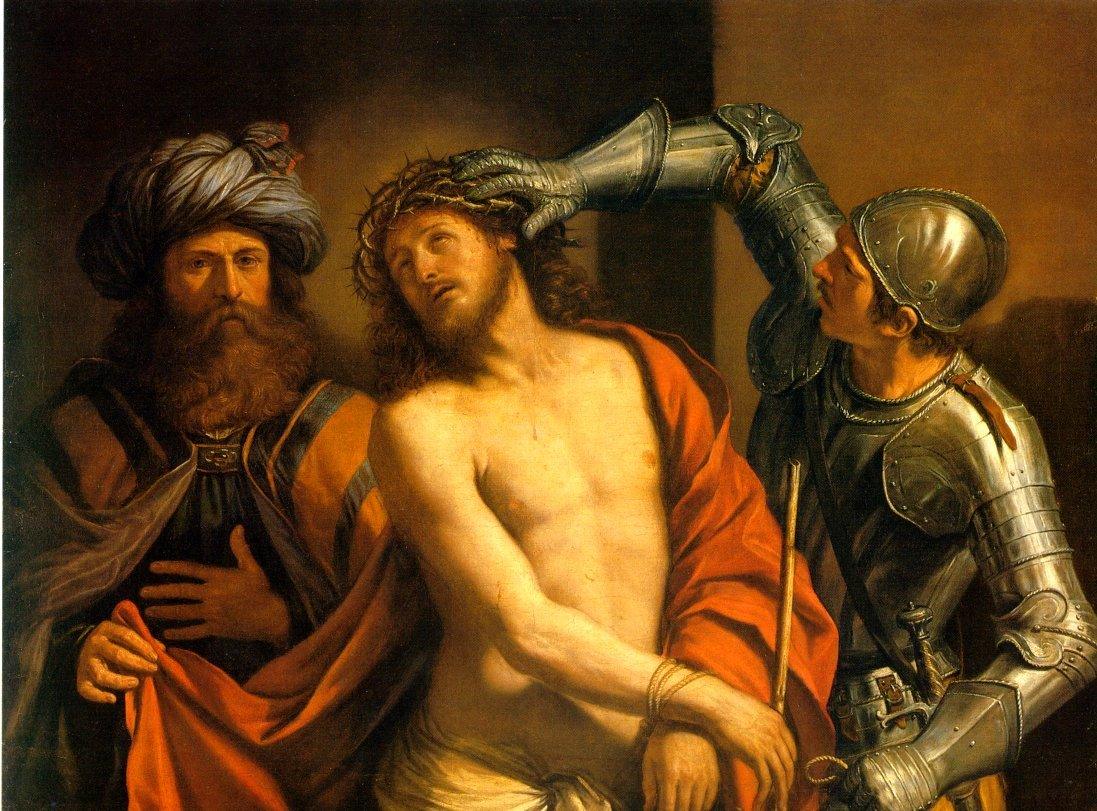
The painting depicts Christ as Ecce Homo at the center of a confined, intense, and carefully focused scene. His partly bare torso is exposed beneath a crown of thorns, while a red cloak crosses his body and opens out toward the figures flanking him. On the left, a bearded man wearing a dark headdress holds part of the fabric; on the right, a figure in a helmet and armor raises his arm above Christ’s head. The three bodies are grouped in an interior almost swallowed by darkness, so that the faces, skin, red of the cloak, and metallic reflections take on an immediate presence.
The title refers to the presentation of Jesus by Pontius Pilate, associated in the Gospel of John with the words “Behold the man.” The episode belongs to the Passion cycle and focuses on the moment when Christ, after being scourged and crowned with thorns, is shown publicly before the crucifixion. The composition makes this exposure the dramatic heart of the work: Christ does not appear as a distant figure, but as one subjected to the gaze of those around him and, by extension, of the viewer. The scene thus combines public humiliation and suffering with a dignity that endures despite the violence.
The visible attributes bring together an iconography of opposing meanings. The crown of thorns signifies pain and degradation, but also serves as a parody of a royal crown. The red cloak heightens this ambiguity: it evokes the appearance of a king while emphasizing the mocking nature of the representation. By contrast, the armor introduces physical, coercive, and threatening authority; the raised arm heightens the tension of the gesture without the need to depict an explicit action. The inclination of Christ’s head and the vulnerability of his central figure contrast with the soldier’s protective surfaces, creating a visual opposition between helplessness and power.
The formal construction relies on warm, theatrical chiaroscuro. The dark background removes almost all spatial references and focuses the viewer’s gaze on the triangle formed by Christ’s face, the vermilion cloak, and the gleam of the armor. The folds of the fabric lead the eye from the figures at the sides toward the torso and crowned head, while the arms and the vertical lines of the armor introduce taut directional movement within the group. The illuminated skin takes on a tactile quality that makes the exposure of the body palpable; by contrast, the browns, blacks, and metallic grays deepen the surroundings and reinforce a sense of confinement.
In keeping with Guercino and the Italian Baroque tradition, the work brings together dramatic lighting, expressive intensity, and a devotional composition with powerful emotional impact. The proximity of the figures rules out a panoramic narrative and turns the episode into a direct, almost theatrical experience: each figure takes part in the presentation of Christ, and each color contrast sustains the tension between symbolic kingship, mockery, and suffering. Notice how the red not only identifies the subject but also connects the hands at the sides with the central figure; around this fabric, light and darkness shape the entire reading of the painting.
Have questions about our oil painting reproductions? See our frequently asked questions.