

Description
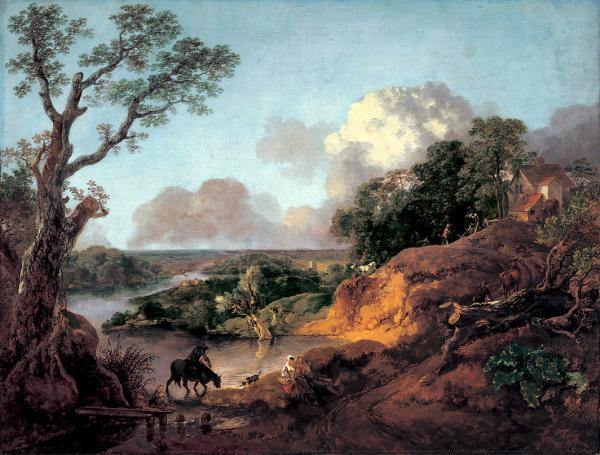
The painting shows a rural view of Suffolk beneath a blue sky crossed by voluminous clouds. A large tree with a twisted trunk dominates the left foreground, its branches extending like a natural frame over the landscape. At its foot, a stream flows from the central area towards the lower edge, gathering dark reflections between banks of vegetation, rocks and earth. In the distance, tree-covered hills recede one after another, while a small house with ochre walls and a reddish roof on the rise to the right brings a domestic presence to the scene. Near the water, a rider on a dark horse and small figures add movement and a human scale to the expansive countryside.
The title places this scene in Suffolk, a county in eastern England associated with rural and agricultural landscapes. The work does not present the countryside as an empty space, but as an inhabited and traversed territory: the house, the rider and the figures by the bank connect nature with everyday life. This relationship is especially significant in the context of Thomas Gainsborough, who was born in Sudbury, Suffolk, and was closely associated with the English landscape tradition. The scene thus brings together a depiction of the countryside and an evocation of a landscape identity shaped by water, trees, dwellings and human presence.
The monumental tree functions as more than a botanical feature: its gnarled trunk and open crown establish a threshold through which the eye enters the composition. In contrast to its vertical weight, the water stretches horizontally and leads toward the horizon. The rider and the figures provide scale, movement, and an everyday dimension that keeps the landscape from becoming purely contemplative. The house on the right-hand slope serves as a sign of permanence, while the wooded hills and densely vegetated banks extend the sense of natural continuity. Together, these elements form an inhabited landscape, balanced between openness, shelter, and movement.
The panoramic composition is organized around clear contrasts. The tree on the left gathers a dark, vertical mass, while the luminous sky and watercourse open the scene toward the distance. The diagonal of the right-hand slope guides the eye to the house and creates a visual path that intersects with the axis of the water. The deep greens of the trees and shrubs are linked with the ochres, browns, and reddish tones of the earth and rocks; the blue-gray reflections add depth. The figures, tiny in comparison with their surroundings, establish scale and create a leisurely rhythm of focal points. Light, filtered through clouds and foliage, shapes the space without disrupting its atmospheric continuity.
In this work, Thomas Gainsborough brings together features associated with his atmospheric rural landscapes: trees, water, sky, and light are integrated through a tonal composition that lends the natural world breadth and movement. Brushwork and areas of color bring the elements together as parts of a single atmosphere. The tree guides the eye toward the stream, and the stream leads it back to the house, the rider, and the distant slopes. The strength of A View in Suffolk comes from this visual flow: the landscape seems serene, yet remains animated by the water, human activity, and the tension between the sheltering foreground and the open horizon.
Have questions about our oil painting reproductions? See our frequently asked questions.