

Description
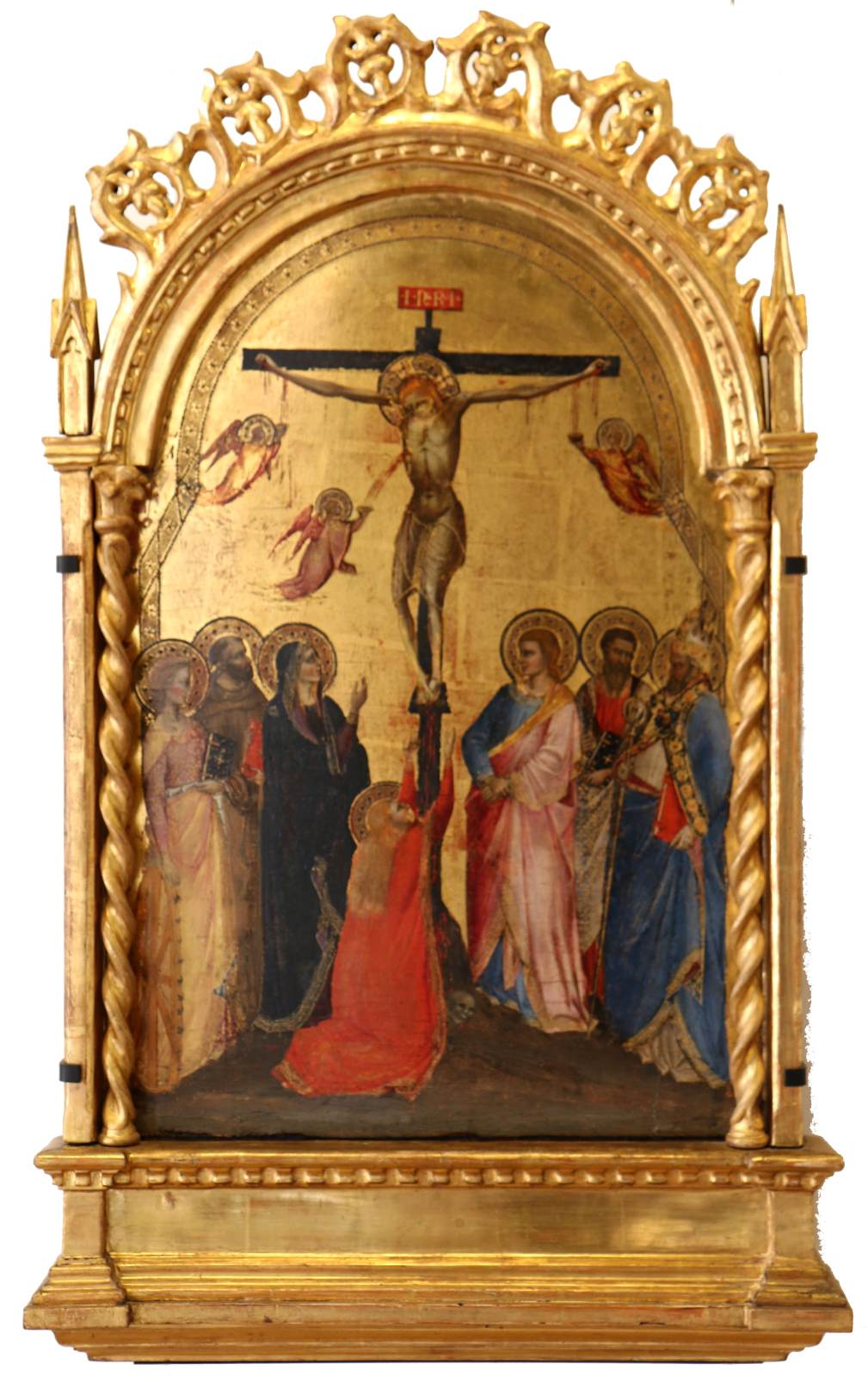
The painting depicts Calvary as a scene of intense devotional focus. Christ occupies the central axis, nailed to a dark cross whose upright extends down to the base of the ensemble. Above the crossbeam, a red cartouche bearing the inscription «INRI» identifies the episode. Several haloed figures gather on either side of and at the foot of the cross: some stand, others lean forward or kneel, while a figure draped in red draws particular attention in the lower area. Three winged beings surround the upper part of the cross, creating a visual link between the earthly drama and the celestial realm. The entire scene is enclosed within an architectural gilded frame featuring a molded arch, twisted columns, pinnacles, and a stepped base.
Calvary is the place traditionally associated with the Crucifixion of Jesus Christ, also known as Golgotha. The work therefore depicts a pivotal moment in the Passion: Christ dies on the cross while those who accompany him form a community of witnesses, mourners, and worshippers. The inscription «INRI» refers to the Latin formula traditionally placed above Jesus’ cross and reinforces the identification of the episode. Rather than separating the sacred event from its ceremonial setting, the composition presents it as an image intended for contemplation, with the gilded architecture visually extending the solemnity of the narrative.
The halos arranged around the figures’ heads transform them into presences belonging to a sacred realm and direct the reading of the scene toward Christ. The kneeling figure beneath the cross introduces a gesture of contemplation that contrasts with the upright poses of the groups at either side. The winged beings suspended around the upper section heighten the celestial dimension and seem to accompany the cross’s upward visual movement. The composition’s symmetry does not dispel the drama; it concentrates it in the crucified body, in the gazes directed toward him, and in the contrast between the red of several garments and the aged golden background.
Formally, the work is structured around a strongly emphasized vertical axis. The cross divides the painted field and acts as an ascending line from the architectural base to the winged figures. The figures are grouped on the left and right in a compact band, creating a rhythm of halos, folds, and colors that continually leads toward the center. The frame’s inner arch repeats and amplifies the curve enclosing the scene, while the twisted columns bring movement to an essentially frontal structure. Gold functions both as a luminous surface and as a dividing element: it distinguishes the space of the depiction and transforms the altarpiece into an object with a ceremonial presence.
In this work by Giovanni Bonsi, expressive power arises from the union of the painted image and the gilded architecture. The scene does more than recount Christ’s death; through its frontal composition, the repetition of the halos, and the axial arrangement of all its forms, it transforms the event into a visual experience of veneration. It is worth noting how the frame guides the eye toward the cross and how, from there, the human groups and winged figures create a collective response to the sacrifice. The solemnity of the whole lies precisely in this coordination of the episode from the Passion, the sacred attributes, and the altarpiece structure that presents it.
Have questions about our oil painting reproductions? See our frequently asked questions.