

Description
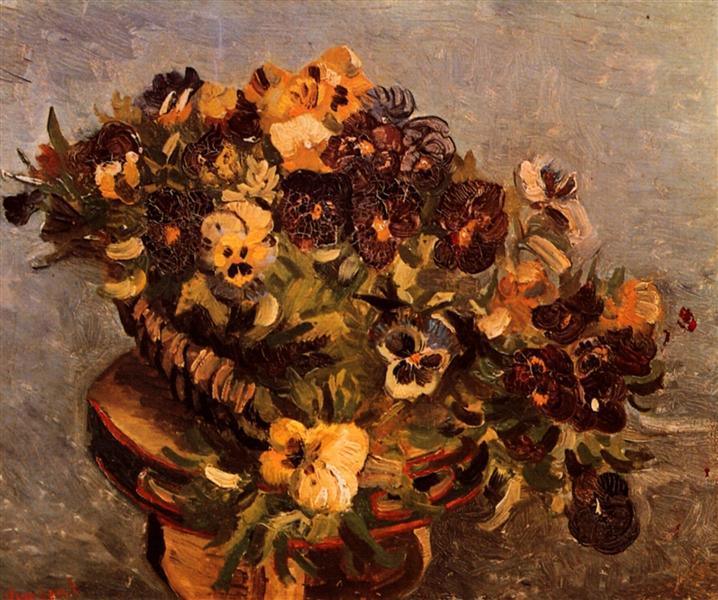
The painting depicts a compact bouquet of pansies in a low, decorated vase. The flowers crowd together in a lush mass of yellows, oranges, ochres, dark reds and browns, interwoven with green leaves and stems that cross the entire composition. The vessel, visible in the lower-left and central areas, is partly obscured by foliage, as if the spreading plants were overflowing its boundaries. There are no human figures or narrative setting: this domestic subject focuses all attention on the relationship between the flowers, the vessel and the neutral background in bluish-gray and earthy tones.
As a floral still life, the painting arranges objects and flowers, turning their everyday presence into a subject for pictorial contemplation. The bouquet is more than simply a gathering of flowers; it is a study in color, volume and visual rhythm. Traditionally associated with contemplation and remembrance, the pansies lend a serene resonance to a composition of great chromatic intensity. In the hands of Vincent van Gogh, this domestic subject takes on an expansive presence: the vase serves as an anchor, while the flowers reorganize the space around it.
The accumulation of corollas, leaves and branching stems creates an impression of abundance and organic vigor. In the conventional language of still life, the warm flowers may be associated with vitality and fleeting beauty; here, however, that fragility is counterbalanced by the density of the whole. The interwoven foliage creates a sense of continuous growth, while the partly concealed vase ceases to be an isolated object and becomes the visual support for an expansive profusion of plants. The diagonal arrangement reinforces this energy and leads the eye from the vessel to the flowers above.
The composition fills almost the entire frame and compresses the depth of the background, making the bouquet feel close, dense, and physically present. The strongest concentration of color lies in the center and toward the right, where yellows and oranges engage with darker reds and browns. The green and olive leaves introduce pauses in the color that separate the flowers without breaking the unity of the whole. Visible brushwork builds the forms through energetic touches and contrasts in texture: the petals are defined by accumulations of color, the stems by dark lines, and the background by a broad texture that sustains the bouquet’s vibrancy.
This sensibility is closely associated with Vincent Van Gogh: intense color, visible brushwork, and an expressive construction of form even when depicting an everyday subject. In Vase with Pansies, the painting does not depict the flowers in merely botanical terms; it transforms them into a vibrant mass that dominates the field of vision. It is worth observing how the partially hidden container supports a composition that seems to grow outward, and how the warm tones glow against the blue-gray background. The work’s strength lies in this tension between containment and exuberance: a simple bouquet becomes a concentrated experience of color, rhythm, and vegetal energy.
Have questions about our oil painting reproductions? See our frequently asked questions.