


Description
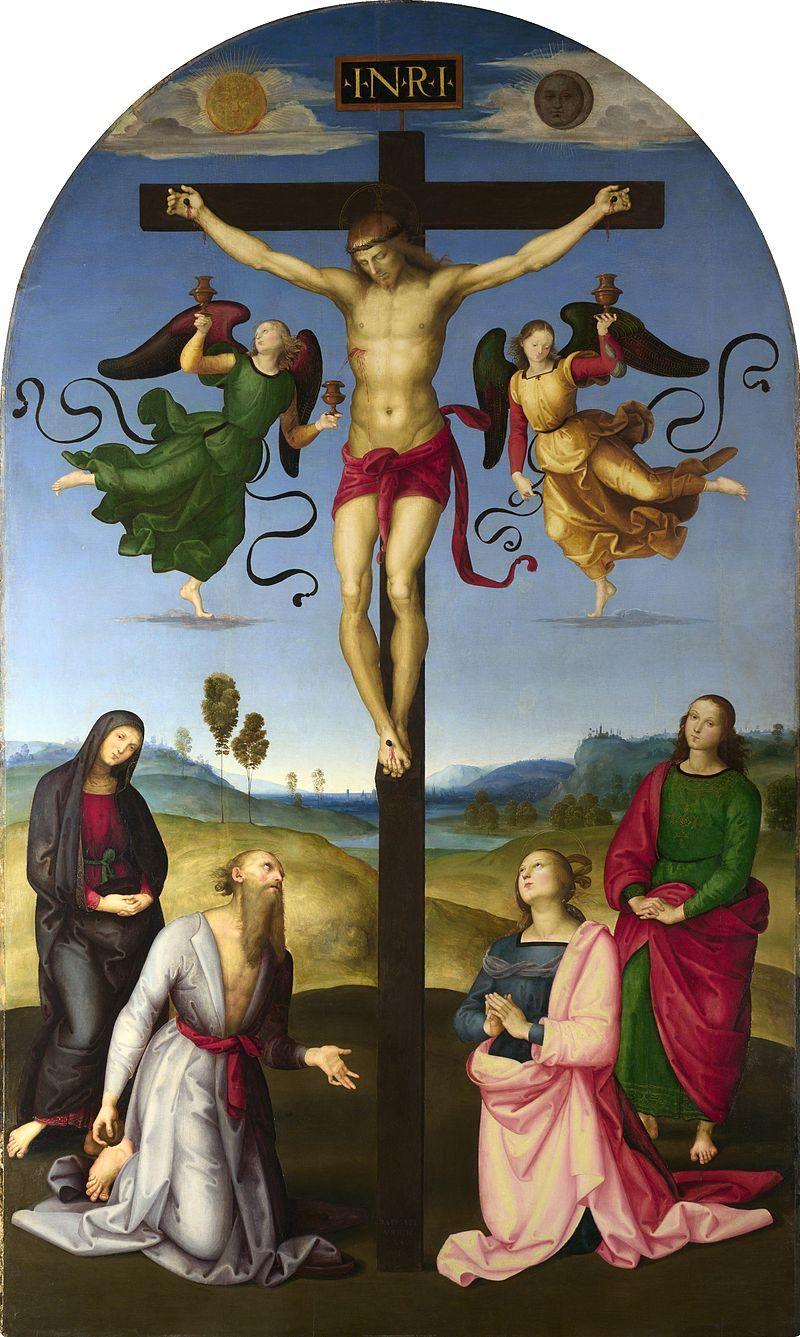
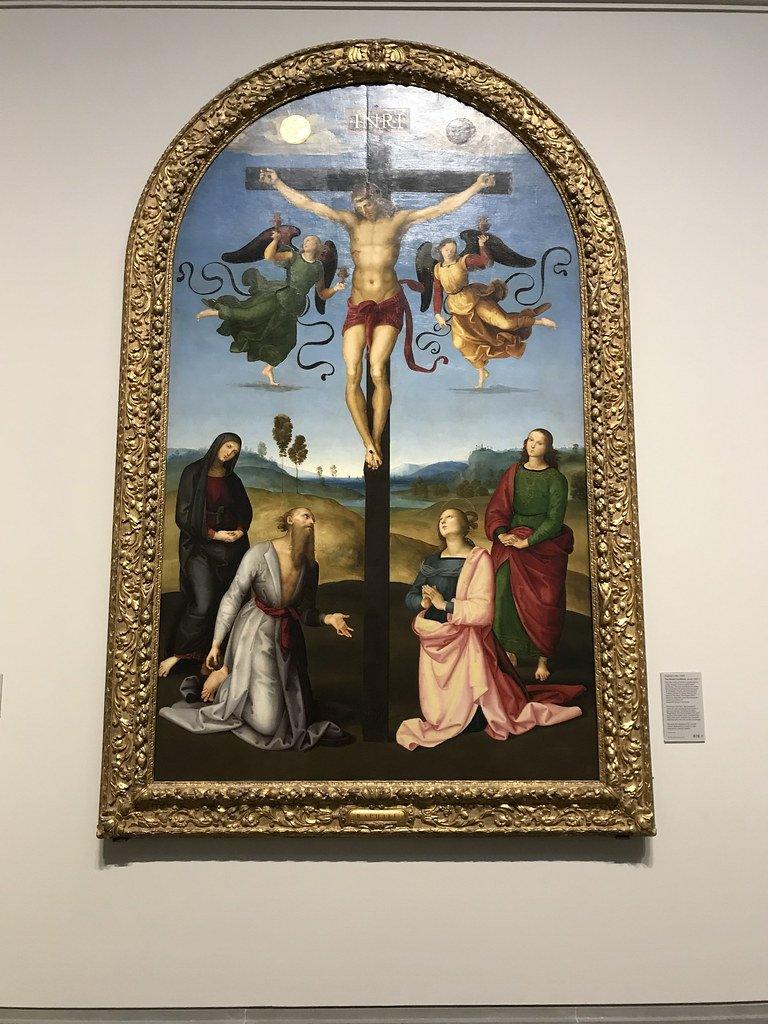
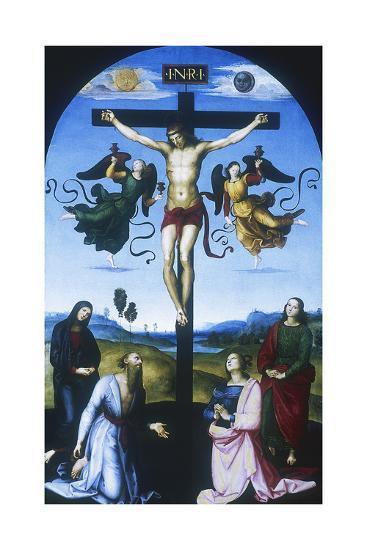
This extraordinary painting by Raphael was originally an altarpiece located in the church of San Domenico in Città di Castello, near Urbino, the artist’s birthplace. It depicts the Virgin Mary and Saint John the Evangelist on either side of the cross. Saint Jerome and Mary Magdalene are kneeling in front of them.
One of the painter’s earliest works, this altarpiece was commissioned by the wool merchant and banker Domenico Gavari for his funerary chapel dedicated to Saint Jerome.
In the work, Christ’s body hangs from the cross. Two angels hover on delicate slivers of cloud on either side, catching the blood flowing from his wounds in golden chalices reminiscent of those used to serve wine during Mass at the altar below.
The sun and moon are visible in the sky, marking the eclipse that coincided with Christ’s death. Saint Jerome and Mary Magdalene are at the foot of the Cross, gazing at Christ’s body with reverence and piety. The Virgin, dressed in purplish black to signify mourning, stands to the left of the Cross, with John the Evangelist on the right. Both look toward the viewer and wring their hands in grief.
Art can make something terrible appear beautiful. This ability can also be seen in The Mond Crucifixion. The painting has toned down the pain and suffering Christ endured on the cross. Jesus is shown immaculate and peaceful, except for the wounds on his feet, hands, and side. Raphael emphasizes Christ’s perfection, remaining faithful to the High Renaissance style of painting.
In the work, the atmospheric perspective, together with the landscape, displays the style of Perugino, whom Raphael followed. Rather than focusing on the painful and horrific nature of Christ’s death, it reinforces the doctrine of transubstantiation, serving as a representation of symbolic blood for the Eucharist.
The Mond Crucifixion was analyzed at the London-based art museum, the National Gallery. The pigments typical of the Renaissance period were identified there.
Raphael painted his work using, among other pigments, ochres, vermilion, verdigris, lead-tin yellow, and natural ultramarine. The color red has powerful significance. Every figure in the painting has a touch of red. All the figures are touched by the painting and redeemed by the blood of Christ.
Other colors also connect elements of the painting in turn. Some colors in the image are repeated in its lower half. For example, the blue of the sky is echoed in the clothes worn by Saint Jerome, and the green of the clothes worn by one of the two angels also appears in Saint John’s garments.
Saint Jerome was not present at the Crucifixion, but he is included in this scene because the chapel was dedicated to him. He gestures toward the Cross and holds the stone with which he beat his chest while living as a hermit in the desert. The miracles that occurred after Christ’s death were painted in scenes on the predella (the lower painted panel shown beneath the main panel of the altarpiece). Two predella panels survive in the North Carolina Museum of Art in Raleigh and the National Museum of Ancient Art in Lisbon. There was probably at least one additional panel originally. Gavari himself may have chosen to dedicate the altar to Saint Jerome, since he also named his firstborn son Girolamo (Jerome in Italian).
The altarpiece is strongly influenced by Perugino, the leading artist in central Italy at the time, with whom Raphael developed a close artistic relationship while living in Perugia. The overall design is based on several versions of Christ crucified in a landscape painted by Perugino in the late 1480s and 1490s, and is especially similar to his altarpiece of the Crucifixion for the convent of San Francesco al Monte in Perugia, commissioned in 1502 and completed in 1506.
In that painting, angels with fluttering ribbons hold chalices to collect the blood from Christ’s wounds; the Virgin and the Evangelist are almost identical to Raphael’s figures, and Mary Magdalene is in the same pose on the opposite side of the Cross. Raphael probably saw Perugino’s works in his workshop in Perugia before they were unveiled. In addition to adopting Perugino’s figures’ sweet oval faces, small features and stylized hand gestures, Raphael took the principles of symmetry, harmony and compositional clarity from Perugino’s works. However, Raphael adapted them, giving them greater softness and sophistication. Here, however, it is not entirely clear who copied whose work.
In Raphael’s early works, he often based his compositions on a simple geometric grid, which he incised into the panel to help transfer his drawing, as we can see in the Ansidei Madonna. No grid is visible in the Mond Crucifixion, although the image’s strong symmetry and geometric structure suggest that Raphael may initially have used a similar method to lay out his composition. He used a ruler and compasses to incise the outline of the Crucifix, and a compass to incise the sun and moon. The way he left unpainted spaces for the figures and made no revisions or changes while painting suggests that he was working from a carefully prepared design in a detailed drawing. During this period, Raphael frequently used dark, shaded brushstrokes to reinforce areas of shadow, a technique derived from Perugino that is particularly noticeable here in the drapery. Raphael also used his hands and fingers to blot and model the paint on the wet surface. His fingerprints and palms are visible in the shadows around the heads, especially in Christ’s hair, face and beard.
Raphael scratched through the brown paint at the foot of the Cross to the layer of silver leaf beneath it to sign the painting: RAFAEL / VRBIN / AS /.P.[INXIT] (“Raphael of Urbino painted this”). Vasari commented that if Raphael had not signed the painting, no one would have believed that he, rather than Perugino, had painted it.