

Description
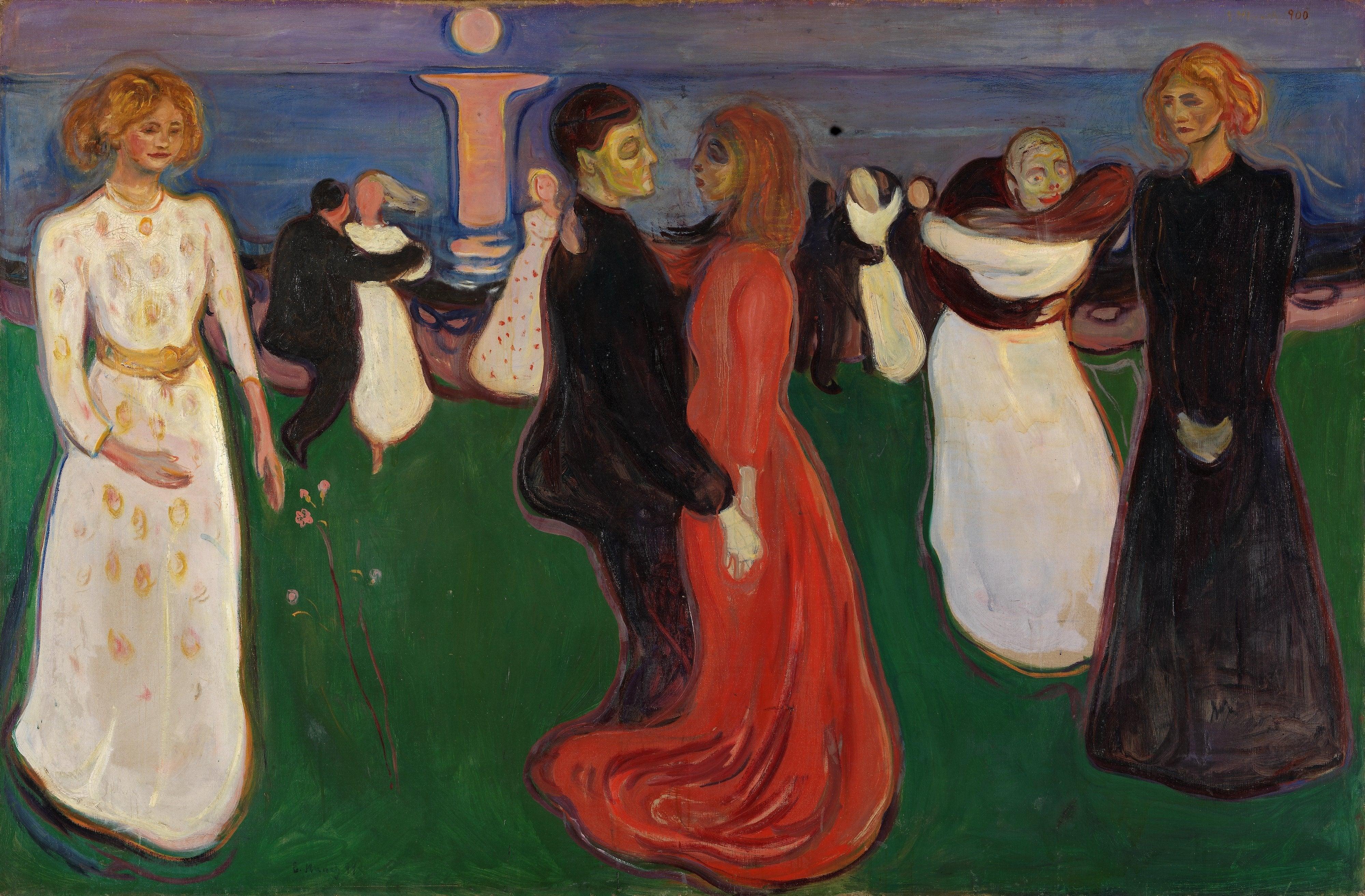
The painting The Dance of Life, by Edvard Munch, depicts a nocturnal scene in which several human figures gather, draw close to one another, and appear to give themselves over to a collective dance. At the far left, a standing woman stands out in a white dress decorated with luminous motifs; toward the center, various couples and groups create a sequence of gestures, profiles, and embraces. The couple formed by a man dressed in black and a woman in red dominates the foreground, while a tall female figure, also dressed in black, closes the composition on the right. A blue, gray, and violet sky stretches over the green landscape, crossed by undulating lines and a circular yellow and pink moon.
The work transforms a nocturnal gathering into an allegory of human existence. The composition is associated with an interpretation of the life cycle: the female figures dressed in white, red, and black can be arranged as a progression from youth and innocence to romantic experience and maturity. The central couple forms the emotional core of the scene, while the moon and landscape set the episode apart from an everyday celebration and place it in a symbolic register. Thus, the dance functions not merely as bodily movement, but as a condensed image of life’s different stages and their emotional bonds.
Color carries much of the meaning here. The white figure at the far left introduces a bright, open presence; the red of the central figure brings intensity, desire, and energy; and the black, repeated in several garments, adds gravity and a more introspective dimension. The central couple seems to become the meeting point between these hues and the different moments suggested by the scene as a whole. The moon lends a circular, nocturnal rhythm, while the tall vertical form beneath it acts as a visual axis. Around it, the figures gather as if taking part in a ritual or theatrical scene, and the small flowers in the foreground connect the human dimension with the vegetation.
The horizontal composition places the figures in a central band, but it does not create a sense of stillness. The bodies, outstretched arms, tilted poses, and long dresses create a rippling movement echoed by the bands of the landscape. The dark green ground supports the scene like a platform, contrasting with the cool, changing sky. The scale of the central couple brings them closer to the viewer and makes them the narrative focus, while the figures at the sides serve as visual thresholds: the woman in white opens the journey, and the woman in black brings it to a close. The defined outlines and simplified forms make the gestures immediately legible without diminishing their emotional weight.
In this work, Edvard Munch brings together features widely associated with his visual language: simplified yet intense figures, expressive color, sharply defined profiles, and a landscape that acts as an extension of the psychological state. The recognizable scene is thus transformed into a dramatic composition in which nature, night, and the figures all take part in the same rhythm. It is worth noting how the red of the central couple is suspended between two dark figures, and how the moon extends the dance’s circular movement upward. In this arrangement of color and space, the theme of life appears less as a linear story than as a cycle of encounters, desire, transformation, and memory.
Have questions about our oil painting reproductions? See our frequently asked questions.