

Description
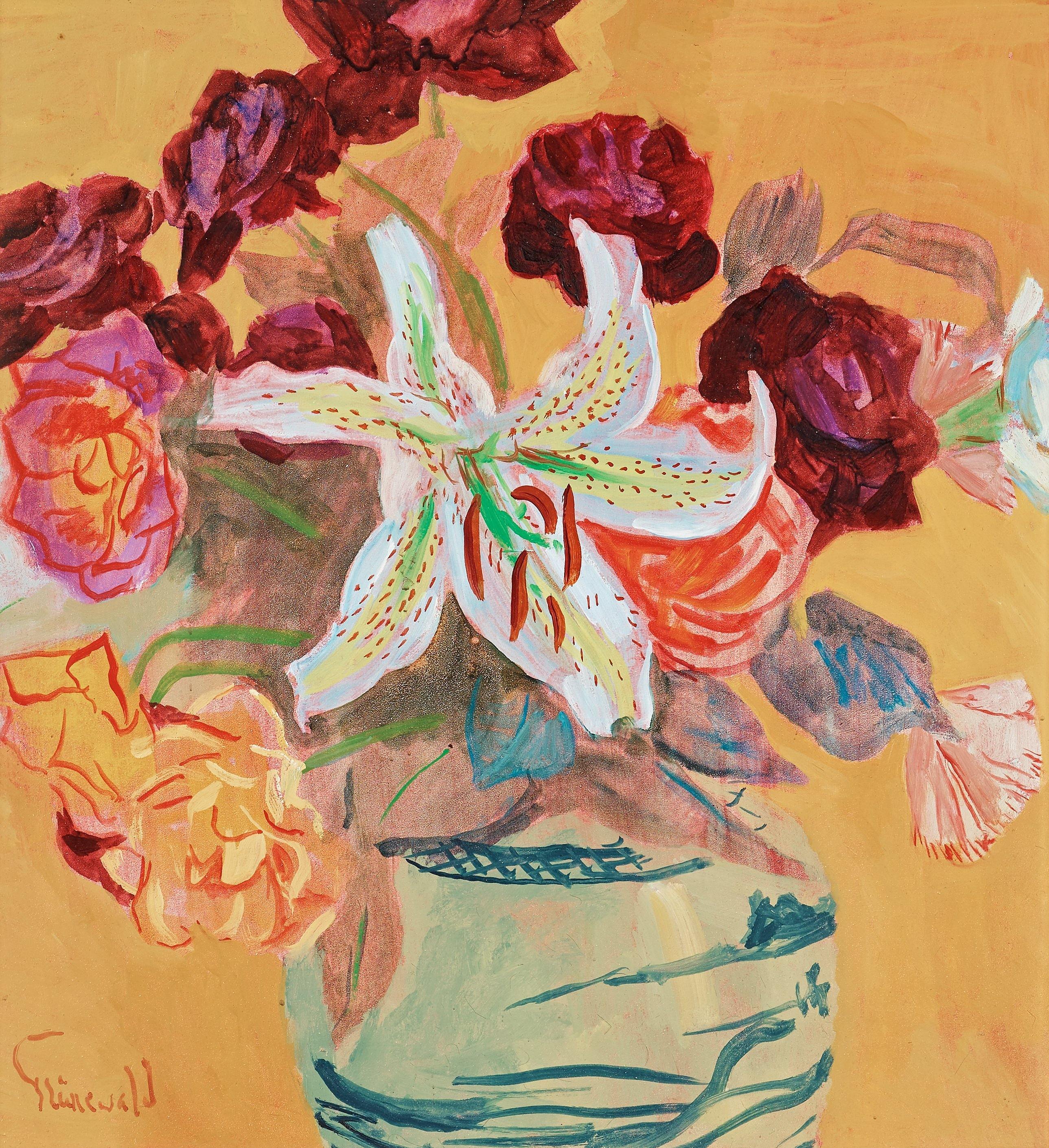
The painting presents an exuberant floral still life, built around a large white lily opening at the center of the composition. Its outstretched petals, marked with reddish patches and green lines, immediately draw the eye. Around it, flowers in burgundy, violet, pink and orange tones cluster together, forming an abundant mass that spreads over the jar. In the lower area, the rounded vessel is decorated with blue-green bands and strokes, while leaves and stems connect the flowers to its base. The uncluttered, warm golden ochre background intensifies the ornamental, vibrant character of the arrangement.
As a genre, still life focuses on inanimate objects, and flowers are among its most fertile subjects: they make it possible to organize forms, colors and rhythms without relying on figurative narrative. In this work, the bouquet does not depict an anecdotal scene, but rather an architecture of abundance sustained by the relationship between the flowers and the vessel that holds them. The composition turns the floral arrangement into an expansive, almost theatrical presence. The jar serves as a material anchor and as a point of departure for the stems to rise, connect the masses of color and distribute movement toward the sides and upper part of the composition.
The white lily acts as a focal point of light amid a field saturated with reds, violets and oranges. Its open bloom introduces a luminous pause that allows the other flowers to be read in contrast. The bouquet’s density reinforces a sense of vitality and decorative exuberance, while the leaves and stems create continuity among the floral forms. The decorated jar takes on expressive importance of its own: its blue-green bands extend the vegetation’s chromatic dialogue and keep the vessel from becoming merely a neutral support. The work thus brings together a visual tension between the lily’s delicate openness and the compact energy of the arrangement.
The composition is vertical and centered, but not rigid. The lily establishes a dominant visual axis; the dark flowers form an upper and side crown that expands the volume, while the pink and orange clusters balance the lower part. The flat background eliminates complex spatial depth and focuses attention on the overlapping petals, leaves, and stems. The loose, gestural brushwork favors lively contours, patches of color, and energetic transitions rather than a meticulous depiction of each species. The ochre background makes the saturated hues vibrate, while the central white flower brings clarity and regulates the composition’s visual rhythm.
The work is associated with the Expressionist sensibility broadly linked to Isaac Grünewald: intense color, energetic brushwork, and a pictorial construction with powerful visual impact. Drawing and color work together; each petal contributes to the overall form and, at the same time, to the bouquet’s chromatic pulse. The eye travels from the white lily to the dark flowers, then descends along the stems to the jar. This journey reveals the painting’s inner logic: a still life that transforms a floral arrangement into an architecture of color, matter, and energy.
Have questions about our oil painting reproductions? See our frequently asked questions.