

Description
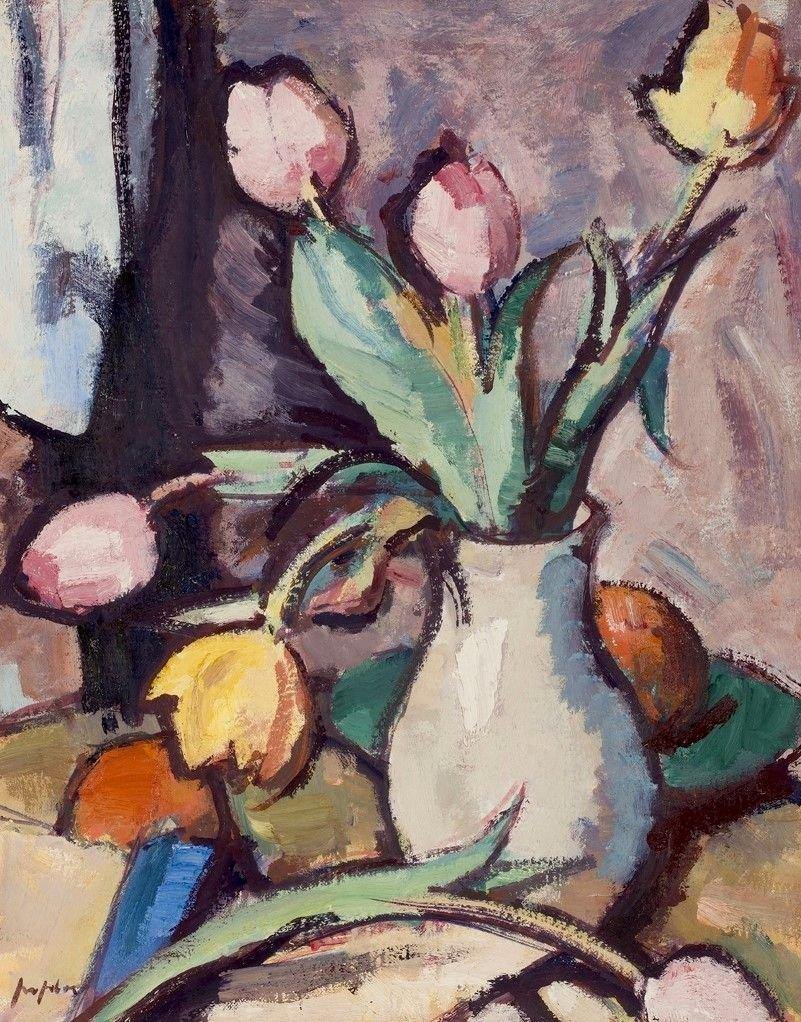
The painting shows a still life of tulips gathered in a tall, pale vase, positioned in the lower centre of the composition. The green stems fan upwards and diagonally, while the elongated leaves extend the movement of the bouquet to both sides. Among them are rounded flowers in pale pink, deep pink, yellow, orange and red, arranged from the lower area to the upper edges. The vase, rendered in whites, creams and greyish blues, provides a tranquil base for the flowers’ expanding range of colour. In the background, broad dark brushstrokes and areas of violet, mauve, pink and beige form a compact space, more painterly than descriptive, in which the bouquet commands all the attention.
As a floral still life, the work belongs to a genre devoted to turning everyday objects into an opportunity to study colour, balance and the material presence of forms. Here, the bouquet of tulips does not depend on an external narrative: its interest arises from the relationship between the flowers, stems and vase within an intensely colourful composition. The arrangement retains something recognisable and domestic—a vessel holding flowers—but the organisation of the background and the simplification of the outlines lift the scene beyond a merely naturalistic depiction. The whole evokes the vitality of a bouquet and, at the same time, the ephemeral quality traditionally associated with flowers gathered in an interior.
The multicoloured flowers invite us to read the painting as a celebration of chromatic variety and the rhythm of forms. Each corolla introduces a distinct note, while the repetition of rounded volumes establishes a visual cadence that runs through the bouquet. The stems and leaves, extending in divergent directions, lend an organic energy that prevents the vase from functioning as an immobile centre. The dark background intensifies the luminosity of the petals and makes the colours advance towards the foreground. The curved shape of the lower band completes the scene with a visual base that stabilises the composition, while the dark outlines heighten the tension between the decorative and the expressive.
The composition is organised around a balance between verticality and radial expansion. The vase establishes a firm central axis; from it, the stems rise, cross and spread towards the edges, guiding the eye between the flowers above and the groups beside the vessel. The overlapping brushstrokes do not depict each petal in meticulous detail, but instead condense the forms into patches of colour defined by lines and dark accents. This economy of description reinforces the dynamic character of the surface. The violets and browns of the background serve as a structure for depth, but also as a counterpoint that makes the yellows, oranges and pinks vibrate. The viewer’s attention thus shifts between the floral detail and the abstract unity of the composition.
This work by Samuel John Peploe displays features widely associated with his still lifes: intense colour, visible brushwork and a simplified construction of forms, close to the Post-Impressionist sensibility of the Scottish Colourists. The bouquet acts as a vibrant core of colour, its energy arising from the tension between the tulips’ organic spread and the compact structure of the dark and violet brushstrokes that support them. The vase does more than hold the flowers; it organizes the entire pictorial field: its verticality gathers the stems, its light tones balance the background, and its position turns colour into an experience of rhythm, weight and movement.
Have questions about our oil painting reproductions? See our frequently asked questions.