

Description
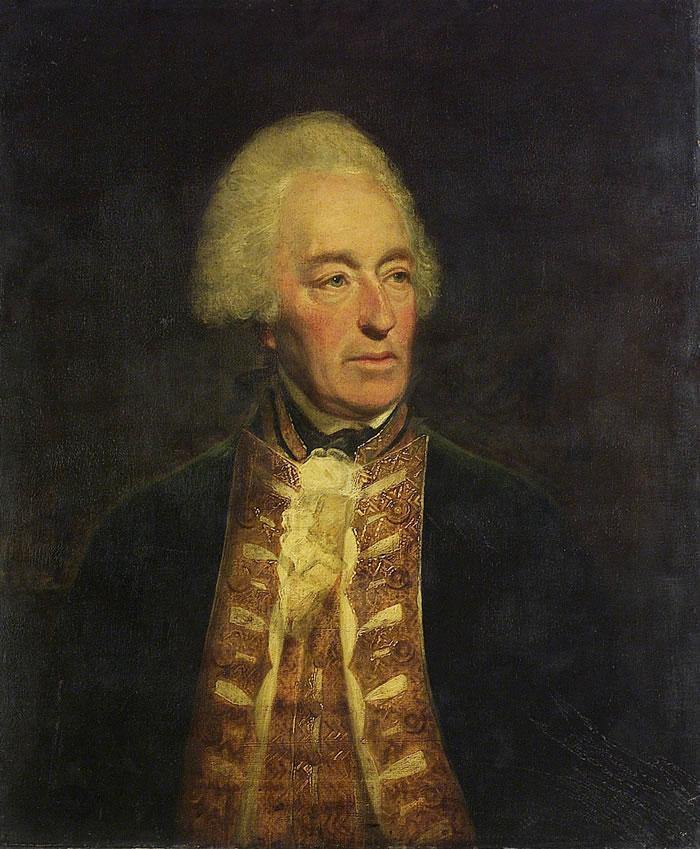
The painting depicts Admiral Robert Roddam in a half-length portrait, centered against a dark background that leaves little room for the surroundings. His face, turned slightly to the right, conveys a serious, restrained expression. A voluminous, light-colored powdered wig frames his head, while a dark, high-collared outer garment covers his shoulders and torso. At the center of the composition, the ornate front of his attire stands out, rendered in browns, golds, and cream tones beneath a light-colored collar or cravat. The figure occupies almost the entire field of view and is presented with the gravity befitting a portrait of authority.
The title identifies the sitter as Robert Roddam, an 18th-century British naval officer, and places the work within the tradition of the formal portrait. This genre relies neither on a narrative scene nor on a landscape to communicate the sitter’s importance: pose, clothing, and physical presence make him the focus of the story. His formal attire links the admiral to an elite society in which public appearance expressed hierarchy, rank, and status. The work thus conveys a historical identity through visible signs of dignity and authority, without resorting to a descriptive setting.
The powdered wig reinforces the sitter’s connection to the courtly and aristocratic culture of his time. Its light-colored volume creates a strong contrast with the background, giving the head an almost sculptural presence. The garment’s richly decorated front can be read as an assertion of social distinction: muted golds, light bands, and ornamental motifs draw the eye toward the chest, where the clothing functions as a visual extension of rank. The empty background intensifies this impression, separating the sitter from any everyday activity and turning him into a public figure, isolated and memorable.
The formal structure relies on a stable vertical composition. The head is positioned in the upper third, while the ornamentation of the torso creates a descending axis that guides the eye from the face to the visible lower area. The dark jacket and background provide a deep base for the cream, gold, and pink tones of the face, so that the light seems to concentrate on the figure without spreading into the surrounding space. The three-quarter turn introduces a slight lateral direction, but the overall structure remains restrained and frontal. This combination of minimal movement, chromatic contrast, and a densely clothed surface creates a solemn, quiet presence.
Associated with the name of Lemuel Francis Abbott, the work can be appreciated above all for the way it transforms simple devices—a dark background, a restrained pose, and carefully rendered clothing—into an image of historical authority. The portrait does not need to show ships, battles, or narrative attributes to evoke the admiral’s status: the serene face, light-colored wig, and ornate attire shape the way we read it. Notice how the light separates the figure from the background and how the eye’s journey from the head to the chest makes the clothing an essential part of the identity portrayed. The painting’s strength lies in this union of physical presence, visual hierarchy, and chromatic sobriety.
Have questions about our oil painting reproductions? See our frequently asked questions.