Georgia O'Keeffe, known as the mother of American modernism, revolutionized the way we perceive the landscape and natural elements through her striking works. Her paintings, often described as a blend of silence and intense color, challenge conventional perception and invite us to a unique visual experience. In this article, we will explore how the artist used her color palette and the representation of silence to leave an indelible mark on modern art.
O'Keeffe's Color Palette: A Visual Symphony
The Influence of the Landscape on Her Choice of Colors

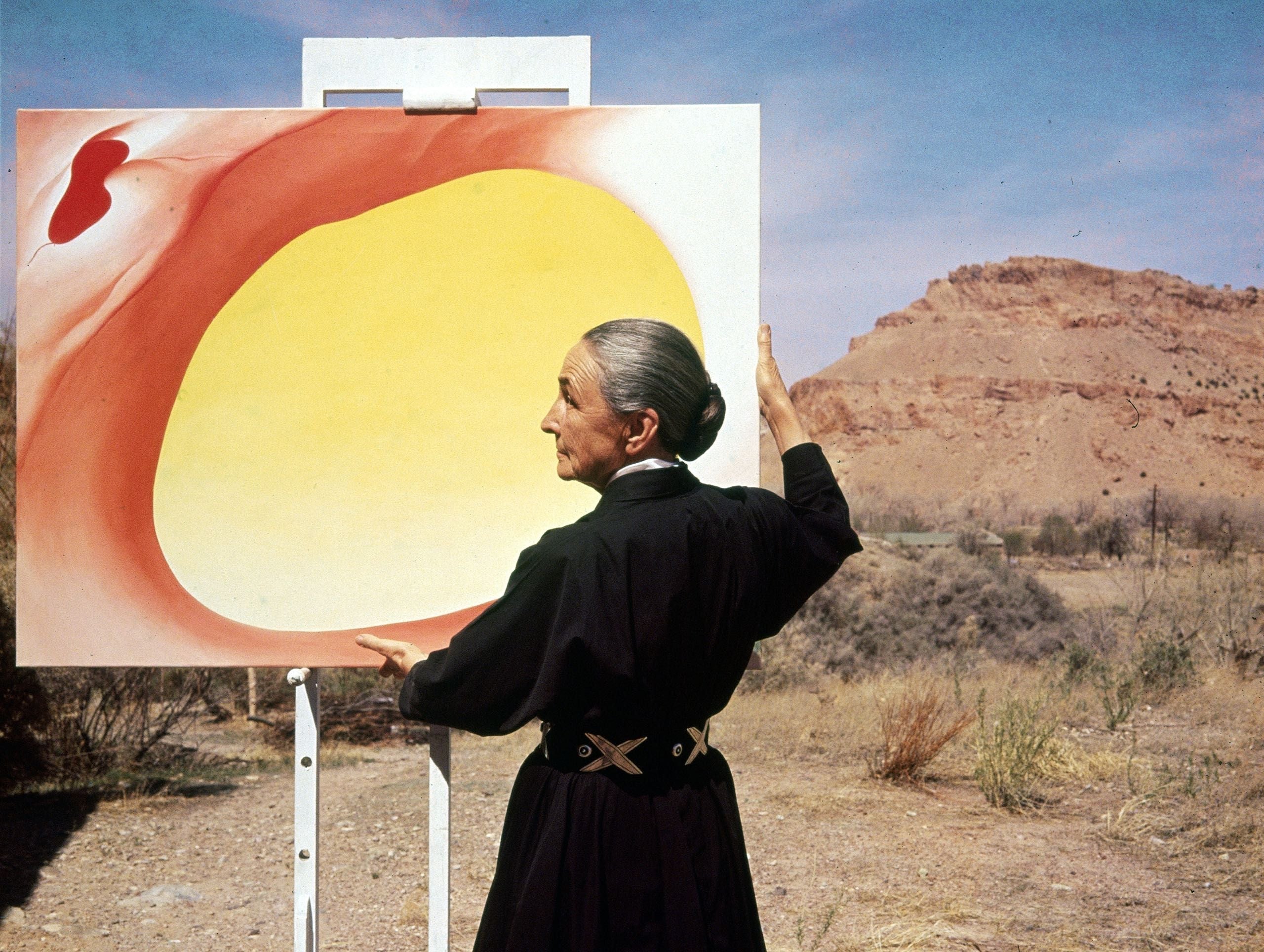
O'Keeffe found unparalleled inspiration in the vast landscapes of the southwestern United States. The deep colors of the desert, such as vivid reds and burnt oranges, became the stars of her canvases. These tones not only reflect an external landscape but also an inner landscape full of emotions and contemplation. To better understand her influence, one can consider the environment that surrounded her: the immense expanse of the sky and the rock formations, elements that defined her personal palette.
Contrasts and Nuances That Define Her Style
The use of contrast is fundamental in O'Keeffe's style. By combining bold colors with more muted tones, she creates a visual tension that captures the viewer's attention. An example of this can be found in her series of enlarged flowers, where the shades unfold from the center to the edges of the flower, creating a sense of depth and three-dimensionality. This technique not only reflects the inherent beauty of nature, but also conveys the idea that the small can be as grand as the monumental.
Silence and Space: The Art of Contemplation
The Stillness of the Desert: An Endless Source

The silence of the New Mexico desert provided O'Keeffe with a refuge and a source of inspiration. In this environment, the artist found a tranquility that is reflected in the simplicity of her compositions. The representation of silence in her work suggests a deliberate pause, an opportunity to reflect on the essence of nature. This contemplative quality can be appreciated in works such as "Sky Above Clouds IV," where vast spaces seem to stretch on infinitely, inviting the viewer to lose themselves in the immensity of the sky.
The Representation of Space in Her Works

Beyond colors and forms, O'Keeffe plays with space in a way that transforms the canvas into an echo of the vastness she perceived. The artist used negative space to emphasize the presence of her subjects, whether a flower or a mountain, giving them an almost sculptural importance. This approach, which can be explored in depth in articles about the magic behind every brushstroke, shows us how emptiness can speak as eloquently as the object itself.
KUADROS ©, a famous painting on your wall. Hand-made oil painting reproductions, with the quality of professional artists and the distinctive seal of KUADROS ©. paintings reproduction service with satisfaction guarantee. If you are not completely satisfied with the replica of your painting, we will refund 100% of your money.
Artistic Evolution: From New York to New Mexico

Georgia O'Keeffe's move from the bustling urban environment of New York to the serenity of the New Mexico desert marked a turning point in her artistic career. In New York, O'Keeffe had been exposed to the avant-garde of the time, which influenced her early works characterized by abstract forms and vibrant colors. However, it was in New Mexico where she found her true artistic voice, channeling the vastness and tranquility of the landscape into her work.
The change of scenery not only altered her color palette, but also her thematic approach. Instead of skyscrapers and urban chaos, the hills, flora, and clear skies of New Mexico became recurring subjects in her paintings. This transformation can be seen in her "Blue" and "Pelvis" series, where she explores the connections between nature and the human form, inviting the viewer to a new way of seeing the familiar.
The influence of New Mexico on her work is a testament to how the environment can reshape an artist's perspective, providing new forms and meanings to her art. This artistic journey is a fascinating theme that can be explored more deeply in details of O'Keeffe's life in New Mexico.
O'Keeffe's Masterpieces: A Journey Through Her Legacy
Georgia O'Keeffe's legacy is made up of a collection of masterpieces that continue to resonate in the world of contemporary art. From her early explorations in abstraction to her iconic paintings of flowers, each piece reflects a deep respect for nature and an inexhaustible search for beauty in the simple. Works such as "Jimson Weed/White Flower No. 1" not only challenge the traditional perceptions of her time, but also capture the essence of life itself.
The journey through her legacy would not be complete without mentioning her series of animal skulls, in which the artist found a unique beauty in the most unusual objects. These works not only symbolize the desolation of the desert, but also the permanence of nature against the passage of time, a recurring theme that can be explored through detailed analyses of her works.
When observing her masterpieces, one discovers not only her extraordinary technical skill, but also her ability to communicate deep emotions through art. O'Keeffe left behind a legacy that continues to inspire generations of artists and art lovers alike, highlighting the importance of looking beyond appearances and finding meaning in what surrounds us.
Minimalism in O'Keeffe's Work: Less Is More
The Power of Simplified Detail
Georgia O'Keeffe is recognized for her ability to reduce visual elements to their purest essence , creating a powerful impact with the minimum number of components. This minimalist approach not only challenges artistic conventions, but also invites deep contemplation of each work. O'Keeffe used simple lines and reduced forms to capture the complexity of nature, allowing the viewer to focus on details that often go unnoticed.

A notable example is her series of enlarged flowers that, by simplifying the details, makes the viewer pause to look at the texture and play of light. She herself said that she wanted people to see flowers the way she saw them. This is a reminder of how simplicity can be deceptively complex, and how every artistic choice is deliberate.
To truly appreciate the power of this simplified detail, one can compare her work with that of artists who opt for visual saturation. While O'Keeffe chose reduction, others like Mark Rothko explored emotion through layers of color. This artistic choice reflects a conscious decision that defines her legacy in the art world.
The Economy of Color and Form
O'Keeffe's use of color in her works is another aspect of her minimalism that cannot be overlooked. Through a controlled palette, the artist manages to evoke deep emotions without resorting to a wide variety of tones. This economical approach to color reflects technical mastery that allows the viewer to focus on the form and content of the work.
For example, in her depictions of the New Mexico Desert, O'Keeffe used earthy colors and intense skies that capture the essence of the landscape with a limited amount of pigment. This use of color is not only aesthetically pleasing, but also serves to emphasize the natural elements that inspired her work.
Critics have noted that her economy in the use of color and form is a technique that also reflects contemporary influences, such as abstract art, and how minimalism can be observed in different artistic disciplines. O'Keeffe's economy is a reminder of how less can be more and how this continues impacting contemporary art in meaningful ways.
O'Keeffe's Impact on Contemporary Art
Artists Influenced by Her Style
Georgia O'Keeffe's legacy continues to inspire contemporary artists who seek to emulate her minimalist approach and her ability to see the extraordinary in the ordinary. Her impact is evident in the work of modern artists who aim to simplify their compositions to highlight essential emotions and concepts. A good example is the work of artists who center their art on reduced landscapes, where minimalism and emotion meet.
This influence also extends to those who experiment with color in a cost-effective way, showing how O'Keeffe's approach continues to resonate in an art world that values both complexity and simplicity. Analyzing how other artists interpret her minimalist techniques provides a deeper understanding of how her style has been reinterpreted over the decades.
Legacy in Modern Galleries
Modern art galleries continue to celebrate O'Keeffe's legacy, highlighting her influence on the development of contemporary art. Her works are exhibited alongside those of other masters of the 20th century, giving visitors a clear view of how her artistic innovation has influenced generations of artists. The acceptance of her techniques in modern galleries reaffirms her status as a revolutionary figure in the art world.
Visiting an exhibition dedicated to O'Keeffe is like entering a world where each piece invites introspection and reflection. Her ability to capture the essence of nature through minimal means remains relevant, and her influence can be seen in the way galleries organize their exhibitions, often adopting an innovative approach that reflects the spirit of her work.
Symbolism in O'Keeffe's Work: Beyond What Is Visible
Georgia O'Keeffe's work is full of symbolism, often challenging conventional perceptions. Her paintings often present an abstraction of natural forms, such as flowers and landscapes, inviting viewers to look beyond the obvious. O'Keeffe used symbolism to explore themes of femininity, nature, and spirituality, giving each work a meaning that transcends its visual representation.
The use of magnified forms and vibrant colors in her works suggests an inner universe full of deep emotions and connections to the natural environment. This symbolic approach allows viewers to interpret her paintings on multiple levels, finding in each brushstroke a different story or emotional state.
O'Keeffe's ability to encapsulate complex concepts in simple forms has led to her works being studied not only as artistic pieces, but also as philosophical and cultural expressions. Her ability to transform the everyday into the sublime remains a subject of fascination and study in the field of contemporary art.
Memorable Exhibitions: O'Keeffe Around the World
Georgia O'Keeffe's exhibitions have traveled the world, allowing a global audience to experience her iconic work. Each exhibition offers a unique opportunity to explore the evolution of her career and the different phases that marked her artistic trajectory. From major retrospectives in renowned museums to more intimate exhibitions, O'Keeffe's presence in the international art circuit is a testament to her lasting influence.
A notable example was the exhibition at the Museum of Modern Art (MoMA), where both her early works and those that consolidated her place in art history were highlighted. Each exhibition is designed to offer visitors a complete immersion in O'Keeffe's world, highlighting not only her masterpieces, but also her creative process and her legacy.
These exhibitions not only celebrate her artistic skill, but also educate the public about her life and her impact on modern art. As her works continue to inspire new generations, O'Keeffe’s exhibitions remain a fundamental pillar in the understanding and appreciation of contemporary art.
O'Keeffe’s Creative Process: Between Inspiration and Technique
Georgia O'Keeffe’s creative process is a fascinating blend of inspiration and meticulous technique. Known for her landscapes and vividly colored flowers, O'Keeffe not only captured the essence of her subjects, but also managed to convey an emotional depth that resonated with viewers. The process began with a deep observation of the environment around her. O'Keeffe absorbed every detail, from the structure of a petal to the play of light in the New Mexico desert.
“No one sees a flower really, it is so small, we have no time. And to see takes time, like to have a friend takes time.” — Georgia O'Keeffe
This detailed approach was complemented by a solid technique she developed throughout her career. One of her key decisions was the use of intense colors to express deep emotions. For example, her fiery reds and cool blues not only described landscapes, but also whispered something about the human soul. The ability to use color as a form of direct communication is an aspect that continues to inspire contemporary artists. For more information on how other artists have used light and color, you can visit the article about Vermeer and his intimate revolution.
Distinctive Painting Techniques
O'Keeffe’s painting techniques stood out for their simplicity and precision. One of her most distinctive methodologies was the simplification of forms. By reducing elements to their basic shapes, O'Keeffe achieved a visual clarity that allowed color and emotion to dominate the composition. This technique is evident in her paintings of flowers, where a single petal can become the star of the piece, amplifying its visual impact.
Another important aspect was her handling of perspective. O'Keeffe often played with unusual perspectives, offering angles that challenged traditional notions of representation. This unique vision allowed her to express a personal and subjective reality that connected directly with the viewer. A clear example of her approach can be seen in her series of landscapes of the American Southwest, where the vastness of sky and earth merge into almost abstract compositions.
For those interested in the evolution of painting techniques, it may be relevant to explore the article about perspective in the Renaissance.
The Relentless Pursuit of Perfection
The pursuit of perfection was a constant in O'Keeffe’s work. Her dedication to technical perfection and emotional expression was evident in every brushstroke. This search was not limited only to her painterly techniques, but also extended to the choice of her subjects. O'Keeffe drew inspiration from simple forms and vast expanses of nature, seeking to capture what she described as a “perfect moment”.
In her studio, O'Keeffe spent hours adjusting and reworking her pieces, seeking that precise balance between form and meaning. This commitment to excellence is what allowed her to create works that are not only visually striking, but also possess lasting emotional depth. Attention to detail and a commitment to quality are lessons that today’s artists can apply in their own work.
Landscapes of Silence: A Sensory Experience

Georgia O'Keeffe’s landscapes are an invitation to silence and contemplation. Her depictions of the desert and flowers not only offer a visual view, but also evoke a complete sensory experience. These landscapes are an expression of her deep connection with nature, and each work invites the viewer to pause and truly see.
The simplicity of her compositions is deceptive; beneath the surface, every detail is calculated to evoke a particular feeling. When observing her works, one can almost feel the warmth of the sun or the fragrance of a flower. This sensory approach is what sets her landscapes apart from others and what makes her works so enduring over time.
The Use of Light and Shadow
The handling of light and shadow in O'Keeffe’s landscapes is fundamental to creating an atmosphere of silence and contemplation. Through a careful study of how light impacts her surroundings, O'Keeffe was able to capture moments of serenity and peace. Every subtle change in shadow or in the color of the light adds an emotional dimension to the work.
For example, in her series of paintings of the desert landscape, daylight softens the colors of the earth and sky, creating an almost mystical effect. This use of light not only reflects her physical surroundings, but also highlights the viewer’s inner emotional space. To explore more about the impact of light in art, it is recommended to read about the influence of light in Vermeer in this article.
Landscapes That Invite Reflection

O'Keeffe’s landscapes are not only visually impressive, but also lead the viewer to introspective reflection. Each work is designed to be more than a simple visual representation; it is a gateway to a meditative state. This ability to capture silence and introspection turns her paintings into almost spiritual experiences.
When faced with her landscapes, one is compelled to consider their own place in the natural world. The clean lines and vibrant colors are a constant reminder of the beauty that surrounds us and the need to preserve it. These landscapes are a legacy of O'Keeffe’s unique vision, a reflection of her deep understanding and love of nature.
In short, O'Keeffe’s works are a testament to her ability to combine technique and emotion, creating landscapes that not only capture the eye but also free the spirit. For those seeking a deeper connection with art, KUADROS offers high-quality reproductions that let you bring O'Keeffe’s beauty into your home.
KUADROS ©, a famous painting on your wall. Hand-made oil painting reproductions, with the quality of professional artists and the distinctive seal of KUADROS ©. paintings reproduction service with a satisfaction guarantee. If you are not completely satisfied with your painting replica, we will refund 100% of your money.