




Description
There are images that are not merely contemplated, but confronted. Works that do not seek to please or impress, but to stop time and compel the viewer to remain silent. Diego Velázquez’s “Christ on the Cross” belongs to that rare and powerful category: a painting that needs neither exaggerated drama nor elaborate staging to achieve an almost unbearable spiritual depth. Here, greatness lies not in spectacle, but in restraint.
Velázquez, the great master of the Spanish Golden Age, known for his absolute mastery of light, matter, and human psychology, achieves in this work something seemingly simple: he presents Christ crucified. But within that apparent simplicity lies a silent revolution in the history of religious art.
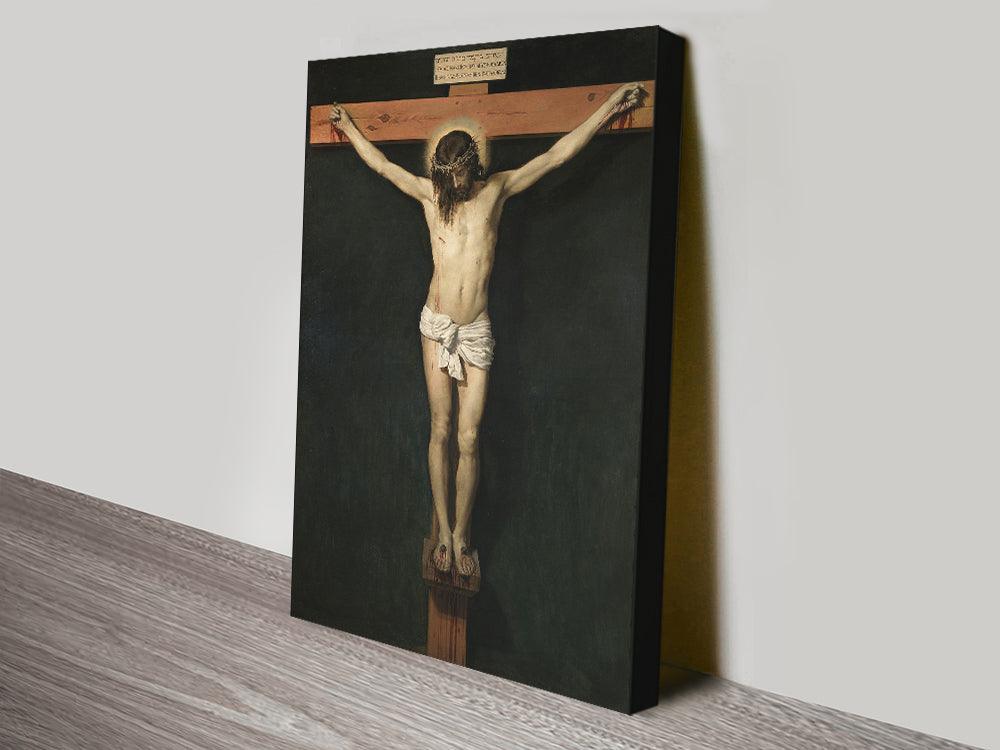
The body of Christ appears suspended against a dark, almost absolute background. There is no landscape, no crowd, no stormy sky, no Roman soldiers. There are no distractions. Everything has been deliberately removed. Velázquez strips the scene of any narrative element to focus on the essential: the body, the sacrifice, the presence.
This decision is radical. In contrast to other Baroque representations of the Crucifixion laden with theatrical emotion, blood, tormented gestures, and dynamic composition, Velázquez opts for an almost unsettling serenity. Christ does not scream. He does not writhe. There is no explicit violence beyond the necessary wounds. His body hangs with restrained dignity, with a beauty that borders on the sculptural.
The compositional balance is absolute. The cross forms a perfect vertical axis, while the outstretched arms create a horizontal that stabilizes the image. The body, slightly leaning forward, introduces a minimal tension, enough to recall the gravity of the moment without breaking the harmony.
One of the most striking elements is the lighting. The light does not come from a visible source; it seems to emerge from the figure itself. Christ’s skin, pale and delicately modeled, captures the light with extraordinary softness. Every muscle is defined without rigidity, every shadow is precise but never harsh. Velázquez achieves what few artists have managed: to paint flesh that breathes even in death.
The contrast with the dark background intensifies this presence. It is as if Christ were emerging from nothingness, suspended in a space outside time. This darkness is not merely a visual device; it is a pictorial silence, an emptiness that amplifies the spiritual dimension of the scene.
The anatomy is another of the work’s most fascinating aspects. Velázquez does not over-idealize nor does he fall into melodrama. The body is real, human, tangible. One senses the weight, the tension in the arms, the natural fall of the torso. Yet there is an elegance in the proportions that elevates the figure toward the divine. It is a perfect balance between humanity and transcendence.
The loincloth, white and delicately worked, introduces a chromatic and symbolic contrast. Its texture seems almost palpable, with folds that capture the light masterfully. This seemingly secondary detail plays a key role: it anchors the figure in the earthly realm while the rest of the body seems to ascend toward the spiritual.
Christ’s head falls gently forward. There is no exaggerated expression of pain, but rather a quiet surrender. The crown of thorns is present, but it does not dominate the scene. The blood is minimal, almost symbolic. Velázquez avoids any excess, and in that restraint he finds a much deeper emotional force.
This approach reflects a very particular sensibility within the context of 17th-century Spain, deeply marked by Counter-Reformation spirituality. The Church sought images that encouraged contemplation, introspection, and a direct connection with the divine. Velázquez responds to this need not with grandiloquence, but with visual silence.
The upper placard, with the inscription in several languages—Hebrew, Greek, and Latin—introduces a historical and theological element. It is not a mere decorative detail; it is a statement of the universality of the message. However, even this element is handled with restraint, without stealing attention from the central figure.
What is truly extraordinary about this work is how it transforms pain into beauty without trivializing it. Velázquez does not hide suffering, but neither does he exploit it. Instead, he turns it into a contemplative experience. The viewer does not react with horror, but with quiet reflection.
This Christ is not just a religious figure; he is a presence. His isolation in the pictorial space turns him into something almost metaphysical. He does not belong to any specific historical moment, but to a suspended time. He is eternal.
In technical terms, the painting is a display of mastery. The brushwork is controlled, precise, but never rigid. There is an economy of means that reveals the artist’s complete confidence. Velázquez does not need to demonstrate his skill; he exercises it with an almost invisible naturalness.
One of the least discussed, but deeply significant, aspects is the absence of nails in the hands visible from certain angles, due to the pictorial treatment. This creates an interesting ambiguity: violence is present, but not emphasized. The viewer’s mind completes what the eye barely perceives.
This work also engages in dialogue with the Spanish sculptural tradition, especially with the polychrome carvings of the crucified Christ. However, Velázquez translates that three-dimensional language into painting with incomparable subtlety, eliminating any theatricality and focusing on the essence.
For the modern viewer, accustomed to constant stimuli and information-saturated images, this painting offers something radically different: a pause. There is nothing to “decode” in narrative terms. Everything is there, but it requires time. It requires presence.
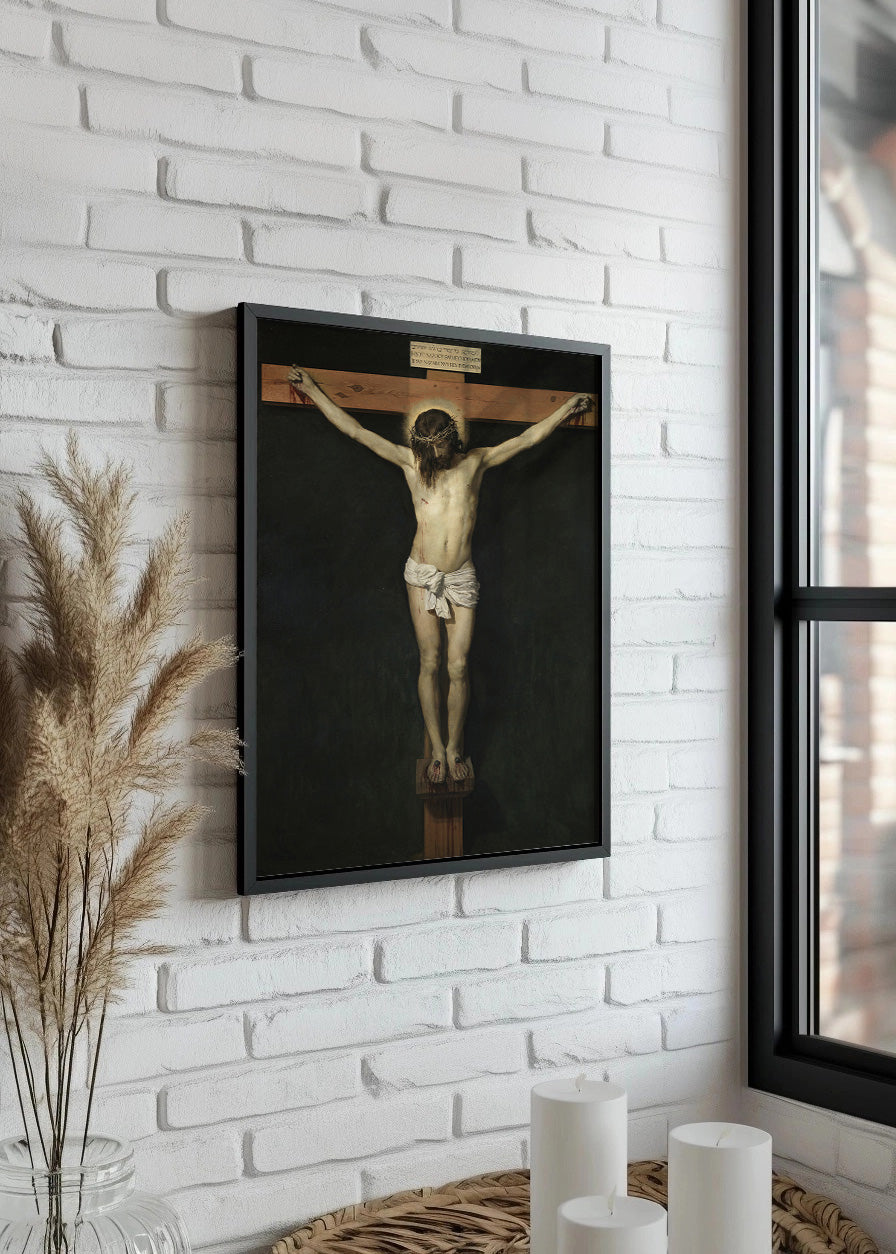
Hanging a reproduction of this work in a home space is not simply decorating a wall; it is introducing a point of gravity. An image that transforms the atmosphere, invites silence, and creates an atmosphere of reflection.
Because Velázquez’s “Christ on the Cross” is not a painting to glance at and move on. It is a work that stops you. That challenges you. That lingers.
And perhaps that is where its greatest power lies: in a world full of visual noise, this image still speaks to us in a low voice.
KUADROS ©, a famous painting on your wall.
Hand-made oil painting reproductions, with the quality of professional artists and the distinctive seal of KUADROS ©.
Art reproduction service with satisfaction guaranteed. If you are not completely satisfied with the replica of your painting, we will refund 100% of your money.