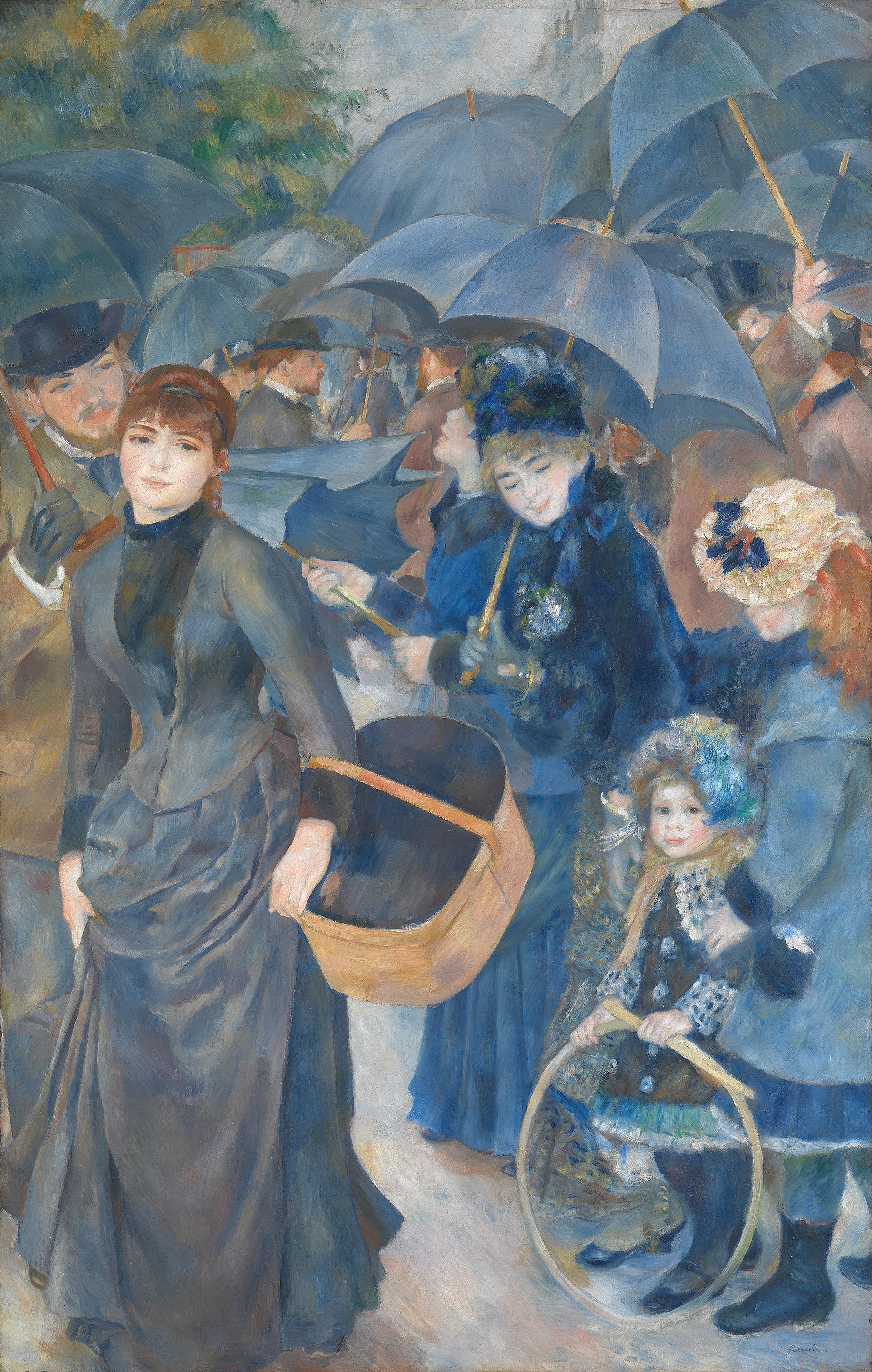
Pierre-Auguste Renoir, a name synonymous with joy, sensuality, and above all, light. His delicate and vibrant brushwork captured the fleeting beauty of nineteenth-century Parisian life, immortalizing scenes of dances, social gatherings, and female portraits that radiate unmatched warmth. Renoir was not only a painter; he was a chronicler of beauty in its purest form, a master of color and light who knew how to capture the fleeting nature of the moment with a mastery that established him as one of the pillars of Impressionism.
Pierre-Auguste Renoir was born in Limoges, France, in 1841, into a humble family. From an early age, he showed an innate talent for drawing and painting. At the age of 13, he began working as an apprentice in a porcelain workshop, where he learned decorating techniques and how to handle color. This early experience was fundamental to his artistic development, as it provided him with a solid foundation in drawing and painting, as well as a deep knowledge of materials and painting techniques. At 21, he entered the School of Fine Arts in Paris, where he studied with Charles Gleyre and met other young artists who, like him, sought to break away from academic conventions and explore new forms of expression. Among them were Claude Monet, Alfred Sisley, and Frédéric Bazille, with whom he would form the core of the Impressionist movement.
Renoir's encounter with Impressionism marked a turning point in his artistic career. From that moment on, he abandoned academic conventions and joined the search for a new way of representing reality, based on direct observation of nature and the capture of sensory impressions. Together with Monet and other artists, Renoir began painting outdoors, seeking to capture the light and color of the moment. He experimented with new painting techniques, such as loose and fragmented brushwork, and the use of pure, luminous colors. This period of experimentation and creative exploration was fundamental in shaping Renoir's personal style, characterized by its joy, sensuality, and his particular vision of beauty.
Renoir's work is characterized by his particular interpretation of the principles of Impressionism. While he shares with other artists of the movement a concern for light and color, loose brushwork, and the depiction of modern life, Renoir developed his own style, marked by sensuality, joy, and his particular vision of feminine beauty. Unlike Monet, who focused on representing the effects of light on the landscape, Renoir was more interested in the human figure, especially the female figure, which he portrayed with unmatched sensuality and delicacy. His brushwork, softer and more fluid than that of other Impressionists, helps create an atmosphere of intimacy and warmth in his paintings. In addition, Renoir used a richer and more varied color palette than other Impressionists, combining warm and cool colors to create light and shadow effects.
Light and color are fundamental elements in Renoir's work. Like other Impressionists, Renoir was obsessed with the representation of natural light and its effects on forms and colors. However, unlike Monet, who focused on capturing atmospheric effects and changes in light throughout the day, Renoir used light and color to create an atmosphere of warmth and sensuality in his paintings. His female figures, bathed in golden light and surrounded by warm colors, radiate unmatched beauty and vitality. The use of contrasts between light and shadow, as well as the combination of complementary colors, helps create a sense of depth and volume in his paintings. A notable example is "Dance at Le Moulin de la Galette," where the light filtering through the trees creates a flickering, moving effect that reflects the joyful and festive atmosphere of the place. Light in Renoir's work is not only a technical element, but also an expressive one, helping convey the artist's emotions and feelings.
Female beauty was Renoir's great obsession throughout his artistic career. His female portraits are an ode to the sensuality, delicacy, and vitality of women. Renoir did not limit himself to representing the physical appearance of his models, but sought to capture their personality, their mood, and their inner beauty. His portraits are an expression of his admiration and respect for women, whom he considered the personification of beauty and harmony. Through his soft and delicate brushwork, Renoir managed to convey the warmth of the skin, the softness of the hair, and the luminosity of his models' eyes. His female portraits are a testament to his ability to capture the essence of female beauty and transform it into art.

The Luncheon of the Boating Party - Renoir
Throughout his career, Renoir worked with numerous models, who posed for him and contributed to the creation of his most emblematic works. Some of these models, such as Aline Charigot, who would become his wife, and Suzanne Valadon, who would later become a renowned painter, played a fundamental role in his artistic journey. Aline Charigot, besides being his model, was his companion and confidante, and gave him the support and stability he needed to develop his work. Suzanne Valadon, for her part, brought her freshness and spontaneity to Renoir's portraits, and inspired him to explore new ways of representing the female figure. Renoir's relationship with his models was one of collaboration and mutual respect, in which both benefited from each other. An example of the importance of models in his work is the painting "The Luncheon of the Boating Party," in which several friends and collaborators of Renoir are portrayed, including Aline Charigot, who appears in the foreground with a small dog.

Moulin de la Galette: An Icon of Impressionism
"Dance at the Moulin de la Galette" is one of Renoir's most iconic works and an icon of Impressionism. In this painting, Renoir depicts a scene from everyday life in the famous Parisian cabaret of the Moulin de la Galette, located in Montmartre. The scene is full of movement, color, and joy. Renoir captures the festive and bustling atmosphere of the place, with its flickering lights, lively dances, and varied characters. Renoir's loose and fragmented brushstroke helps create a sense of dynamism and spontaneity in the painting. The vibrant and luminous colors, as well as the use of contrasts between light and shadow, help create an atmosphere of warmth and joy. "Dance at the Moulin de la Galette" is a celebration of life, beauty, and pleasure, and a demonstration of Renoir's talent for capturing the essence of the era.
Renoir had a special ability to capture movement and joy in his paintings. His scenes of dances and social gatherings are full of life, color, and dynamism. Through his loose and fragmented brushwork, Renoir was able to convey the sense of movement and spontaneity of the figures. His figures, often depicted in natural and carefree poses, radiate a contagious joy and vitality. The use of vibrant and luminous colors, as well as the combination of light and shadow, help create an atmosphere of warmth and joy in his paintings. Renoir did not limit himself to representing the physical appearance of his figures, but sought to capture their mood, their personality, and their relationship with the surroundings. His paintings are a reflection of his optimism and his love of life.

La Grenouillère - Renoir
Renoir, deeply connected with nature, elevated it to a central position in his work. He did not limit himself to depicting outdoor scenes, but sought to capture the very essence of light and atmosphere. His landscapes, such as "La Grenouillère" (1869), display a palette dominated by vibrant greens, subtle blues, and touches of yellow that evoke the luminosity of the water and vegetation. The choice of colors was not arbitrary; Renoir meticulously studied the effects of light on each element of the landscape, adapting his palette to reflect the tonal variations and subtle gradations he observed. An example of his attention to detail is his use of complementary colors to create contrast and depth, a technique he learned by observing the work of artists such as Eugène Delacroix. For Renoir, nature was not just a backdrop, but an inexhaustible source of inspiration and a subject worthy of the most meticulous representation. Nature, then, dictated the palette, but also the spirit of his works, imbuing them with joy and a particular sensuality.

Dance at the Moulin de la Galette - Renoir
Renoir used several innovative techniques to capture atmosphere and light in his landscapes. One of them was fragmented brushwork, characteristic of Impressionism, which consisted of applying small strokes of pure color juxtaposed rather than mixed on the palette. This allowed the viewer's eye to mix the colors optically, creating a sense of vibration and luminosity. Another important technique was the use of glazes, thin layers of translucent paint applied over other layers to modify the tone and intensity of the color. This allowed him to create effects of depth and atmosphere, as well as soften contours and create a sense of unreality. In "Dance at the Moulin de la Galette" (1876), the masterful use of light filtering through the leaves of the trees can be seen, creating a dappled and vibrant effect. The decision to use these techniques was not simply aesthetic, but a search for the most faithful possible representation of visual perception. The greatest risk was that the painting would look unfinished, but Renoir overcame this with precision and delicacy. These techniques, added to his exceptional sensitivity for capturing the nuances of light, allowed him to create landscapes that evoke a sense of immediacy and freshness. Another example of his mastery of light is his work "Luncheon of the Boating Party" (1881), where the sunlight plays with the objects and the people, creating an atmosphere of vitality.

Bathers - Renoir
Although Renoir established himself as a key figure of Impressionism, his artistic career was not limited to this movement. Starting in the 1880s, he began to feel growing dissatisfaction with the dissolution of form and the lack of structure that often characterized Impressionist works. This period, often referred to as his "Ingres-like crisis," led him to experiment with a more linear and defined style, inspired by classical masters. Renoir sought to reconcile the capture of light and atmosphere with greater solidity and volume in his figures. An example of this evolution is his series of "Bathers," where the female figures acquire a monumentality and a physical presence that contrast with the evanescence of his earlier works. The decision to explore new expressive paths was not easy, as it meant moving away from the fundamental principles of Impressionism. However, Renoir was convinced that it was necessary in order to achieve greater artistic fulfillment. The main challenge was not to lose the freshness and spontaneity that characterized his work, while at the same time maintaining greater precision in the representation of form. The painting "The Large Bathers" (1884-1887) clearly represents this stage, with more solid figures and more precise drawing.
The final stage of Renoir’s career was marked by a growing influence from classical art, especially the painting of artists such as Peter Paul Rubens and Jean-Auguste-Dominique Ingres. Renoir admired the sensuality and exuberance of Rubens’ forms, as well as the precision and elegance of Ingres’ drawing. These influences are evident in his late works through a warmer, richer palette, greater attention to detail, and an idealization of the female figure. The “Bathers” of this period, for example, evoke classical and mythological compositions, but with a touch of modern sensuality. The path was not without criticism, as some considered that Renoir was abandoning the innovative spirit of Impressionism. However, he defended his right to explore new expressive avenues and to integrate different influences into his work. For Renoir, art was not a dogma, but a process of constant searching and experimentation. His drive for perfection led him to explore other techniques and styles. “The Bathers” (c. 1918-1919), one of his last works, is a clear example of this classical influence and the maturity of his style. To obtain more information about the influence of other great masters, you can visit this article about Turner.
Renoir’s legacy extends far beyond his era, influencing generations of later artists. His innovative approach to light, color, and form, as well as his ability to capture the fleeting beauty of everyday life, made him a key figure in the transition toward modern art. Artists such as Pierre Bonnard and Édouard Vuillard, members of the Nabis group, recognized Renoir’s influence in their own search for a more subjective and decorative representation of reality. His optimism, joy of life, and ability to find beauty in the everyday are qualities that resonate with many contemporary artists. The decision of many young artists to follow in Renoir’s footsteps lies in his ability to convey emotions and sensations through painting. One of the risks faced by artists influenced by Renoir is falling into superficial imitation, but the most talented manage to develop their own style that incorporates the essential elements of his work. An example of Renoir’s influence can be seen in the work of some 20th-century painters who continued exploring the theme of the female nude with a similar sensibility.
Renoir, a master of Impressionism, was characterized by his distinctive technique, marked by loose brushstrokes and a vibrant color palette. Unlike academic artists who strove for an exact representation of reality, Renoir sought to capture the fleeting impression of light and color. He used soft brushes to apply paint in small touches, creating a sense of movement and vibration. His palette was made up of pure, bright colors, which he mixed directly on the canvas to achieve effects of luminosity and transparency. Renoir experimented with different techniques throughout his career, adapting his style to the subjects he explored. For example, in his portraits, he used more precise brushstrokes to capture the individual features of his models, while in his landscapes, he allowed himself greater freedom and spontaneity.
In "Dance at the Moulin de la Galette" (1876), Renoir's mastery of light and color can be seen in the creation of a festive and joyful atmosphere. The loose, vibrant brushstrokes capture the movement of the dancers and the brightness of the setting. The work conveys a sense of spontaneity and vitality, distinctive characteristics of the Impressionist style.
Renoir's life was intertwined with that of other Impressionist artists, such as Claude Monet, Edgar Degas, and Camille Pissarro. Together, they challenged the conventions of academic art and revolutionized the way the world was represented. Renoir shared studios, ideas, and exhibitions with his fellow Impressionists, but he also maintained an artistic individuality that set him apart. Unlike Monet, who focused mainly on landscape, Renoir was interested in the human figure, especially women and children. His style, although influenced by Impressionism, was characterized by greater warmth and sensuality. Relations among the Impressionists were not always easy; there were artistic disagreements and personal rivalries, but also a deep mutual respect and a camaraderie that enabled them to overcome challenges and leave a lasting legacy in art history.
The relationship between Renoir and Monet was particularly close. They worked together outdoors, painting the same landscapes and sharing techniques and perspectives. However, their styles diverged over time, reflecting their different interests and artistic sensibilities. It is said that Renoir admired Monet's boldness, while Monet appreciated Renoir's warmth and humanity.
Renoir's personal life was marked by ups and downs that influenced his work. From his humble beginnings as an apprentice porcelain painter to his recognition as one of the most important artists of his time, Renoir faced financial challenges, health problems, and artistic controversies. His marriage to Aline Charigot, a dressmaker, provided him with emotional and family stability, and his children became his favorite models. In his later years, Renoir suffered from rheumatoid arthritis, which made his work difficult, but it did not stop him. Despite the pain and physical limitations, he continued painting until his death, using brushes tied to his deformed hands. His perseverance and passion for art are a testament to his indomitable spirit.
Renoir died in 1919, leaving behind an artistic legacy that continues to inspire generations of artists and art lovers.
KUADROS ©, a famous painting on your wall. Hand-made oil painting reproductions, with the quality of professional artists and the distinctive seal of KUADROS ©. paintings reproduction service with satisfaction guarantee. If you are not completely satisfied with your painting replica, we will refund 100% of your money.