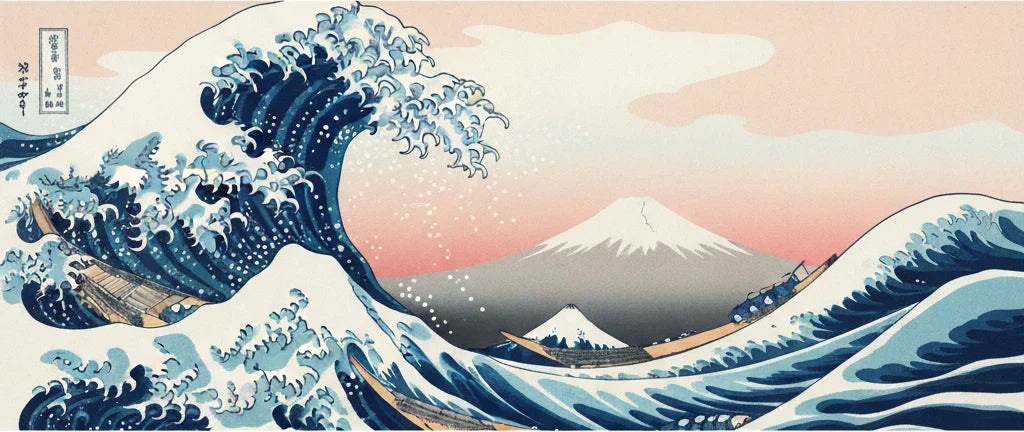
In the vast tapestry of universal art, few works resonate with the seismic force and timeless elegance of "The Great Wave off Kanagawa." This iconic woodblock print by Japanese master Katsushika Hokusai is not just an image; it is a portal to a world of profound natural beauty, a meditation on human fragility, and a testament to artistic genius that transcends cultures and eras. Its influence extends far beyond museums, permeating popular culture and redefining our perception of nature and art.
Through this masterpiece, Hokusai captured the very essence of elemental force, immortalizing a moment of sublime power that continues to captivate viewers around the world.
Born in 1760 in the vibrant and bustling district of Asakusa, in Edo (present-day Tokyo), Katsushika Hokusai showed from an early age an innate and voracious curiosity about the world around him, a quality he immediately channeled into drawing. Unlike other children of his time, Hokusai seemed to find particular pleasure in observing and reproducing the most minute details of nature and everyday life. It is said that his first formal foray into art occurred when, դեռ still a child, he was adopted by his uncle, Nakajima Ise, who worked as a mirror craftsman for the shogunate. This opportunity gave him access to tools and materials, and to a work discipline that would undoubtedly shape his future. The lack of detailed records about his early childhood has given rise to an aura of mystery, but what is undeniable is the deep connection Hokusai established with imagery and visual representation from his earliest years. This childhood fascination was not a mere hobby; it was the seed of a vocation that would define him, a first whisper of the artistic dragon sleeping within him, ready to unleash its creative power in the decades to come. His ability to capture the essence of an object or a scene with precise and expressive strokes, even in his youth, foreshadowed the master he would become.
Hokusai’s training was intrinsically tied to the flourishing woodblock printing industry in the Edo period. At the age of fourteen, he was apprenticed to an engraver named Katsukawa Shunsho, a renowned master of ukiyo-e, the style of “pictures of the floating world” that dominated the popular art scene. During his apprenticeship, Hokusai not only acquired the fundamental technical skills for carving and printing woodblocks, but also absorbed the aesthetics and characteristic themes of ukiyo-e: scenes of everyday life, kabuki actors, beauties, landscapes, and historical tales. However, Hokusai soon showed an ambition that went beyond workshop conventions. His restless nature and insatiable desire to learn led him to explore various styles and techniques, often coming into conflict with his masters and patrons. It is said that he was expelled from Shunsho’s workshop on two occasions, once for using materials from his rival. This rebelliousness, far from being an impediment, became a driving force in his development. Hokusai understood that woodblock printing, despite being a mass-production technique, held immense artistic potential. He learned not only to execute the intricate cuts, but also to breathe life and emotion into each line, laying the foundations for his future mastery of this medium, exploring the versatility of this art found in the streets and in the hands of artisans who democratized the image. His journey through the guilds and workshops of Edo was a deep immersion in the heart of Japanese artistic production, forging a resilient character and technical mastery that would be revealed in his masterpiece.
Water, in its countless manifestations, was a recurring and obsessive muse for Hokusai throughout his prolific career. He portrayed it not as a simple backdrop or passive element, but as a dynamic protagonist, full of life, power, and subtlety. From the unleashed fury of waves crashing against the rocks to the serene caress of the breeze over the surface of a pond, Hokusai possessed an extraordinary ability to capture the changing, multifaceted essence of the aquatic element. In his works, water is never static; it is always in motion, whether in the foam dissolving away, in the invisible currents flowing, or in the drops dancing in the air. This dynamic representation was achieved through keen observation and masterful technique. Hokusai studied the behavior of water under different conditions: its texture, its refraction of light, its implied sound, and its destructive or life-giving force. The mastery with which he rendered the tension and foam of a wave about to break in “The Great Wave off Kanagawa” is a sublime example of this obsession, but his interest also embraced the calm waters of Japanese garden ponds, dew drops on a leaf, or the steam rising from a cup of tea. This constant exploration of water reveals a profound understanding of nature and its power, as well as an ability to translate fluidity and impermanence into such a fixed medium as printmaking. His ability to imbue a natural element with such character and expressiveness sets him apart as an exceptional observer and an artist of uncommon depth.
If water represented strength and mutability, Mount Fuji embodied for Hokusai stability, majesty, and the spiritual connection between earth and sky. This iconic mountain, revered in Japanese culture for its symmetrical beauty and imposing presence, became a recurring theme and an inexhaustible source of inspiration for the artist, culminating in his celebrated series “Thirty-six Views of Mount Fuji.” Far from being a simple collection of landscapes, this series is a fascinating study of the mountain’s multiple facets, seen from different angles, in various seasons, under different weather conditions, and in the company of human activity. Hokusai did not limit himself to reproducing its form; the mountain is transformed into a symbol, a visual and emotional anchor in a world in constant change. In some views, Fuji appears imposing and dominant; in others, it recedes, hidden by clouds or mist, suggesting its mystery and inaccessibility. Hokusai depicted it surrounded by scenes of everyday life: fishermen in their boats, peasants working in the fields, travelers on the road. This juxtaposition of the eternal natural element with the fleeting nature of human existence underscores the artist’s philosophical perspective on time and eternity. The series “Thirty-six Views of Mount Fuji” is a testament to Hokusai’s dedication to a single subject, exploring every compositional and emotional possibility it offered, demonstrating that an apparently simple motif could be a universe of artistic and spiritual meaning, an inexhaustible canvas for his contemplative genius.
At the heart of Hokusai’s masterpiece, “The Great Wave off Kanagawa,” lies a composition of a boldness that broke with convention and redefined Japanese printmaking. The image immediately captivates us with the striking curve of the giant wave, rising menacingly, about to crash down on the fragile boats sailing beneath it. What distinguishes this work is not only its dramatic subject, but the mastery with which Hokusai uses visual elements to create dynamic tension. The wave’s curved, powerful line not only dominates the space, but also contrasts with the more straight and stable lines of Mount Fuji appearing in the distance, a contrast that heightens the sense of imminent catastrophe. The use of emptiness, of negative space, is equally crucial. Hokusai does not fear leaving areas undrawn, allowing the white of the paper to breathe and highlight the main forms. This deliberate use of emptiness, particularly in the sky and between the crests of the waves, not only keeps the composition from feeling cluttered, but also intensifies the sense of scale and power of the main wave. The slightly elevated perspective places us as privileged observers of this natural drama, creating an immersive experience. The overall composition is a study in dynamic balance, where opposing forces—stability and chaos, life and danger—intertwine masterfully to create an unforgettable image that captures the essence of human fragility in the face of nature’s immensity.
One of the most significant innovations in "The Great Wave off Kanagawa" is the bold and dominant use of a vibrant blue color, a shade that transformed the traditional ukiyo-e palette. This color was not a common organic pigment in Japan at the time, but rather the so-called "Prussian blue" (berlinerblau), a synthetic pigment discovered in Europe and brought to Japan through trade with the Dutch. The introduction of Prussian blue was a milestone for Japanese artists, as it offered an intensity and durability that surpassed many of the natural pigments available. Hokusai was one of the first and boldest to adopt this new color, recognizing its potential to create dramatic and realistic effects, especially in the depiction of the sea. In "The Great Wave," Prussian blue is not just a tint; it is the very essence of the ocean, bringing a depth and vibrancy that were previously difficult to achieve. The richness and saturation of the blue used by Hokusai not only capture the majesty of the water, but also add a surprising modernity to the print, demonstrating the artist's openness to outside influences. This revolutionary pigment allowed Hokusai to achieve a more striking and emotionally resonant depiction of the sea, marking a turning point in his use of color and in the evolution of ukiyo-e toward greater visual expressiveness. The availability of this new color significantly expanded the artist's creative possibilities, allowing him to unleash his vision of the overwhelming power of the ocean in an unprecedented way.
Amid the monumental force of the wave, Hokusai introduces a crucial element that anchors the scene in human reality: the small and vulnerable fishing boats known as 'oshiokuri-bune'. These canoes, with their occupants crouched and clutching the oars, represent man's desperate struggle against the uncontrollable forces of nature. The choice of these specific boats is no coincidence; they were used to transport fresh fish to the markets of Edo and were exposed to the dangers of the open sea. Hokusai places them at the base of the wave, in a position of maximum vulnerability, emphasizing the overwhelming disparity of power between human scale and the vastness of the ocean. The figures inside the boats are tiny, barely perceptible against the immensity of the water, underscoring the fragility and precariousness of human life in the face of the fury of a primordial element. Despite their small size, the rowers show an implicit determination, an attempt to withstand the imminent onslaught. This depiction of human struggle is not one of defeat, but of resistance, an act of courage in the face of a force that surpasses them. "The Great Wave" thus becomes a profound meditation on the human condition, our constant coexistence with dangers that transcend our control and our ability to confront them with resilience. The image captures the tension between life and death, the insignificance of the individual and their tenacious spirit of survival, an echo that resonates strongly to this day.

The 'War Drawings' and the search for visual truth
Throughout his long life, Hokusai demonstrated an unrelenting pursuit of the faithful and honest representation of reality, an ambition that was manifested particularly intensely in his early works and in certain periods of his career. The so-called “War Drawings” (Gassen-zu), although not a formally cataloged series, represent a notable effort to document battle and its horrors with stark realism. It is said that Hokusai, fascinated by the dynamics of conflict, strove to capture the action, movement, and brutality of war as it happened, without romantic idealization. This approach to art as a means of recording the truth, even when that truth was unpleasant or violent, is a defining characteristic of his genius. His interest in detailed observation extended beyond the battlefields; Hokusai dedicated himself to studying human anatomy, animals, plants, and natural phenomena with almost scientific meticulousness. This obsession with visual precision laid the groundwork for his ability to capture the essence of what he saw, endowing his works with exceptional vitality and credibility. Far from being merely a decorative artist, Hokusai used his art as a tool for inquiry, a method for understanding the world in all its complexity. This dedication to visual truth, even in his most dramatic representations, is what gives his work lasting resonance, showing that art can be both an expression of beauty and a mirror of the harshest reality.
Far from being confined to Edo, Hokusai undertook a series of extensive travels throughout the Japanese archipelago, a journey that not only enriched his life experience but also fundamentally nourished his artistic output. These trips, often made at a time when people’s movement was more restricted, allowed him to observe firsthand the geographical, cultural, and social diversity of his country. The celebrated series “Thirty-six Views of Mount Fuji,” although centered on a single motif, is only one facet of his vast pictorial undertaking. On his journeys, Hokusai documented life on the coasts, in the mountains, in the cities, and in rural villages, creating what can be considered a pictorial atlas of the soul of Japan. Each print, each sketch, becomes a window into a specific region, capturing its distinctive landscapes, local customs, people, and industries. This direct immersion in the reality of Japan provided him with an unmatched repertoire of subjects and details, infusing his art with an authenticity and depth that resonated profoundly with the Japanese public. The travels not only expanded his vision of the world, but also strengthened his connection to his own land and its people. The energy and vitality that emanate from his representations of landscapes and everyday scenes are a direct reflection of his lived experience, of his ability to absorb and translate the essence of the places he visited into images that transcend mere illustration to become poetic and moving interpretations of Japanese identity.
Katsushika Hokusai, in his insatiable curiosity and drive for innovation, demonstrated an uncommon openness for his time toward Western artistic trends. Although access to artworks European works in Edo-period Japan was limited, Hokusai's ingenuity allowed him to absorb and reinterpret key concepts. Dutch prints, which arrived through the limited trade contacts in Dejima, offered glimpses of shading techniques and the depiction of linear perspective, elements that had previously been foreign to ukiyo-e. Hokusai did not limit himself to copying; he studied how European artists achieved a sense of depth and volume. A fundamental aspect was the introduction of scientific perspective, with vanishing points and converging lines, which contrasted with the flatter, more symbolic traditional representation in Japan. This is evident in works where buildings or landscapes acquire a three-dimensional dimension that defies the conventions of his time, endowing his compositions with an unprecedented sense of space and realism. This dialogue, although one-sided in many respects due to isolation restrictions, enormously enriched his visual language, allowing him to fuse Japanese aesthetic sensitivity with the emerging awareness of Western spatial representation.
The key to Hokusai's success in this fusion lay in his ability to integrate these influences without losing the essence of Japanese art. It was not a simple adoption, but an intelligent adaptation. For example, when using an incipient form of shading to give volume to figures or rocks, he did not resort to the dark, dense chiaroscuro of the European Baroque, but rather to subtle gradations that preserved the lightness and elegance characteristic of ukiyo-e. His interest in perspective translated into more dynamic compositions, where the viewer felt immersed in the scene. This intellectual and artistic openness was a key driver of his evolution and the enduring significance of his work, laying the foundations for future generations of Japanese artists and marking a milestone in the history of global art. The study of works like his reveals how cultural interconnectedness drives artistic innovation.

Three-dimensionality in ukiyo-e: breaking the mold
Traditionally, ukiyo-e, the "floating world" art, was characterized by a two-dimensional aesthetic, prioritizing line, flat color, and ornamental composition over the illusion of realistic depth. However, Hokusai, driven by his study of Western techniques and his innate visual genius, began to experiment boldly with three-dimensionality. In his prints, one can observe a growing sophistication in the representation of space, achieved through the application of subtle tonal gradations, known as bokashi (blending), which gave volume to elements such as waves, mountains, and even human figures. This use of bokashi not only added depth, but also created an atmosphere and a dynamism that had previously been less prominent.
In addition to bokashi , Hokusai skillfully employed linear perspective and the overlapping of planes to build scenes with a palpable sense of space. Instead of placing all the elements on the same imaginary plane, he organized his compositions so that the closer objects partially obscured the more distant ones, a fundamental technique in Western art for suggesting depth. This skill is evident in his depictions of urban and natural landscapes, where architecture recedes or paths wind toward the horizon, inviting the eye to follow a virtual three-dimensional route. A clear example can be seen in his series "Thirty-Six Views of Mount Fuji," where the different elevations and distances between the elements create notable stage-like depth. Hokusai's mastery in introducing three-dimensionality into ukiyo-e was not only a technical exercise, but a profound reinvention of the genre, opening up new expressive possibilities and setting a precedent for the representation of space in Japanese art.

Japonism: the explosion of Japanese aesthetics in Europe and America
In the mid-19th century, Japan's forced opening to international trade triggered an unprecedented cultural phenomenon: Japonism. This fascination with Japanese art and culture captivated artists, designers, and collectors in Europe and America, radically transforming the Western art scene. Japanese prints, including Hokusai's works, arrived in large quantities, often as packing material for porcelain and other goods. Their distinctive aesthetics, characterized by asymmetry, the bold use of flat colors, dynamic lines, and the absence of traditional linear perspective, offered a radical alternative to European academic conventions, dominated by realism and classical idealism. Western artists found in these prints a source of inspiration to break free from rigid established norms, seeking new forms of visual expression.
Japonism was not merely a passing trend; it became a transformative force that influenced various artistic movements. The Impressionists and Post-Impressionists, in particular, absorbed the lessons of ukiyo-e about composition, brushwork, and the handling of color. The way Hokusai and other artists of the genre depicted nature, everyday life, and the fleeting nature of moments inspired these painters to experiment with similar themes and to adopt bolder, more spontaneous compositional approaches. The off-center arrangement of elements, unusual framing, and emphasis on the canvas surface, all hallmarks of ukiyo-e, echoed in the works of artists such as Monet, Degas, and Van Gogh. The impact of Japonism on Western art was so profound that it marked the beginning of an era of more fluid cultural exchange, laying the foundations for a more global and diverse appreciation of artistic expressions. Today, the study of Japonism allows us to better understand how transcultural influences continue to shape the artistic landscape, a phenomenon that can be seen even in the fusion of traditional and digital techniques in contemporary art, as we explore in articles about digital art.

The impact on Impressionists and Post-Impressionists: brushstrokes of inspiration
The influence of Hokusai and ukiyo-e on the Impressionist and Post-Impressionist movements is undeniable and manifests in multiple ways. Artists such as Claude Monet, Edgar Degas, Mary Cassatt, and Vincent van Gogh were drawn to the compositional freedom and chromatic intensity of Japanese prints. Monet, for example, adopted the way of depicting water and nature with a looser, more fragmented brushstroke, seeking to capture the fleeting impression of the moment, a sensitivity that resonated with the philosophy of ukiyo-e. His water lilies and seascapes show an appreciation for rhythmic patterns and ephemeral beauty that Hokusai had already explored.
Degas, for his part, drew inspiration from the unusual framing and bold perspectives of ukiyo-e for his depictions of dancers and scenes from Parisian life. The way Degas cropped figures at the edges of the canvas and used high or low viewpoints recalls Hokusai's dynamic compositions. Mary Cassatt, who was also deeply influenced by Japonism, found in the intimate scenes of domestic life and mother-child relationships depicted in ukiyo-e an echo of her own thematic interest. Van Gogh, perhaps one of the most fervent admirers, even directly copied Japanese prints, such as Hiroshige's "Bridge in the Rain," to study their techniques. His own work, with its vibrant colors, flowing lines, and sense of vital energy, shows a clear debt to Japanese aesthetics. Hokusai's work, and in particular his "Great Wave," acted as a catalyst, freeing Western artists from academic constraints and paving the way for a more personal and expressive vision of art.
Ukiyo-e, in its essence, is not the product of a single artist, but the result of an intricate artisanal collaboration. The creation of a Hokusai print involved the intervention of three key figures: the draughtsman (the artist), the carver, and the printer. The artist, like Hokusai, conceived the original design and put it on paper. Subsequently, a specialized carver meticulously transferred the drawing to a woodblock, usually made of cherry wood, carving the lines with astonishing precision. Each color required a different woodblock, carved with great care to fit perfectly into the final print. Finally, the printer applied the pigments to the blocks and pressed the paper onto them, creating the printed image. This joint effort, in which each member contributed their mastery, was fundamental to the quality and visual richness of the works, allowing the mass reproduction of complex and beautiful images.
Hokusai’s mastery lay not only in his designs, but also in his understanding of the capabilities and limitations of this collaborative technique. He knew how to draw so that the carver could interpret his lines and how to anticipate the interaction of colors to achieve striking visual effects. The close relationship between the artist and the artisans was crucial; smooth communication and mutual respect ensured that the artist’s original vision was faithfully translated into the final product. This collaborative dynamic gave rise to some of the most enduring images in art history, allowing works such as the "Great Wave off Kanagawa" to achieve unprecedented circulation. The essence of this artisanal technique, where mastery of the material and artistic vision come together, continues to resonate in the art world. Today, appreciation for manual reproduction techniques, such as Hand-made oil painting reproductions, reminds us of the importance of craftsmanship in the creation of lasting artworks.
Hokusai’s prints, far from being mere ephemeral consumer goods in 19th-century Japan, quickly became coveted collectibles. Their aesthetic appeal, the visual narrative they offered, and the technical skill displayed in their production made them highly desirable both in their country of origin and, later, abroad. The arrival of these prints in Europe and America, as mentioned above, sparked the phenomenon of Japonism and stimulated intense interest among collectors and artists. These works of art, affordable compared with canvas painting, allowed a wider audience to enjoy the beauty of Japanese art.
The reproducible nature of the print made its global spread easier, but it also made preservation and authentication crucial matters for serious collectors. The quality of the print, the condition of the paper, and the rarity of certain editions significantly influenced the value of the prints. Institutions such as museums and libraries, together with private collectors, began to amass vast collections of ukiyo-e, preserving an invaluable artistic legacy for posterity. This collecting practice not only safeguarded the works, but also made their study and dissemination possible, contributing to a global understanding of the richness of Japanese art. Today, the acquisition and study of antique prints remain a vital part of the art collecting world, a testament to the intrinsic value and cultural resonance of these masterpieces. Interest in art collecting in the 21st century, addressing both traditional and contemporary works, continues to demonstrate the enduring nature of this hobby, as discussed in articles about art collecting in 2026.

The Thirty-Six Views of Mount Fuji: a journey beyond Kanagawa
While the "Great Wave off Kanagawa" is undoubtedly Katsushika Hokusai's most iconic work and an icon of world art, reducing his vast legacy to a single image would be a serious mistake. His series "The Thirty-Six Views of Mount Fuji" (富嶽三十六景, Fugaku Sanjūrokkei) is a masterful compendium of his landscape genius and his deep connection with Mount Fuji, the sacred peak that dominates the Japanese landscape. This series, conceived as a set of 46 prints (including 10 later additions), presents Fuji from countless angles and contexts, each with its own perspective and narrative. Hokusai's genius lies in his ability to capture the majesty and omnipresence of Fuji, not only as a geographic element, but as a cultural and spiritual symbol.
In this series, Hokusai demonstrated astonishing artistic versatility. We see Fuji wrapped in snow in "Fuji in Clear Weather" (雪の不二), emerging through the mist in "Fuji from Sagami Province" (相州梅沢), or seen through a fishing net in "Fuji with Fishing Net" (漁師の不二). Each print is a study in composition, atmosphere, and emotion. Some views are grand and commanding, while others are intimate and subtle, often framed by scenes from the everyday lives of ordinary people, from fishermen to travelers. This duality between the mountain's sublime presence and the mundanity of human existence is one of the series' most captivating features. Through "The Thirty-Six Views of Mount Fuji," Hokusai not only documented Japan's geography, but also explored humanity's relationship with nature and the divine, cementing his reputation as an undisputed master of landscape. The series is a testament to how a recurring subject can be explored with infinite variety and depth, inviting the viewer on an inexhaustible visual journey.

Hokusai Manga - Katsushika Hokusai
Beyond his iconic views of Mount Fuji, Hokusai's catalog covers an astonishing diversity of subjects that offer a window into life in 19th-century Japan. His ability to observe and capture the everyday life of people from all social classes is one of the pillars of his legacy. In his depictions of urban scenes, we see the bustle of the markets, the vibrant architecture of cities like Edo (modern-day Tokyo), and the lively lives of their inhabitants. These prints document not only the appearance of the cities, but also daily activities, trades, and social interactions.
At the same time, Hokusai devoted much of his work to depicting rural life and Japan's natural landscapes. His prints of rural scenes often convey a sense of calm and serenity, showing farmers working in the fields, fishermen in their boats, or people traveling along country paths. These compositions often highlight the beauty of nature, vernacular architecture, and the harmony between human beings and their surroundings. Works such as those in the "One Hundred Views of Mount Fuji" series or those in his illustrated book "Hokusai Manga" reveal his insatiable curiosity about the world around him, capturing everything from serene landscapes to human anatomy with astonishing detail and vividness. This prolific output shows that Hokusai was much more than a painter of waves or mountains; he was a visual chronicler of his time, a keen observer of the human condition, and an artist capable of finding beauty and interest in the simplest aspects of life.