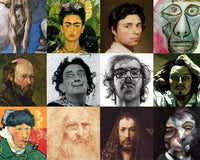
Frida Kahlo, one of the most iconic artists of the 20th century, transformed her personal experiences of pain and love into artworks vibrant and defiant works. Through her self-portraits, she revealed her inner world and her constant struggle against physical and emotional suffering. Her work is not only a window into her personal universe, but also a reflection of Mexican culture and traditions.
We explore Frida's life from her childhood in Coyoacán to her tumultuous relationship with Diego Rivera, discovering how each stage of her life influenced her unique and provocative art.
Frida Kahlo's Childhood: Roots in Coyoacán
Family Influences
Frida Kahlo was born in a blue house in Coyoacán, where her family's influences played a crucial role in her artistic development. Her father, Guillermo Kahlo, a German photographer, instilled in her an appreciation for visual art and photographic precision. This paternal influence was fundamental, as it taught her to observe the world with a detail-oriented eye, something that would later be reflected in her meticulous brushwork.
Her mother, Matilde Calderón, of indigenous ancestry, passed on to her the richness of Mexican culture and its traditions. This cultural mestizaje was a pillar of inspiration for Frida, who, through her paintings, celebrated Mexican identity with vivid colors and folkloric elements. To learn more about cultural influences in art, you can read about the legacy of pure emotions in abstract expressionism.
The Impact of Polio
At the age of six, Frida contracted polio, an illness that left her right leg thinner than the left. This event marked the beginning of a life full of physical challenges. Although the illness isolated her from other children, it also gave her valuable time to develop her interest in art and literature. Kahlo, with her tireless spirit, overcame the isolation by exploring new forms of expression and determination.
To strengthen her physical weakness, her father encouraged her to practice sports such as boxing. This push not only improved her stamina, but also shaped a fighting mindset that would become a recurring theme in her work. The impact of these early years is palpable in her art, which stands out for a visual strength that defies fragility.
The Accident That Changed Her Life
Physical Pain as a Constant Companion

On September 17, 1925, Frida suffered a streetcar accident that fractured her spine and pelvis, leaving her in a state of constant pain. This traumatic event not only changed the course of her life, but also cemented pain as a central theme in her work. During her long recovery, she began painting intensely, using art as a way out and an outlet for expression.

Her self-portraits, filled with symbolism and suffering, reflect her daily struggle and inner strength. Kahlo once said that she painted her reality, highlighting how physical pain became an emotional palette on her canvases. This unique approach set her apart and established her as an artist who transformed suffering into visual beauty.
First Steps in Art

Confined to a bed, Frida developed her artistic technique by observing and practicing. An adapted easel and a mirror above her bed were her initial tools, allowing her to explore self-portraiture while searching for her artistic identity. Kahlo not only found solace in art, but also a new reason to keep going, channeling her personal experiences into every brushstroke.
Her early evolution was influenced by artists from different movements, but she always maintained a personal and distinctive essence that resonated in her work. This can be compared to how some artistic movements, such as abstract art, use forms and emotions to communicate deep truths.
Love and Storm: Diego Rivera
A Relationship of Passion and Conflict

Frida's encounter with Diego Rivera was both a love story and a storm of emotions. Her marriage to Rivera, a renowned Mexican muralist, was a whirlwind of intense passions and conflicts. Despite the infidelities and separations, they shared a deep artistic and personal connection that significantly influenced their respective careers.
Rivera played a crucial role in Frida's evolution as an artist, supporting her and challenging her to explore new dimensions in her art. The complexity of their relationship became a recurring theme in her work, where she explored themes of love, betrayal, and reconciliation with brutal frankness.
The Artistic Impact of Her Marriage
Her marriage to Diego Rivera not only affected Frida's personal life, but also left a mark on her artistic style. Rivera encouraged her to use vibrant colors and to adopt a bolder approach to her subjects. This fusion of artistic influences can be seen in works where Kahlo incorporates elements of realism, symbolism, and surrealism, creating a unique visual language.
Through her marriage, Frida also gained access to artistic and political circles that fueled her social awareness and her desire to express Mexican identity in her art. For a complementary perspective on how personal relationships can influence art, consider reading about Andy Warhol's legacy and its impact on pop culture.
Self-Portrait as a Reflection of Identity
The Influence of Surrealism

Frida Kahlo is often associated with Surrealism, although she herself said she did not paint dreams but her own reality. However, Surrealist influences are evident in her self-portraits, where she combines fantastical elements with realistic details to explore her identity and emotions. Kahlo used Surrealism as a tool to unravel her inner world, creating compositions that challenged traditional perception.
This approach allowed Kahlo to address universal themes through the personal, an aspect that has made her a timeless figure in art. To explore how other artists have used Surrealism to express their worldview, you can read about Vermeer's intimate revolution and its impact on art.
Some Iconic Self-Portraits

Frida Kahlo's self-portraits are a testament to her ability to fuse personal pain with artistic expression. Works such as "The Two Fridas" and "Self-Portrait with Thorn Necklace" show her complex relationship with her identity and her body. "The Two Fridas," for example, represents her cultural duality and emotional duality, while "Self-Portrait with Thorn Necklace" symbolizes her suffering and resilience.
These self-portraits not only capture moments from her life, but also challenge the viewer to consider the intersection between the personal and the political, the individual and the universal. This ability to communicate a profound message through art is what has secured her place in the pantheon of great artists.
Frida and Politics: Between Art and Revolution
Commitment to the Mexican Revolution
Frida Kahlo was not only an iconic artist, but also a figure committed to politics of her time. Her adherence to the ideals of the Mexican Revolution was reflected both in her personal life and in her work. Kahlo joined the Mexican Communist Party in 1927, a decision that was evident in her relationship with Diego Rivera, another fervent communist. The importance of this political affiliation lay in using her art as a tool for social criticism and support for progressive movements.
The influence of her political ideals on her work is palpable. Her painting "Marxism Will Give Health to the Sick" is a powerful example of how she blended ideology with her artistic identity. However, this commitment was not without conflicts, as her relationship with communism became complicated by the confrontation with the political reality of her time and the tensions within the party itself.
Political Symbolism in Her Work
Kahlo's symbolism in her work is charged with political references . Her works frequently incorporated elements that symbolized class struggle, national identity, and foreign influences in Mexico. In "Self-Portrait on the Borderline Between Mexico and the United States," the artist makes a sharp contrast between the cultures of both countries, reflecting her critique of the American way of life versus the Mexican cultural richness.
Frida used her art to expose injustices and inequalities, as seen in "The Frame," where the use of pre-Columbian and revolutionary iconography is interwoven to criticize imperialist exploitation. These clear and powerful messages not only made her work an essential part of Mexican art, but also turned her into a powerful voice of cultural and political resistance.
The Blue House: A Sanctuary of Creativity
Transformation into a Museum

Frida Kahlo's Blue House, located in Coyoacán, Mexico City, was much more than a home; it was her creative and emotional refuge. After her death in 1954, the house was turned into a museum in 1958, preserving the artist's spirit and offering an intimate window into her life and creative process. The transformation of the Blue House into a museum was a joint effort by friends and family, who sought to preserve both Kahlo's work and legacy for future generations.
The museum houses a vast collection of personal belongings, artworks and documents that offer deep insight into her personal and artistic world. These exhibits allow visitors to explore the complexity of her life, from her best-known works to sketches and lesser-seen pieces, offering a unique journey through her artistic evolution.
Mexico's Cultural Heritage
The Blue House, in addition to being an art museum, is a symbol of Mexican cultural heritage. Frida Kahlo was a fervent defender of Mexican identity, and this commitment resonates in every corner of the place. From traditional textiles and furniture to the collection of Mexican folk art, every element of the museum celebrates the country's cultural richness.
The museum also offers a platform to explore the influence that Mexican culture had on Kahlo's work, serving as a reminder of how tradition and modernity can coexist in art. Museum visitors can experience firsthand how Frida incorporated elements of Mexican culture and folklore into her art, creating a bridge between the past and the present.
Frida Kahlo's Legacy in the 21st Century
Influence on Contemporary Art
Frida Kahlo's legacy has had a lasting impact on contemporary art. Her unique style, which combines realism with surrealism, has inspired countless artists around the world. Through her innovative and brave approach to addressing personal and political themes, Kahlo has left an indelible mark on modern artistic movements.
Contemporary artists have found inspiration in her bold use of color and her exploration of personal identity, bringing her influence into new media and contexts. Kahlo’s work, with its blend of introspection and activism, continues to resonate in an era where individual voices are more powerful than ever. Thus, her legacy lives on in the evolution of street art, where themes of identity and resistance are frequently explored.
Icon of Popular Culture
Beyond the art world, Frida Kahlo has become a pop culture icon. Her image, with her distinctive eyebrows and flamboyant style, has been reproduced in countless forms, from fashion to tattoos. Kahlo’s life, full of pain and passion, has captured the public’s imagination, cementing her status as an iconic figure of the 21st century.
This cultural phenomenon is due in large part to her authenticity and her ability to challenge the norms of her time. Frida has become a symbol of strength and perseverance, resonating especially with women’s empowerment movements and LGBTQ+ communities that see her as a pioneer of self-expression and cultural resistance.
Kahlo’s Technique and Color Palette
The Intensity of Colors
Frida Kahlo is known for her vibrant palette and the intensity of the colors she used in her paintings. Her ability to use color not only as an aesthetic element, but also as a means of emotional expression, is a distinctive feature of her work. The reds, greens, and blues in her paintings not only capture the viewer’s attention, but also communicate the deep emotional meaning behind each piece.

Colors like red in "The Broken Column" evoke physical and emotional pain, while green in "Self-Portrait with Thorn Necklace" symbolizes hope and renewal. This intentional use of color allows viewers to connect with the emotions Kahlo felt while creating each work, making her paintings a complete sensory experience.
Unique Combination of Elements
Kahlo’s technique is characterized by a unique combination of stylistic and narrative elements. Her ability to blend the real with the surreal, often using personal symbols and motifs, sets her apart as a master of storytelling through painting. In her work "The Two Fridas," for example, Kahlo uses duality to explore her divided identity, creating a visual narrative that is both personal and universal.
This combination of elements allows her works to transcend time, resonating with diverse audiences through their ability to communicate deep emotions and human experiences. The mix of personal symbolism and cultural iconography in her paintings offers a glimpse into Kahlo’s inner universe, making each piece an introspective and emotional journey.
Exhibitions and International Recognition
Frida on the World Stage
Frida Kahlo, through her unmistakable style and her powerful visual narrative transcended borders, establishing her as an emblematic figure in global art. Her works have been exhibited in prestigious galleries and museums around the world, including the renowned Reina Sofía Museum, where visitors can experience the intensity of her art firsthand. An example of her international impact was evident in the major retrospective organized in 2024 at the Museum of Modern Art in New York, where the exhibition drew more than 1 million visitors.
International recognition is reflected not only in the massive attendance at her exhibitions, but also in the influence her work has on contemporary artists from various disciplines. Kahlo inspires not only through her technique, but through her ability to narrate her own pain and her dreams through the canvas, becoming a symbol of resilience and authenticity. Curators and art experts continue to explore new ways to present her legacy, ensuring that new generations understand the historical and emotional weight of her work.
Recent Impactful Exhibitions
In recent years, several exhibitions have brought Frida Kahlo's work to new audiences, such as the innovative show at the São Paulo Museum of Art in 2025, which integrated augmented reality technology to offer an immersive experience. This fusion of art and technology allows visitors not only to observe, but also to interact with the paintings, creating a deeper and more personal connection with the works.
These initiatives, although ambitious, are not without criticism. Some art purists argue that technology could dilute the original essence of the pieces. However, many see these practices as an opportunity to revitalize interest in classical art among younger audiences. Organizations seeking to carry out this type of exhibition must carefully consider the balance between innovation and the preservation of artistic authenticity.
Ultimately, recent exhibitions not only celebrate Kahlo's work, but also raise essential questions about how to preserve and present art in the 21st century, ensuring that her legacy continues to inspire and challenge established cultural perceptions.
Kahlo's Death: An Eternal Farewell
On July 13, 1954, the world lost one of its most iconic artists, Frida Kahlo. Her death marked the end of a life full of personal challenges and artistic triumphs, but it left behind a legacy that continues to resonate over time. Her death was a moment of profound mourning in Mexico and in the art world.
Despite her passing, Kahlo left an indelible impact, not only through her paintings, but also through her writings and her presence in popular culture. Her house, the Blue House in Coyoacán, has become a sanctuary for those seeking to better understand her life and work. Today, visitors from around the world come to this emblematic place to pay tribute to her life and legacy.
Kahlo's death not only meant the loss of an artist, but also that of a figure who challenged the social and political norms of her time. Her courage and honesty in depicting her personal experiences have inspired countless artists and activists around the world. In her final words, she said: "I hope the departure is joyful and I hope never to return." However, her spirit and her art remain present, inspiring generations with their power and unique voice.
KUADROS ©, a famous painting on your wall. Hand-made oil painting reproductions, with the quality of professional artists and the distinctive seal of KUADROS ©. paintings reproduction service with satisfaction guarantee. If you are not completely satisfied with your painting replica, we will refund 100% of your money.