Few images in the history of art have managed to capture the essence of existential fear with as much intensity as Edvard Munch's 'The Scream'. More than a simple depiction of horror, this Norwegian masterpiece has become a universal symbol of human anguish, resonating with viewers around the world across generations.
In this article, we will explore in depth the multiple layers of meaning contained in 'The Scream', from its historical context and Munch's personal inspirations to the different versions that exist and its lasting impact on art and popular culture. Join us on a journey to unravel the secrets of this iconic painting and understand why it remains so relevant in the 21st century.
'The Scream' transcends language and cultural barriers because it addresses a primordial emotion: fear. It is not a specific fear, such as the fear of the dark or of heights, but a deeper, existential dread. It is the fear of loneliness, of death, of insignificance in a vast and indifferent universe. The central figure, with its distorted face and hands pressed against its head, has become the personification of this universal anguish. The work's success lies precisely in its ability to connect with the inherent vulnerability of the human condition. The viewer does not need to know Munch's personal story to understand the desperation that emanates from the painting. It is enough to have ever experienced the feeling of being overwhelmed by existence to identify with 'The Scream'.
To fully understand the impact of 'The Scream', it is crucial to place it in its historical context. Europe at the end of the 19th century was a hotbed of new and contradictory ideas. The rise of science and technology contrasted with a growing sense of alienation and disillusionment. Nietzsche's philosophy, with its proclamation of the "death of God," resonated with a generation that had lost faith in traditional structures of meaning. The city of Vienna, in particular, was a center of artistic and intellectual innovation, but also a breeding ground for existential anguish. Figures such as Sigmund Freud explored the depths of the human psyche, revealing the inner conflicts and repressed desires that lie beneath the surface of consciousness. In this atmosphere of uncertainty and turmoil, 'The Scream' emerged as a visual expression of the era's widespread anxiety. The painting became a mirror in which society could see its own unease reflected.
The story behind 'The Scream' is as unsettling as the painting itself. Munch described the original inspiration in his diary, recounting a walk along Ekeberg hill in Oslo at sunset. "I was walking along the street with two friends, when the sun set – suddenly the sky turned blood red, and I felt a shudder of sadness. A searing pain in my chest. I stopped, leaned against the railing, deathly tired – over the black-blue fjord and over the city hung blood and tongues of fire. My friends kept walking, and I stood there trembling with fear – and I sensed the great infinite scream of nature". This account reveals that 'The Scream' is not a literal depiction of an event, but rather an expression of an intense emotional state. Nature, instead of being a refuge of peace and beauty, becomes a source of terror and anguish. The transformative experience was etched into Munch's mind and drove him to create one of the most striking images in modern art.
It is interesting to note that the intense red skies Munch describes in his diary may have had a real basis. In 1883, the volcanic eruption of Krakatoa in Indonesia spewed enormous amounts of ash into the atmosphere, causing spectacular red sunsets around the world for several years. Some art historians have suggested that Munch may have witnessed one of these phenomena and that this influenced his depiction of the sky in 'The Scream'. While there is no definitive evidence to confirm this theory, it is undeniable that the Krakatoa eruption was a massive event that captured the attention of the entire world. The idea that a global natural disaster may have contributed to the creation of such a powerful work of art adds another layer of complexity to its interpretation. The connection between Munch's personal anguish and the catastrophic events occurring in the outside world suggests that 'The Scream' is, ultimately, a reflection on the fragility of human existence in the face of the relentless forces of nature. Even, an example of the feeling of despair that overtook some people after the COVID-19 pandemic in 2020.
The central figure in 'The Scream' is notably androgynous, with no clearly masculine or feminine features. This ambiguity has led to various interpretations. Some critics suggest that the figure represents humanity as a whole, stripped of social and gender conventions. Others see in it a representation of Munch himself, who often struggled with his identity and sexuality. Regardless of its precise meaning, the figure's androgyny contributes to its universal quality. It is not a specific man or woman, but an archetypal representation of human vulnerability. Its exaggerated and distorted features, combined with its expression of horror, create an image that resonates with the subjective experience of anguish. The figure is not reacting to a concrete external danger, but to an internal feeling of terror and despair. This inwardness is what makes 'The Scream' so powerful and enduring.

The Scream, oil on cardboard from 1893: The most famous version
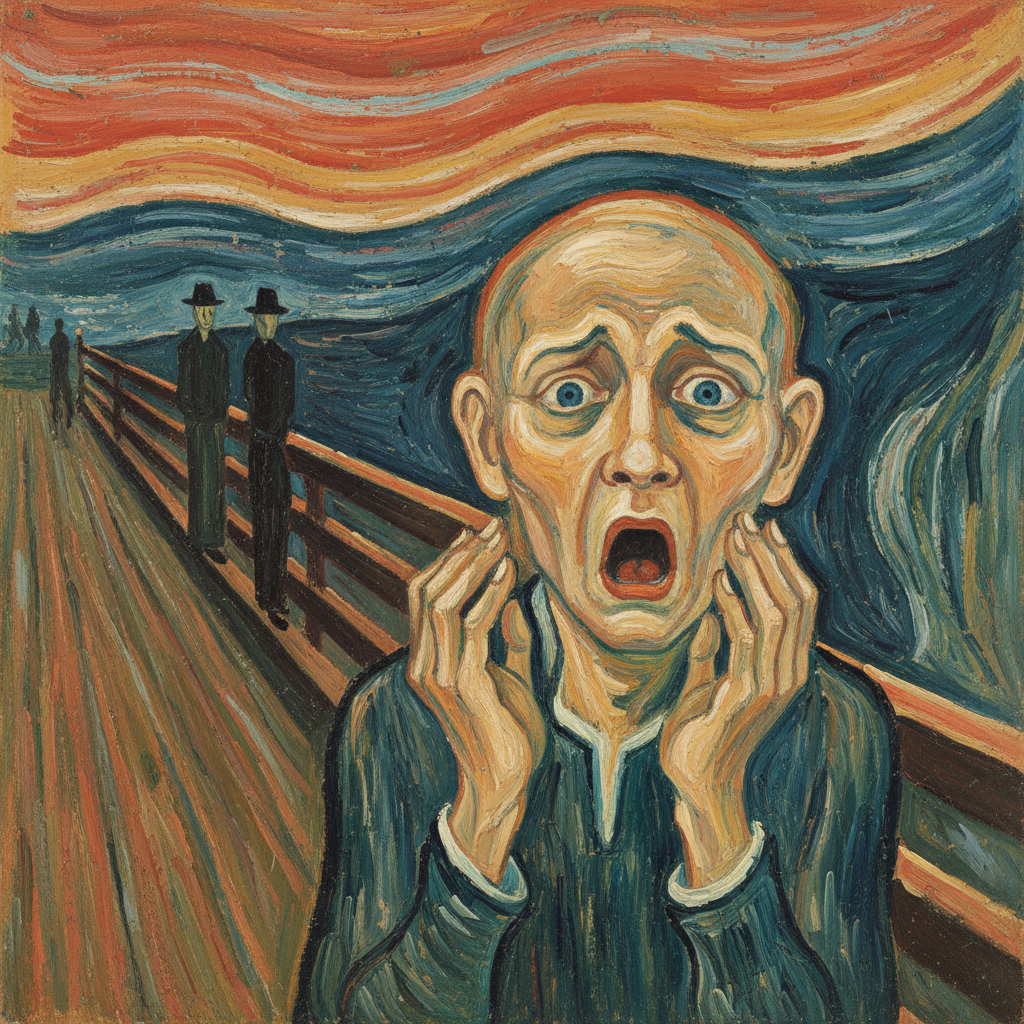
The best-known version of 'The Scream' is the oil on cardboard painted in 1893, which is currently in the National Gallery of Norway in Oslo. This version is iconic for its simple yet striking composition, its vibrant colors, and the emotional intensity it conveys. The central figure, with its cadaverous face and bulging eyes, is instantly recognizable. The sky, with its swirls of red and orange, creates a sense of agitation and chaos. The brushwork is loose and expressive, which contributes to the atmosphere of tension and anxiety. This version of 'The Scream' has been reproduced countless times and has become an omnipresent symbol of modern anguish. However, it is important to remember that this is only one of the several versions Munch created throughout his life. Each of them offers a unique perspective on the work and reveals the evolution of the artist's thought and style.

The Scream, pastel from 1893: Chromatic intensity and fragility
Another important version of 'The Scream' is the pastel on cardboard also made in 1893. This version stands out for its greater chromatic intensity and its sense of fragility. The colors are brighter and more saturated than in the oil version, which intensifies the emotional impact of the work. The pastel technique, with its soft and velvety texture, adds a sensual quality to the image. However, it also conveys a sense of vulnerability and transience. Pastel is a delicate medium that can fade or be damaged easily, reflecting the fragility of the human psyche. This version of 'The Scream' is currently in a private collection and is less well known than the oil version, but it is equally important for understanding Munch's vision.

The Scream, lithograph from 1895: The democratization of terror
In 1895, Munch created a lithograph of 'The Scream', which allowed the work to be distributed to a wider audience. Lithography is a printing technique that makes it possible to produce multiple copies of an image at low cost. This meant that 'The Scream' could reach people who could not afford to buy an original painting. Lithography also allowed Munch to experiment with different visual effects, such as line and contrast. The lithographic version of 'The Scream' is more austere than the painted versions, but no less striking for that. The simplification of the forms and the reduction of the color palette emphasize the essence of the image: the pure expression of terror. This version of 'The Scream' played a crucial role in popularizing the work and transforming it into a cultural icon.

The Scream, tempera on cardboard from 1910: A more muted and somber palette
The latest known version of 'The Scream' is the tempera on cardboard painted around 1910. This version is characterized by a more muted and somber color palette than the earlier versions. The reds and oranges in the sky are less intense, and cool colors such as blue and gray predominate. The central figure also appears more tired and emaciated. Some critics suggest that this version reflects Munch's mental state in his later years, marked by illness and depression. However, it could also be interpreted as a reflection on the passage of time and the inevitability of death. This version of 'The Scream' is the least known of all, but it offers a valuable perspective on the evolution of Munch's thinking and his relationship with the work.
Color in 'The Scream' is not used descriptively, but expressively. The colors do not represent objective reality, but rather the artist's subjective emotions. The intense red of the sky symbolizes anguish and terror, while the dark blue of the fjord represents loneliness and despair. Munch uses color to create an atmosphere of tension and chaos, reflecting the disturbed mental state of the central figure. The bold and unconventional use of color is a distinctive feature of Expressionism, an artistic movement that emerged in the early 20th century and sought to express emotions directly and intensely. 'The Scream' is considered one of the precursor works of Expressionism, and its influence can be seen in many later artists.
Perspective in 'The Scream' is also distorted, which contributes to the feeling of disorientation and anxiety. The lines converge toward a vanishing point that is outside the painting, creating a sense of emptiness and alienation. The perspective does not represent objective reality, but the artist's subjective experience. Munch uses distortion to convey the feeling that the world is out of control and that the central figure is trapped in a nightmare. This technique is characteristic of Expressionism, which sought to represent reality from a subjective and emotional perspective. The distorted perspective in 'The Scream' is a powerful tool for expressing existential anguish.
'The Scream' is also influenced by Symbolism, an artistic movement that emerged in the late 19th century and sought to represent ideas and emotions through symbols and metaphors. Rather than representing reality literally, Symbolist artists used images and objects to evoke moods and emotions. In 'The Scream', the central figure is not simply a person screaming, but a symbol of human anguish. The red sky is not simply a sunset, but a symbol of terror and despair. Munch uses symbolism to create a work that transcends literal representation and appeals to the viewer's emotions and intuition. This influence of Symbolism is what makes 'The Scream' such a rich and complex work, and why it continues to resonate with today's audience.
In 1994, one of the versions of 'The Scream' was stolen from the National Gallery in Oslo in an operation that seemed straight out of a spy movie. The thieves entered through a window, leaving a mocking note that said: "Thanks for the poor security". The theft took place just before the Lillehammer Winter Olympics, adding a tone of national humiliation to the incident. The thieves' decision to target 'The Scream' reflected not only its monetary value, but also its immense cultural and symbolic value for Norway. One of the obstacles in the investigation was the lack of witnesses and the speed with which the theft was carried out. The police initially focused on international art gangs, but also considered the possibility of a commissioned theft.
Ten years later, in 2004, tragedy struck again. This time, armed men burst into the Munch Museum in broad daylight and took 'The Scream' and 'Madonna', another Munch masterpiece. This theft was even bolder and more violent than the previous one. The thieves threatened staff and visitors with firearms, showing a clear disregard for human life and cultural heritage. Choosing 'The Scream' again as the target underscores its iconic appeal and perceived vulnerability. A possible reason for choosing this moment could have been a perceived weakness in the museum's security measures. The swift execution of the theft, combined with the bold use of firearms, further complicated the investigation.
Fortunately, both versions of 'The Scream' were eventually recovered. After the 1994 theft, the painting was recovered in an undercover operation. The 2004 theft had an even happier ending, with the recovery of both paintings in 2006. The Norwegian police, in cooperation with Scotland Yard, played a fundamental role in recovering the works. The recovery of the paintings was an immense relief for the art world and for Norway in particular. The authorities' decision not to give in to the thieves' demands and to persevere with the investigation showed an unwavering commitment to protecting cultural heritage. These thefts highlighted the critical need to strengthen security measures in museums, especially for iconic artworks like 'The Scream'. More information about the recovery efforts can be found in trusted sources such as the National Museum of Norway website.
'The Scream' has transcended the boundaries of the art world to infiltrate global popular culture. Its instantly recognizable image has made it the subject of countless parodies, tributes, and references across various forms of media. From appearances in 'The Simpsons' to adaptations in street art, 'The Scream' has become a universal symbol of existential anguish, but also of irony and humor. The reason 'The Scream' lends itself so well to parody lies in its simplicity and the emotional force it conveys. The androgynous figure with its mouth open in a silent scream is easily recognizable and adaptable to different contexts. One example could be a version of 'The Scream' with video game characters or politicians.
The omnipresence of 'The Scream' in popular culture has also led to its commercial use. The image can be found on all kinds of products, from coffee mugs and T-shirts to posters and phone cases. This commercialization raises questions about the exploitation of Munch's work and the trivialization of its original meaning. Some argue that commercial use dilutes the powerful message of existential anguish conveyed by the painting, reducing it to a mere consumer image. Others, however, believe that commercialization helps keep the image of 'The Scream' alive and brings it closer to a wider audience. The decision to use 'The Scream' for commercial purposes must consider the balance between promotion and the preservation of artistic meaning. For example, a company using 'The Scream' in an advertising campaign could partner with a mental health charity to raise awareness about emotional distress.
In the digital age, 'The Scream' has found new life as an Internet meme. Its image is used to express a wide range of emotions, from frustration and anxiety to horror and surprise. The 'The Scream' meme has become a quick and effective way to communicate complex feelings in a visual language that transcends cultural barriers. The meme's ability to adapt to different situations and contexts is one of the reasons for its popularity. For example, it is used to express frustration over everyday problems such as slow Internet or waiting in line. The decision to use 'The Scream' as a meme must take into account the context and the target audience. If the goal is to express existential anguish, the meme can be a powerful tool. If the goal is to make fun of Munch's work, the meme can be offensive. A humorous note could be, for example, a cat meme imitating the pose of 'The Scream' with the text "When you realize it's Monday".

Dresden Street, Ludwig Kirchner
Edvard Munch, beyond 'The Scream', was a seminal figure in the development of Expressionism, an artistic movement that sought to express the artist's emotions and subjectivity above the realistic representation of the world. His work profoundly influenced generations of artists, from German Expressionists such as Ernst Ludwig Kirchner and Emil Nolde to contemporary artists who explore themes of anguish, alienation, and the human condition. The emotional intensity and gestural brushwork characteristic of Munch became hallmarks of Expressionism. For example, Kirchner's work "Street, Dresden" shows a clear influence of Munch's depiction of urban anxiety. Artists' decision to emulate Munch's style was often based on their desire to convey strong emotions and challenge traditional artistic conventions.
Munch’s work has been the subject of numerous psychoanalytic analyses, which seek to understand the connection between his art and his personal experiences, including his traumatic childhood, his failed romantic relationships, and his struggles with mental illness. Some critics see in 'The Scream' a visual representation of existential anguish and the alienation of modern man, while others interpret it as an expression of Munch’s own personal anguish. Munch’s exploration of themes such as death, love, and anxiety resonated deeply with the principles of psychoanalysis, which sought to explore the depths of the unconscious. For example, the recurring use of the female figure in Munch’s work has been interpreted as an expression of his ambivalent feelings toward women. The psychoanalysts’ decision to analyze Munch’s work is based on the belief that art can provide a window into the unconscious.
Despite having died in 1944, Edvard Munch remains an incredibly relevant artist in the 21st century. His work continues to be exhibited in museums around the world, attracting a diverse audience that identifies with his universal themes of anguish, loneliness, and the search for meaning in an uncertain world. Munch’s ability to capture the complexity of the human experience and to express deep emotions makes him a timeless artist who continues to inspire and challenge today’s viewers. Globalization and growing awareness of mental health have contributed to a renewed appreciation of Munch’s work. For example, recent exhibitions of his work have attracted a young audience interested in exploring themes of anxiety and depression. His work is available for your enjoyment, and you can also appreciate his art through paintings oil reproductions available at kuadros.com.

Despair, Munch
Before 'The Scream', Edvard Munch had already explored themes of anguish and despair in his work 'Despair' (1892). Although less iconic than 'The Scream', 'Despair' shares many thematic and stylistic similarities. Both works present solitary figures in an oppressive landscape, expressing feelings of alienation and existential anguish. However, 'Despair' is more introspective and less universal than 'The Scream'. The figure in 'Despair' seems more absorbed in its own thoughts, while the figure in 'The Scream' appears to be reacting to an external horror. Munch’s decision to create two works that explore similar themes suggests his deep concern with the human condition and his desire to find ways to express his own emotional experiences. Both works are tied to the artist’s inner quest.
'The Scream' has had a considerable influence on contemporary art, inspiring artists from various disciplines to explore themes of anguish, anxiety, and alienation in their own works. From painting and sculpture to photography and video art, the imprint of 'The Scream' can be seen in a wide range of artistic expressions. Some artists have reinterpreted the iconic image of 'The Scream' in original and innovative ways, while others have used its symbolism to address contemporary social and political issues. The persistence of 'The Scream' as a source of inspiration in contemporary art demonstrates its enduring relevance and its ability to connect with the emotions and concerns of today's audience. For example, the work of artist Sarah Lucas often features distorted and grotesque figures that recall the anguish expressed in 'The Scream'. Other artists have adapted the image to current concerns, such as climate change or social inequality.
Other artists who explore existential anguish: Francis Bacon, Egon Schiele
Edvard Munch was not the only artist to explore existential anguish in his work. Francis Bacon, known for his distorted and grotesque portraits, captured the fragility and vulnerability of the human condition with visceral intensity. Egon Schiele, for his part, explored themes of sexuality, death, and emotional anguish in his self-portraits and nudes. These artists, like Munch, used their art as a way to express their own emotional experiences and to confront the painful realities of the world. These artists' decision to address difficult and taboo subjects contributed to the breaking of traditional artistic conventions and opened new avenues for artistic expression. As in Munch's works, the artists convey that inner anguish through their paintings, as we can observe, for example, in the works of Caravaggio.
In May 2012, one of the four versions of 'The Scream' was auctioned at Sotheby's for the astonishing sum of 119.9 million dollars, setting a new record for the most expensive work of art ever sold at auction at the time. [Source: Artnet]. This event propelled the painting's fame even further and cemented it as a symbol of popular culture. The sale not only reflected the artistic value of the work, but also its historical importance and cultural impact. The exorbitant price demonstrated that 'The Scream' is more than just a painting; it is an icon that represents the anguish and alienation of human beings in the modern world. The decision to auction the work sparked debate about the commodification of art and public access to masterpieces. The sale also benefited a Norwegian foundation dedicated to children's health, allocating part of the proceeds to charitable projects.
There has been much speculation about the possible influence of Edvard Munch’s mental health on his work, including 'The Scream'. Munch suffered from anxiety and depression throughout his life, and these personal experiences may have contributed to the emotional intensity that manifests in his paintings. Some experts suggest that the androgynous figure in 'The Scream' could be a representation of Munch himself struggling against his inner demons. The dark color palette and unsettling composition could also reflect his turbulent mental state. However, it is important to note that there is no definitive evidence confirming a direct correlation between Munch’s mental illness and his art. Rather, it can be argued that his personal experiences, both positive and negative, served as a source of inspiration for his creativity. Other artists such as Van Gogh also channeled their inner struggles into masterpieces.
The scene depicted in 'The Scream' is inspired by a real walk that Munch used to take in Ekeberg, a hill overlooking Oslo, Norway. Today, this place has become a pilgrimage site for art lovers seeking to connect with Munch’s work and vision. The lookout offers a panoramic view similar to the one seen in the painting, allowing visitors to experience the unsettling atmosphere that inspired Munch. The exact location has been the subject of debate, but it is believed to be near Mosseveien road. Walking through Ekeberg is an immersive experience that allows visitors to feel the connection between the artist, his work, and the natural surroundings. The city of Oslo has recognized the cultural importance of Ekeberg and has installed informational plaques explaining the relationship between the site and 'The Scream'. Visiting Ekeberg offers a new perspective on Edvard Munch’s work and life.
Edvard Munch’s life was marked by illness and death from an early age. His mother died of tuberculosis when he was only five years old, and his sister Sophie died of the same disease nine years later. These early losses had a profound impact on Munch, and death became a recurring theme in his work. The experience of witnessing the suffering and death of his loved ones made him acutely aware of the fragility of life and the inevitability of death. These traumatic experiences haunted him throughout his artistic career, influencing his style and the themes he explored. Death was not simply an end, but an omnipresent force shaping human existence. Munch used his art as a way to confront his fears and process the pain of loss.
Death manifests itself in various forms in Munch's paintings. It is often portrayed through pale and gaunt figures, scenes of illness and agony, and the use of somber colors and dramatic contrasts. In works such as "The Sick Child," Munch captures the fragility and vulnerability of life in the face of death. The child's pale, gaunt face, together with the oppressive atmosphere of the room, conveys a sense of despair and resignation. Even in paintings that do not directly address the theme of death, subtle allusions to mortality can be found, such as the presence of solitary and melancholic figures, desolate landscapes, and the depiction of the passage of time. The symbolism of death in Munch's paintings is complex and multifaceted, reflecting his deep reflection on the nature of human existence.
Despite the strong presence of death in his work, Munch did not limit himself to portraying it as a tragic and frightening event. He also explored the idea of accepting mortality as an integral part of life. In some of his paintings, a certain serenity and resignation in the face of death can be observed, as if Munch had come to terms with his own finitude. This acceptance does not necessarily imply an optimistic view of death, but rather an understanding that it is an inevitable part of the life cycle. By confronting death head-on in his art, Munch sought to exorcise his fears and find meaning in existence. His work invites us to reflect on our own mortality and to value the time we have in this world.
'The Scream' has transcended the realm of art to become an omnipresent cultural symbol. Its image has been used in advertising, film, literature, and music, becoming a globally recognizable icon. The painting has been interpreted as a representation of existential anguish, alienation, and despair, themes that resonate with the human condition in modern society. 'The Scream' has inspired artists from various disciplines, influencing the creation of works that explore similar themes. The painting has also been the subject of parodies and humorous reinterpretations, demonstrating its entrenchment in popular culture. Its impact on today's culture and society is undeniable, and its image continues to be used to express emotions and convey powerful messages.
The enduring appeal of 'The Scream' lies in its ability to evoke universal emotions that transcend time and culture. The anguish, fear, and loneliness expressed in the painting are feelings that we can all experience at some point in our lives. The androgynous figure in the foreground, with its distorted face and expression of terror, becomes a mirror in which we can see ourselves reflected. The simplicity of the composition and the intensity of the colors help create an unsettling atmosphere that grips us and invites us to reflect on our own existence. In an increasingly complex and uncertain world, 'The Scream' continues to resonate with audiences because it reminds us of our fragility and vulnerability, and invites us to connect with our deepest emotions. It is a work that speaks to us and reminds us that we are not alone in our struggle to find meaning in life.
The enduring presence of Edvard Munch’s "The Scream" in the collective consciousness is undeniable. Frequently parodied and reinterpreted, the work continues to resonate because of its ability to articulate a primordial human emotion: anguish. Created in 1893, this piece is not simply a depiction of a moment of terror; it is a profound exploration of the existential anxiety that tormented Munch and, by extension, modern society. When contemplating the work, one is confronted not only with the image, but also with the philosophical and psychological backdrop that gave rise to it.
Munch was not seeking to replicate reality objectively, but rather to project his inner state onto the canvas. Consider the choice of color: the sky, far from being a comforting blue, swirls in shades of blood orange and acidic yellow. This palette does not imitate nature, but distorts it to reflect the artist’s inner torment. The central figure, androgynous and dehumanized, is not screaming at an external danger, but at a visceral fear born of its own psyche. Munch’s decision to stylize the landscape, simplifying forms and exaggerating colors, serves to intensify the sense of oppression and unease. It is not a photograph; it is an X-ray of the soul. One example of this is the depiction of the water, which resembles molten lava more than a natural element, contributing to the hellish atmosphere of the scene. To better understand how anguish is subjective and can be artistically represented, we can look for examples of other artists who also approached this theme with a personal perspective such as Rembrandt in his use of chiaroscuro.
The multiple versions of "The Scream" –paintings, drawings, lithographs– reveal an iterative creative process, where Munch constantly refined his vision of anguish. Each version offers a subtle variation in emotional intensity, color palette, or the focus of the figure. Munch’s technique, characterized by nervous brushstrokes and an application of paint that is often diluted, reinforces the sense of vulnerability and fragility. It is said that Munch was inspired by a particularly dramatic sunset he observed while walking with friends, feeling a "great scream in nature." This experience, transformed through his artistic sensibility, became the catalyst for the work. This method of internalizing experiences and projecting them into art is a common trait in Expressionism. A crucial decision was to simplify the forms, allowing color and line to express pure emotion, minimizing the distraction of realistic details. One step toward understanding this decision is to visualize how the Impressionist style of Monet or the treatment of light by Sorolla could have created a completely different painting, with a perspective less centered on raw emotion.
"The Scream" transcends its intrinsic artistic value to become a cultural icon, a universal symbol of alienation and modern despair. Its influence extends to literature, film, music, and, more recently, digital culture, where it appears in memes and parodies. This ubiquitous use of the image, although it sometimes trivializes its original meaning, also ensures its continued relevance in a world increasingly marked by uncertainty and anxiety. The work has been the subject of numerous psychological, sociological, and historical analyses, each offering a different perspective on its enduring power. One example of the work's impact is its frequent appearance in films and television series that explore themes of mental or existential anguish. The painting, stolen twice (in 1994 and 2004) and later recovered, has also fueled its own legend, becoming an object of desire and fascination. The fact that an image can evoke such an intense emotional response, even outside its original context, is a testament to Munch's genius and the profound connection it establishes with the human experience.
Edvard Munch's The Scream remains a haunting testament to the human condition, a reflection of our deepest anxieties and a reminder of art's ability to confront and articulate the most difficult emotions.
KUADROS ©, a famous painting on your wall. Hand-made oil painting reproductions, with the quality of professional artists and the distinctive seal of KUADROS ©. paintings reproduction service with satisfaction guarantee. If you are not completely satisfied with your painting replica, we will refund 100% of your money.