The art world is full of stories of forgotten masterpieces, lost in time and rediscovered by chance or through the insight of a few. These hidden gems, often shrouded in the mystery of their disappearance and reappearance, offer a fascinating window into bygone eras and the genius of artists who, for various reasons, did not achieve the lasting fame of their contemporaries. The excitement of the discovery, the research that follows, and the eventual appreciation of these works remind us that art is a continuous dialogue between the past and the present.
Sometimes, a simple cleaning or a move can reveal an artistic treasure hidden in plain sight, transforming an everyday object into a piece of incalculable historical and aesthetic value. These artistic serendipities not only enrich our cultural heritage, but also highlight the fragility and persistence of human creation through the centuries. The narrative of each rediscovered canvas is an adventure in itself, an invitation to delve into its origin and to understand its meaning in the vast tapestry of art history.

The Arrest of Christ — Caravaggio
Rediscovered in 1990 in the Jesuits' dining room in Dublin after having been considered lost or misattributed for centuries. Perfect to illustrate the idea of a hidden treasure unexpectedly rediscovered.
Art history is full of fleeting talents, artists whose works, despite their intrinsic quality and profound meaning, fell into oblivion over the generations. These masters forgotten artists, whose brushstrokes reveal a mastery comparable to that of the great names, were often overshadowed by the artistic trends of their time, by adverse biographical circumstances, or by the simple lack of a suitable patron to ensure the dissemination and preservation of their legacy. The rediscovery of their canvases is an act of artistic justice, an opportunity to partially rewrite the canonical narrative and to celebrate the diversity of human expression. Consider the hypothetical case of an eighteenth-century painter, Juan de la Cruz, whose religious scenes show an almost Caravaggesque command of light and shadow, but who, lacking major commissions at court, saw his work scattered and little known. His rediscovery in an inventory of the possessions of a noble family reveals a previously unknown chapter of Spanish Baroque art.
The process of reviving these forgotten artists involves exhaustive research. Experts examine historical archives, correspondence, and inventories of private and public collections, and stylistically compare the works in order to attribute them with confidence. This meticulous work not only validates the authenticity and value of the work, but also reconstructs the artist's biography, influences, and potential impact. The exhibition of these pieces in galleries and museums, accompanied by catalogs and academic studies, is crucial for the general public to learn about and appreciate these echoes of forgotten geniuses. Dissemination through digital platforms and high-quality reproductions, such as those created by KUADROS, makes it possible to democratize access to these works, bringing the beauty and history of painting within reach of a broader audience and contributing to their posthumous recognition. The public can thus admire these pieces and, perhaps, consider owning a hand-made oil painting reproduction for their own collection.

Salvator Mundi — Leonardo da Vinci
For a long time considered a mere copy and covered by overpaint, it was restored and later attributed to Leonardo. Ideal for sections on authenticity, restoration, and historical reattribution.
Art, in its often elusive nature, hides treasures that patiently await discovery, not only in the great museums, but also in the most unexpected corners of our everyday life. Unexpected discoveries of masterpieces, often after decades or centuries of apparent oblivion, are events that move the art world and the general public. These finds can occur at auctions of assorted objects, in family estate sales, or even in the attic of an old house, where a canvas, covered in dust and unidentified, turns out to be a hidden gem. The excitement of the collector or owner at the prospect of possessing a piece with a glorious past is palpable, and marks the beginning of a fascinating journey of research and authentication.
The patina of time, manifested through accumulated dust, darkened layers of varnish, and tiny craquelure, far from being an impediment, often becomes a mark of authenticity and age for a work of art. In attics and the back rooms of galleries, these signs of the passage of time are the first clues that a work may hold a significant story. A canvas that has remained intact, untouched by modern trends and restorations, preserves the memory of its creation and of its previous owners. Identifying the value of a painting in these conditions requires not only a critical eye, but also the ability to interpret the signs that time has imprinted on the work, with each particle of dust telling part of its journey.

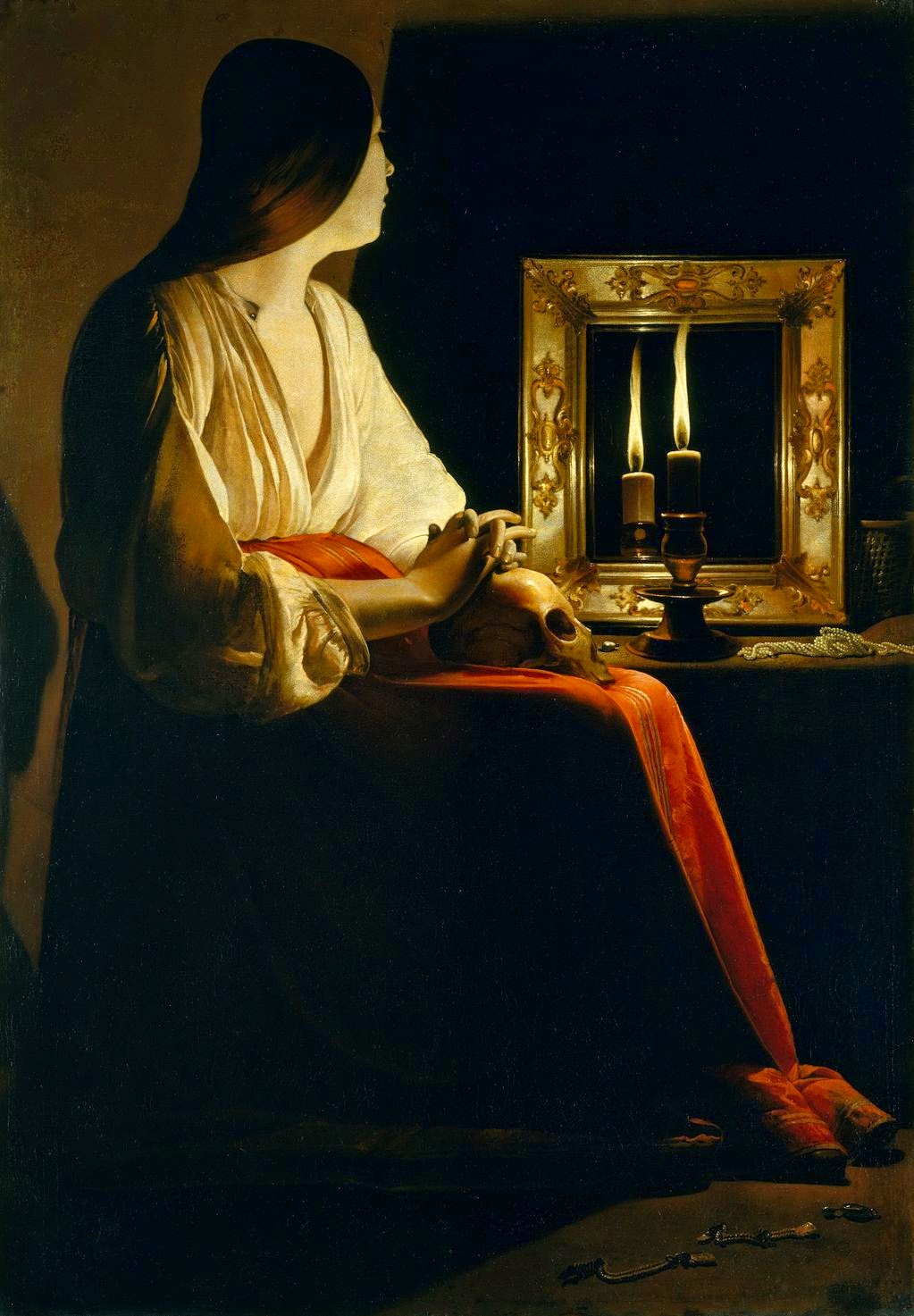
The Penitent Magdalene — Georges de La Tour
Georges de La Tour was practically forgotten by art history for centuries until being rediscovered in the 20th century. The work fits perfectly with the theme of the “masters forgotten”.
Art collecting, especially when it ventures into the search for lesser-known or rediscovered works, requires a trained eye and a deep understanding of styles, techniques, and artistic periods. The discerning collector is not dazzled solely by fame or price, but values intrinsic quality, originality, and the historical potential of a piece. This eye is cultivated through constant observation, rigorous study, and direct experience with artworks. The ability to recognize the potential of an unknown work, to look beyond its current condition or its provisional presentation, is what distinguishes an amateur collector from a true expert, capable of identifying real hidden gems even in the humblest circumstances.
Each rediscovered work of art, beyond its aesthetic and material value, is a portal to secret stories and forgotten cultural contexts. These canvases, as they emerge from their slumber, not only enrich our understanding of the past, but also reveal the vicissitudes of history, the changing fortunes of artists and collectors, and the way in which taste and artistic appreciation have evolved. The narrative surrounding a rediscovered masterpiece is as fascinating as the painting itself, often involving mysteries, family legacies, and even ownership disputes that add layers of intrigue to its intrinsic value. The provenance of a work, that is, its ownership history, becomes a crucial element in untangling these stories, providing clues about its journey through time.
The process of attribution and dating of these rediscovered works is a complex puzzle involving art historians, conservators, and forensic scientists. Through technical analyses such as X-rays, infrared reflectography, or X-ray fluorescence, underdrawings, the artist’s alterations, or the composition of the paint layers can be revealed, offering invaluable insight into the creative process and the authenticity of the work. These scientific studies, combined with documentary research and stylistic analysis, make it possible to reconstruct the history of the work and the artist, bringing to light talents that had been unjustly forgotten. The public can then appreciate these pieces not only for their beauty, but also for the rich tapestry of knowledge they contain, and perhaps want a canvas reproduction for their own space, as a way to connect with that history.

Judith Beheading Holofernes — Artemisia Gentileschi
For centuries, Artemisia was overshadowed by male artists and later revalued by modern art history. In addition, there is a related version discovered in a French attic, directly connecting with the theme of rediscovery.
An artist’s brushstrokes are their fingerprint, a stylistic signature that, with time and experience, becomes recognizable to the trained eye. In rediscovered works, these enigmatic strokes can conceal symbolic meanings, poorly documented influences, or even the evolution of the artist’s own technique. A detailed analysis of the application of color, the texture of the paint, and the gesture of the brush can reveal the secrets of creation, making it possible to understand not only what the artist painted, but also how and why they did it. These enigmas, once solved, add depth and complexity to the appreciation of the work, transforming it from a simple image into a living document of the creator’s mind and hand.
No artist operates in a vacuum; their work is intrinsically linked to the era and cultural context in which they live. Rediscovered masterpieces, like celebrated ones, are reflections of their time, capturing the prevailing philosophical ideas, social tensions, technological advances, and aesthetic sensibilities. The study of provenance and the circumstances of a work’s creation can reveal how historical events, religious beliefs, or political movements shaped the artist’s vision and the content of their painting. Understanding this context not only enriches our interpretation of the work, but also allows us to appreciate the resilience and adaptability of art as a form of human expression over the centuries, even in periods of profound transformation or turmoil.
Baroque, a period of exuberance and overflowing emotionality, gave rise to masterpieces that continue to captivate with their dramatic intensity and deep exploration of the human condition. The pigments, carefully selected and applied with mastery, created atmospheres charged with tension, reflecting an era of major religious, political, and social change. The passion inherent in this artistic movement is expressed in the vivid representation of emotions, in the theatricality of the scenes, and in the bold use of light and shadow. The jewels of the Baroque, often rediscovered in private collections or inherited, offer us a direct window into the sensibility and spirit of that time, allowing us to connect with the expressive force of artists who knew how to capture the soul of their era on canvases that defy the passage of time.

Portrait of a Young Man — Raphael
Considered one of the paintings most important works lost during World War II. It represents the lingering mystery of lost masterpieces and the ongoing search for recovery.
The chromatic richness and depth of the tones used by the Baroque masters are testimony to exceptional technical mastery and an innate understanding of color psychology. The intense reds evoke passion and sacrifice, the golds solemnize the divine and the regal, while the deep darks create a dramatic backdrop that highlights the emotional force of the figures. Each pigment, each layer of paint, was a conscious choice to amplify the message and atmosphere of the work. When contemplating these pieces, whether in their original splendor or through high-quality reproductions that seek to capture that essence, we can feel the palpable energy emanating from these canvases, inviting us to reflect on the universal themes they addressed, from faith and mortality to power and beauty.
Within the vast repertoire of Baroque techniques, tenebrism emerges as one of the most powerful and defining expressive tools of the period. Characterized by an extreme contrast between light and shadow, where darkness dominates most of the composition and light falls dramatically on key elements, this style creates an atmosphere of mystery, tension, and unmatched emotional intensity. Artists such as Caravaggio perfected this technique, using light to focus the viewer's gaze on the dramatic climax of the scene, accentuating the physicality and starkness of the figures. The use of tenebrism was not merely aesthetic; it served to symbolize the struggle between good and evil, the divine and the earthly, and to intensify the observer's spiritual experience, immersing them in a deep contemplation of the human condition and its moral dilemmas.

The Concert — Johannes Vermeer
Stolen in the famous 1990 Isabella Stewart Gardner Museum heist and still missing. It perfectly represents the mystery of lost artworks and the hope of their future recovery.
Baroque paintings often stand out for their ability to capture the soul of their characters and the dramatic essence of the scenes depicted. Whether biblical figures wrapped in mystical ecstasy, portraits of nobility revealing their power and vulnerability, or mythological scenes full of movement and passion, Baroque artists possessed an extraordinary gift for infusing life and emotion into their canvases. The expressiveness of the faces, the gestures of the hands, the tension of the bodies, and the narrative implicit in every detail invite the viewer to connect on a profound level with the story unfolding before their eyes. These works, by transcending mere visual representation, succeed in conveying the complexity of human emotions and the grand narratives of faith, history, and mythology, leaving an indelible mark on those who contemplate them.
Romanticism, an artistic movement that flourished at the end of the 18th century and throughout the 19th, is characterized by a deep exploration of emotion, individuality, and freedom. Moving away from the rigid structures of Neoclassicism, Romantic artists sought to express the intensity of human feelings and the grandeur of nature. Nature, in particular, became a mirror of the human soul, reflecting both its sublime beauty and its terrifying power. Stormy landscapes, melancholic ruins, and scenes of wild life often served as a backdrop for the overwhelming passions and inner conflicts of the characters. This subjective and emotive vision of reality laid the foundations for future artistic explorations, valuing personal experience over objective reason. Freedom, both political and artistic, was a recurring theme, manifesting itself in depictions of revolutions, struggles for independence, and the affirmation of the individual against social norms.

Ecce Homo — Caravaggio
It was almost sold for a minimal sum at an auction in Madrid before experts suspected it might be an authentic Caravaggio. Excellent example of rediscovery and unexpected attribution.
At the heart of Romanticism lies a fascination with nature, not as a mere backdrop, but as a living, breathing entity capable of reflecting the complexity of the human spirit. Romantic artists saw in storms, rugged mountain peaks, and vast oceans a manifestation of human passions: fury, melancholy, aspiration, and wonder. The depiction of nature went beyond mere topographical observation; it was about infusing it with a soul, making it speak the language of emotions. A cloudy sky could evoke sadness, a tumultuous waterfall the untamed force of desire, and a serene landscape the longed-for inner peace. This profound connection between human beings and the natural environment not only beautified the works, but also invited the viewer to introspection, to seek resonances of their own feelings in the immensity of the outside world. The sublime vastness of certain natural vistas offered an almost religious experience, a reminder of human insignificance before the cosmic and, at the same time, of the soul’s capacity to hold such wonders. This perspective deeply influenced later movements, as can be seen in the way landscape representation evolved, even influencing the perception of architecture and the urban environment.
During the Romantic era, the figure of the artist underwent a radical transformation, rising to the category of visionary genius, often solitary and misunderstood. The artist was no longer seen simply as a skilled craftsman, but as a modern prophet, endowed with superior sensitivity and the ability to perceive hidden truths that escaped ordinary mortals. This vision granted the artist moral and intellectual authority, but it also exposed them to misunderstanding and social isolation. Their works, charged with subjectivity and emotional expression, often clashed with aesthetic conventions and the expectations of the bourgeois public, more accustomed to the clarity and order of academic art. However, this very marginality and rebellion became emblems of their authenticity and depth. The lives of many Romantic artists were marked by personal struggles, financial instability, and a constant search for recognition, factors that, paradoxically, fueled their creativity and the intensity of their works. The notion of the "tormented genius" became established, and their work was valued not only for its beauty, but for the intensity of the life experience that had given rise to it, a legacy that endures in the way we still admire certain artists in forgotten expressionism.
The technical mastery of the great masters of art lies in their deep knowledge of materials and their skill in manipulating them with precision and creativity. Workshop secrets, often passed down from master to apprentice or discovered through relentless experimentation, are the invisible tools that shaped the works we admire today. From the selection of pigments to the intricate play of light and shadow, every technical decision contributes to a painting’s atmosphere, realism, and emotional impact. The rigorous study of anatomy, perspective, and composition was fundamental, but what set true innovators apart was their ability to transcend the rules and endow their canvases with a life of their own. The way they applied the paint, the glazes they used to achieve depth and brilliance, and even the type of canvas and ground chosen, all played a crucial role in the final result. These techniques, though often subtle, are what allow a work to transcend time and continue captivating viewers centuries after its creation, as we can see in the dedication and study behind the hand-made oil painting reproductions that honor the legacy of these masters.

Portrait of a Man — El Greco
Many of El Greco’s works were ignored for centuries because his style was considered strange or exaggerated. His critical rediscovery in the 19th century made him one of the great masters of European painting to be rediscovered.
Mastery of the color palette was, and still is, one of the most coveted skills in pictorial art. Artists throughout history have explored the intricate relationship between the primary colors (red, blue, and yellow) and their ability to generate a vast range of shades and emotions. The “alchemy of colors” is not limited to mere mixing; it involves understanding color theory, how adjacent and complementary hues interact, and how each color evokes specific sensations in the viewer. A deep blue can convey serenity or melancholy, a vibrant red, passion or danger, and a luminous yellow, joy or warning. Oil masters, in particular, developed glazing techniques and translucent layers to achieve a luminosity and depth in colors that more modern techniques often struggle to emulate. The careful selection of pigments, their quality, and how they were applied were essential to creating the desired atmosphere, whether the warmth of an intimate scene or the coolness of a winter landscape. Understanding this chromatic harmony and contrast is fundamental to appreciating the visual richness of masterpieces and is reflected in the precision we seek in the oil replicas of paintings.
Chiaroscuro, a technique that uses strong contrasts between light and shadow to model three-dimensional figures, was fundamental in giving pictorial compositions drama and volume, especially during the Renaissance and the Baroque. This technique is not simply about illuminating a scene, but about using light strategically to guide the viewer’s eye, highlight key elements, and create an atmosphere of tension or mystery. The in-depth study of how light interacts with surfaces, how shadows define forms, and how penumbra can conceal or suggest, allowed artists to create figures that seemed to step out of the canvas. Caravaggio is a paradigmatic example of this theatrical use of light, where intense beams emerge from near-total darkness, generating a striking and deeply emotional effect. Mastery of chiaroscuro required precise anatomical understanding and exquisite sensitivity in brushwork, achieving smooth transitions or abrupt contrasts according to expressive need. This technique, which seeks psychological depth through light modulation, is essential to capturing the essence of many masterpieces, something our artists at KUADROS emulate with great care in their painting replicas oil paintings made by hand.

The Distracted Reader — Johannes Vermeer
Vermeer was practically forgotten for almost two centuries after his death. His paintings were slowly rediscovered in the 19th century, completely changing his place in art history.
The history of art is full of fascinating narratives about the rise and fall of artists, whose careers often defy expectations and the linearity of time. Some geniuses achieved fame and recognition in their own era, only to fade into obscurity over the decades or centuries, while others, overlooked or undervalued in their lifetimes, resurfaced thanks to the insight of critics, collectors, or art historians. This cycle of forgetting and rediscovery is particularly visible in the way certain movements or individual artists are reinterpreted in light of new cultural sensitivities or historical discoveries. The "fate of the masters" is not static; it depends on the ongoing evaluation and study of their works, and on how these resonate with the concerns and aesthetics of each new generation. The work of historians and curators, as well as the art market, plays a crucial role in keeping the legacy of these creators alive, ensuring that their contribution to humanity’s cultural heritage does not fade away. The resilience of certain works and artists demonstrates the timelessness of their art, capable of connecting with audiences long after their creators have disappeared, as is the case with the fascination for the legacies that influence contemporary fashion.

Portrait of Adele Bloch-Bauer I — Gustav Klimt
A work looted by the Nazis during World War II and recovered after a long legal battle. Perfect for illustrating the themes of loss, provenance, and historical recovery.
Beyond the ubiquitous names in art history, there exists a vast universe of artists whose contributions, though less celebrated globally, were fundamental to the development of artistic movements or had a significant influence in specific regions or communities. These creators often worked with passion and dedication, facing the limitations of their environment or the barriers to international recognition. Their legacy may be reflected in the formation of new generations of local artists, in the introduction of innovative techniques in a particular context, or in the representation of identities and cultural experiences that would otherwise remain invisible. The study of these figures often requires deeper research and a more regionalized approach, but it reveals facets of art that enrich our understanding of creative diversity. Hypothetical examples include a 17th-century Flemish genre painter whose work documented rural life with exceptional realism, or a modern sculptor who introduced unconventional materials into the art of their country of origin, inspiring others to experiment. Rediscovering these artists is crucial for a complete view of art history, and their influence can even be felt in the quality of the reproduced masterpieces today.
The preservation of artistic heritage is a crucial task that ensures the transmission of masterpieces to future generations. The restoration and conservation of paintings are complex disciplines that combine historical knowledge, chemistry, and technology to safeguard the physical and aesthetic integrity of the artworks. Restoration comes into play when a work has suffered damage or degradation, seeking to restore its original appearance as far as possible, always respecting the original artist’s intention and technique. Conservation, on the other hand, focuses on prevention, creating optimal conditions for storage and display (temperature, humidity, and light control) to prevent future deterioration. Advances in analytical techniques, such as spectroscopy or X-rays, allow experts to understand material composition, identify overpainting or hidden damage, and plan precise, minimally invasive interventions. The importance of these practices is incalculable; without them, many of the works we admire today would have been lost or irreparably damaged, limiting our access to history and visual culture. The meticulous care of original works is a reflection of the dedication we also put into creating handmade oil painting replicas.
The desire to own and contemplate iconic artworks has driven, over the centuries, the development of the art of reproduction. Far from being a simple copy, a high-quality reproduction is a tribute to the original work and its creator, a way to democratize access to beauty and allow art to transcend the limits of museums and private collections. Reproductions made by expert artists capture not only the composition and colors, but also the essence and spirit of the masterpiece. This involves a deep understanding of the techniques used by the original artist, from the application of pigment to the handling of light and shadow. Every brushstroke, every glaze, every nuance is studied and recreated with precision and dedication. The canvas itself, the texture, the ground, and the frame are carefully selected to emulate the experience of the original as closely as possible.
This meticulous process allows reproductions, such as those offered by KUADROS, not only to decorate a space, but also to educate and inspire, bringing the viewer closer to the magnitude of art history.