Secrets of Great Historical Buildings
Some architectural works seem to speak in stone. They not only support roofs and frame plazas: their proportions, their shadows, their labyrinths of lines and numbers seem to encode a vision of the world. Monumental architecture has historically served as an open book for the initiated: a visual catechesis, a cosmology in plan and elevation, a treatise on theology or astronomy encoded in columns and arches. This is a journey we embark on —inevitably partial, but ambitious— through ten buildings that have imbued generations with their symbolic language: solar pyramids, temples dedicated to numbers, basilicas that embrace crowds, mausoleums that promise paradisiacal gardens, complexes that encapsulate the sacred mountain, and cathedrals that make light a sacrament. At each stop, we will pause to patiently read the palimpsest of beliefs: mystical traditions, ancient philosophies, gods, astrologies, and liturgies that 'speak' through stone, marble, wood, and mortar.
The reader will not find unique solutions to all the enigmas here: the greatness of these works consists, in large part, in their fertile ambiguity. The same column can tell different things to an 18th-century mason, a medieval monk, a Renaissance astronomer, or a contemporary devotee. However, there are patterns that reappear: the cardinal four, the eight of regeneration, the trinitarian three, the nine of the perfect, the circle that imagines the sky, and the square that orders the earth. Let us read, then, this atlas of symbols with the calm of one who deciphers a score.
1) The Great Pyramid of Giza (Egypt)

The Great Pyramid —the one of Khufu— is not a building, it is a thesis in stone. Its almost perfect orientation to the cardinal points has suggested since Antiquity that it was, in addition to a tomb, a cosmic instrument: an artificial mountain carefully aligned with the course of the sun and the desert winds. The Egyptians imagined the pyramid as a ramp for the deified king, ascending towards the circumpolar stars; this reading becomes visible in the narrow 'shafts' that originate from the inner chambers and point —according to recurring interpretations— to regions of the sky associated with Osiris (Orion) and with Sopdet (Sirius). Although the accuracy of these alignments is debated, the fact that such channels exist and that the building is tied to true north keeps alive the idea of a dialogue with the heavens.
The geometry of the pyramid, with its square base and four triangular faces, embodies the symbolic marriage of the square (the ordered earth) and the triangle (the ascending impulse that culminates in the point). The edge that rises from the center of each side to the vertex concentrates that gesture: an ascent that culminates in unification. To this geometric grammar is added the solar 'eye': at certain equinoxes and sunsets, shadows outline edges that resemble solar hieroglyphs, as if Ra were signing his presence with an angle of light. The pyramid, in short, is a procession of numbers: four sides, eight edges, one apex; the sum of planes that resolve into one. It is, in the Egyptian sense of the term, an 'akhet': horizon, portal through which the sun is reborn.
The interior —austere, almost mineral— reinforces the initiatory transit. The Great Gallery forces the body to feel the inclination, the narrowness, the temperature: it is a rite of passage from the clear world to the stony heart. There is no exuberant iconography on the walls; the void acts as a mirror for the initiate. It is not coincidental that later hermeticists and Freemasons saw here a school of silence and proportion: the pyramid teaches by subtraction, making gravity and the straight line speak.
Its symbolic legacy is inexhaustible. From medieval alchemists —who saw in its shape the philosophical athanor— to 19th-century engineers —who calculated, fascinated, its precision— the Great Pyramid has not ceased to propose an equation between cosmos and stone. Even the popular controversy about "secret numbers" (relations with π or the golden ratio) says less about the pyramid itself than about the modern desire to read the universe in geometric keys. That desire, in reality, was already there.
2) The Parthenon (Athens, Greece)

The Parthenon, dedicated to Athena Parthenos, distills rationality and myth in equal doses. Its Doric order, severe and measured, is not a simple aesthetic: it is an ethical program. The Greeks attributed to the number the ability to establish the beautiful and the just; in the Parthenon, that number becomes matter. The peripteral perimeter (8 × 17 columns; 46 in total) introduces an arithmetic that is not arbitrary: the eight —double that of the cardinal four— reinforces the idea of an ordered world, while the seventeen, odd, introduces a subtle asymmetry that enlivens the whole. The optical refinement (curvatures of the stylobate, entasis of the columns, minimal inclinations) does not seek to deceive, but to correct the human eye, reminding it that "truth" is always a careful approximation.
But the temple does not speak only with proportions. The continuous Ionic frieze of the cella —a "heterodox" gesture within a Doric temple— narrates the procession of the Panathenaea, elevating civic life to myth. In the pediment and the metopes, episodes from the theogony and mythical history (the Gigantomachy, the Centauromachy, the Amazonomachy) turn the building into a map of the conflict between order and chaos. Athena, goddess of wisdom and strategy, presides over that balance: her temple is an embodiment of the mind that orders and the hand that builds.
The relationship with the stars also emerges, though in a more insinuated way than in Egypt. The orientation of the major axis responds to a search for balance with the sacred topography of the Acropolis and with the solar course over Attica. The building integrates into a cosmic "theater" where the Parthenon dialogues with the Erechtheion and the altar of Athena Nike; each piece, like in Attic music, enters in time to produce a greater harmony. Thus, the temple becomes the "logos" made stone: word, proportion, and city.
The legacy of the Parthenon is paradoxical: ruin and canon. The Enlightenment turned it into an epitome of classical reason, and neoclassicism cited it to the point of exhaustion. But in that repetition, sometimes its subtleties are lost: the curvature that is almost invisible, the vibration of Attic light in the Pentelic marble, the tension between the Doric and the Ionic. The true "secret" of the Parthenon is not a magical number, but an ethics of measure.
3) Chartres Cathedral (France)

Chartres is a symphony of stone and light. In its nave, the Western Middle Ages carved an entire worldview, where theology becomes stained glass and time is embodied in a labyrinth traced on the floor. That labyrinth, with eleven rings, is not a mere "game" for pilgrims: it condenses the soul's journey to God, with a number — eleven — that exceeds the "ten" of the law to suggest the grace that overflows it. Advancing along its path was a symbolic pilgrimage for those who could not go to Jerusalem: Jerusalem is here, at the geometric center of the pavement.
The stained glass windows — among the most extraordinary in Europe — compose a Christianized zodiac. The celestial signs converse with the Months of the Year and with agricultural tasks, ordering human time (sowing, harvesting, reaping) under the clock of the heavens. It is not pagan astrology, but a catechesis: the firmament created by God is a calendar and a metaphor of providential order. The great roses — the western and the northern — function as mandalas of light: perfect symmetries where the circle — heaven — dominates the square — earth — of the lower windows. Chartres turns light into doctrine.
In the Royal Portals, the jambs align kings and prophets, prefigurations of Christ. The verticality of their stretched figures recalls living columns: all humanity supporting the revelation. Some capitals show hybrid creatures — griffins, winged lions — that bring echoes of ancient bestiaries and of the "occult sciences" of the Middle Ages, not so much to celebrate them as to submit them to the Logos. Chartres is, above all, a "school": here flourished the famous cathedral school, heir to Boethius and Dionysius the Areopagite, where the reading of the world passed through Pythagorean arithmetic, the music of the spheres, and sacred geometry.
Its legacy is an alphabet of light. Whoever enters Chartres learns to read time — the months, the solstice that "ignites" certain stained glass windows — and to walk a path that is both topography and mysticism. Few cathedrals have done so much to turn theology into sensory experience.
4) Hagia Sophia (Istanbul, Turkey)

Hagia Sophia — "Divine Wisdom" — is a luminous paradox: a centralized space crowned by a dome that seems to float like a firmament within the earth. Byzantine architecture found here its greatest experiment: a dome on pendentives that transmutes the square (earthly world) into a circle (heaven). The geometry of its dome — which rests on a ring of windows — dematerializes weight and converts light into a suspended ocean. Many pilgrims recounted the astonishment of seeing "the sky" inside a building. That was exactly the intention: to serve as a three-dimensional icon.
The mosaics —some preserved, others covered for centuries— constitute a visual theology. In the pendentives and vaults, six-winged seraphim appear, guardians of divine glory, and a Virgin Theotokos who, seated with the Child in the apse, recapitulates the wisdom that names the temple. After the Ottoman conquest, the conversion into a mosque added symbolic layers: monumental calligraphies with the names of Allah, Muhammad, and the four righteous caliphs, crescent moons atop domes, minarets that 'signal' the sky. The religious polyphony did not erase the original intention: rather, it left a palimpsest where divine Wisdom is celebrated by different languages.
The orientation and the calendar also make their presence felt. On certain days, the morning light traces diagonals that activate golds and blues with a precision that suggests calculation. The building —the work of mathematicians Anthemios of Tralles and Isidore of Miletus— is a 'habitable equation': it embodies the physics of forces and the symbolism of heaven. Hence its legacy: for centuries, Muslim and Christian architects learned from its boldness. Without Hagia Sophia, the Renaissance, Ottoman, and Baroque domes would be unthinkable.
5) Basilica of St. Peter (Vatican City)
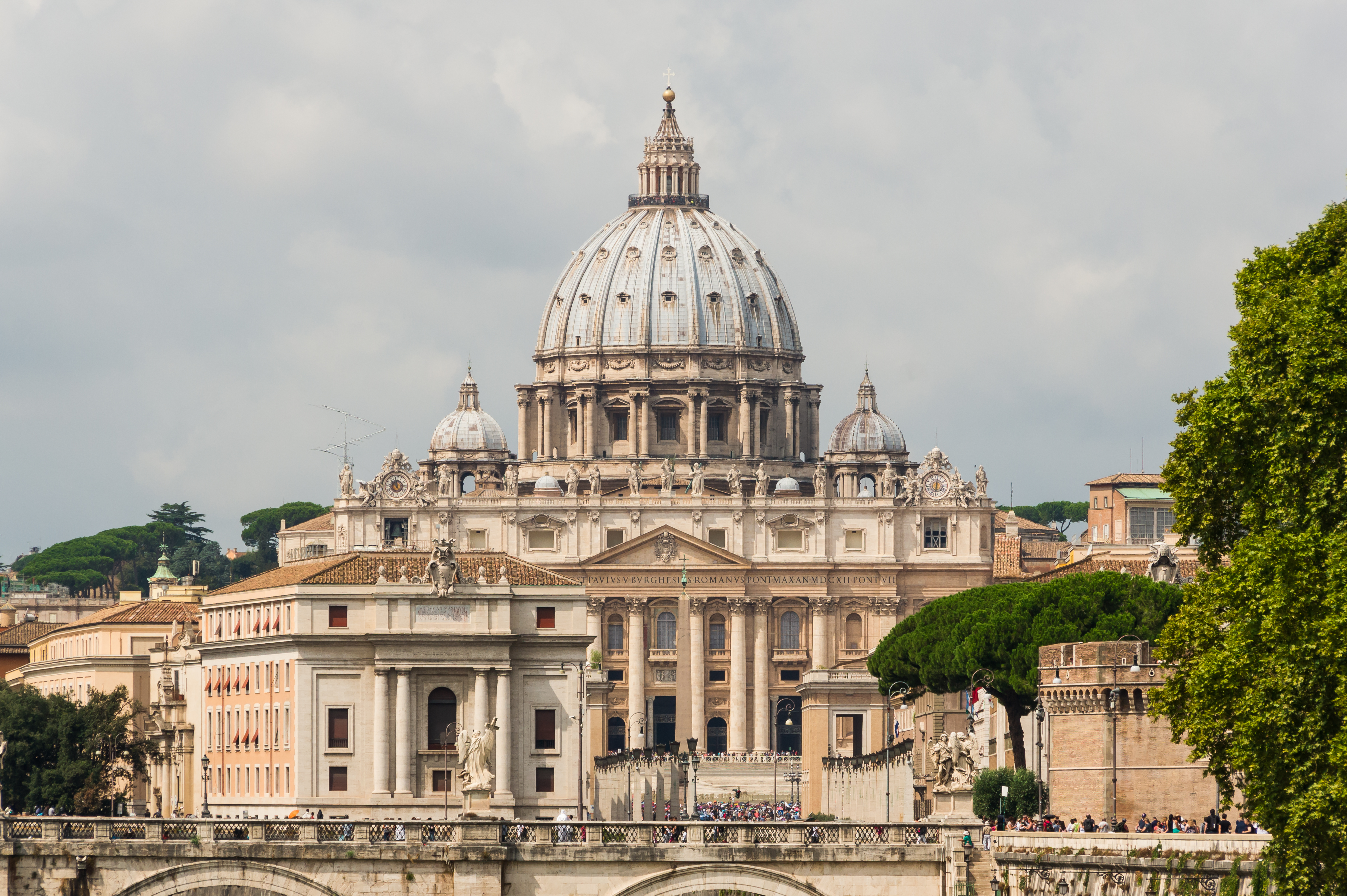
St. Peter is an 'urban orchestra' whose invisible conductor is the ellipse. Bernini's square, with its two colossal arms, embraces —the metaphor is not accidental— the multitude of the faithful. Two semicircles, two hemicycles of columns form a perfect ellipse around the central obelisk. This obelisk, brought from Egypt and erected in the 16th century, deliberately grafts the pharaonic memory into the heart of Christianity, as if the Church wanted to appropriate the ancient solar axis and consecrate it to the light of Christ. On the pavement, a rose of winds and marks of meridians invite one to read the square as an astronomical instrument.
The colonnade composes its own sacred arithmetic: 284 Tuscan columns and 140 sculptures of saints, a number that suggests the 'cloud of witnesses' surrounding the triumphant Church. Inside, Michelangelo's dome —inspired by the 'heaven' of Brunelleschi— elevates Bernini's baldachin like a cosmic tent: four twisted Solomonic columns, echoing the Temple of Jerusalem according to tradition, mark the exact point over the tomb of the apostle. The liturgy and the topography coincided to make the basilica the symbolic heart of Catholicism.
Some have wanted to see traces of 'Masonic geometries' in the square; such readings tend to exaggerate. The truth is more interesting: Bernini and his patrons compose a visual catechesis on mercy (the arms that embrace), martyrdom (the obelisk, a column of light driven into the earth), and the communion of saints (the statues that crown the ellipse). St. Peter, more than an esoteric enigma, is a Baroque theater where faith becomes space.
Its legacy has been immense: from the royal squares of France to American capitols, the idea of a central dome crowning an axial plaza has been replicated as an emblem of visible authority. St. Peter codified the rhetoric of sacred power in the urban language of the West.
6) Taj Mahal (Agra, India)

The Taj Mahal is a poem in marble that rhymes with paradise. Born as a mausoleum for Mumtaz Mahal, the beloved wife of Shah Jahan, its layout and garden translate into geometry the Quranic description of the celestial garden: four rivers springing from the center (the chahar bagh), a fountain from which everything derives, a bilateral order that duplicates perfection. The east-west axis aligns the mausoleum with sunrise and sunset, causing the white marble — porous to light — to change color according to the hour: pink at dawn, golden at twilight, silver at full moon. The light here does not illuminate: it paints.
The numerological symbolism is appreciated in the modules of its layout: an "eight and one" (hasht bihisht) of Persian tradition, where eight spaces surround a central chamber. The four minarets — slightly tilted outward due to seismic calculations — frame the sky around the onion dome, topped by an alam and a crescent moon that inscribe the name of God in the air. The calligraphic inscriptions, in variable proportion to correct perspective, quote suras that speak of mercy, promise, and resurrection. Beneath that marble skin, inlays of semi-precious stones — lapis lazuli, jade, carnelian — draw flowers that do not wither: botany of eternity.
The ensemble functions as a "memory machine": the perfect symmetry, interrupted only by the emperor's tomb (added after Shah Jahan's death), dramatizes the human longing for balance in the face of pain. Hence its universal power: the Taj belongs to a spiritual geography, not just to Mughal India. Its legacy is not measured in imitated domes, but in the conviction that architecture can heal nostalgia with proportions.
7) Angkor Wat (Cambodia)

Angkor Wat is a mountain of gods in horizontal form. Originally dedicated to Vishnu and later consecrated to Buddhism, the complex translates Hindu cosmology into stone: a central Mount Meru — the sanctuary with its five towers — surrounded by successive enclosures and a moat that symbolizes the primordial ocean. The number five, omnipresent, represents the peaks of Meru; the concentric rectangle of galleries narrates the hierarchy of worlds. The famous moat not only defends: it is an ontological boundary between aquatic chaos and the order of the temple.
Its orientation to the west — unusual in Khmer temples — suggests a funerary or setting sun reading. At the equinoxes, the sun aligns with the temple's axis, igniting the stones with orange: cosmic liturgy without a priest. The friezes, extremely long, recount foundational myths such as the Churning of the Ocean of Milk, where gods (deva) and demons (asura) pull the serpent Vasuki to extract the amrita, nectar of immortality. That myth is "inscribed" in the very plan of the temple: from chaos, the substance that maintains order is extracted.
Angkor Wat left Southeast Asia a grammar of sacred mountain and cosmic axis. Its vastness —more landscape than building— reminds us that, in certain cultures, architecture does not close in walls: it organizes territory, sky, politics, and the agricultural calendar. Watching the sunrise over its towers, reflected in the pool, is like reading a poem in which the sun signs its name every day.
8) Temple of Heaven (Beijing, China)

The Temple of Heaven is a treatise on Taoist and Confucian cosmology, written with lacquered wood and white stone. Its guiding principle is ancient: the sky is round, the earth is square. Thus, the Hall of Prayer for Good Harvest —circular, raised three times— sits on a marble terrace stepped in three rings, while the courtyards and walls adopt rectilinear geometries. The triple alludes to the triad Heaven-Earth-Man; the circle, to the qi that envelops and nurtures.
In the Hall, the traditional nail-less structure rests on 28 columns that are not arbitrary: four central ones represent the seasons; twelve intermediate ones, the months; twelve peripheral ones, the "double hours" of the traditional day (shi). The emperor —Son of Heaven— officiated here every solstice, dressed in deep blue, to pray for good harvests. In the Circular Altar (Yuanqiu), 9 concentric rings of slabs sum multiples of nine —the number of Heaven— and the center, the "Celestial Heart Stone," amplifies the voice in an acoustic phenomenon that seems to legitimize the authority of the rite.
The choice of colors —blues and golds— encodes the hierarchy of the five elements (wood, fire, earth, metal, water) and the cardinal points. Every detail, from the carved dragon and phoenix to the sequence of doors, articulates the most political of the theologies: the harmony between cosmic order and good governance. Its legacy is a pedagogy of balance: kings and architects learned here that stability is not stillness, but a dance of well-read cycles.
9) The Sagrada Familia (Barcelona, Spain)

The Sagrada Familia by Antoni Gaudí is a living organism more than a finished work: a petrified forest where the columns branch out like trees and light falls through hyperbolic skylights as if it were passing through leaves. Gaudí, a fervent reader of Nature, composes a vocabulary in which geometry —catenaries, hyperboloids, helicoids— becomes natural theology. Nothing is whimsy: every curve obeys a physical law that, for Gaudí, is also a divine law.
The symbolism is exhaustive. The three façades —Nativity, Passion, and Glory— are three acts of the Creed. On the Passion Façade, a magical square sums to 33 in all directions, the age of Christ, integrating medieval numerical traditions with a nod to Renaissance recreational mathematics. The 18 towers planned —12 apostles, 4 evangelists, Mary, and Jesus— propose a firmament of saints. The inscriptions "Sanctus, Sanctus, Sanctus" on the bell towers turn the wind into liturgy, as the architecture is designed to sound: bells and resonances that return glory to its source.
Gaudí inherited from the medieval treatises the conviction that proportion is a bridge to the divine. His hanging models —networks of strings with bags of pellets— allowed for the optimal shape of arches to be inverted by gravity: natural engineering that reduces lateral thrusts without artifice. This "obedience" to the physical law has spiritual resonance: beauty is the result of conforming to a truth. Thus, the Sagrada Familia reads the universe as a geometric Gospel.
The foundational anecdote of the workshop —with the models destroyed during the Civil War and patiently rebuilt— has fed a mystique of work as prayer. The ongoing work is also a metaphor for the history of salvation: a promise that is fulfilled slowly, stone by stone, generation after generation. The legacy of the Sagrada Familia will not only be its silhouette, but its pedagogy of humility and perseverance.
10) The Capitol of the United States (Washington, D.C.)

Few architectures have accumulated as many civil symbolic layers as the Capitol. Born from the republican ideology, its neoclassical language invokes Rome as the matrix of laws and senate; its cast-iron dome (19th century) crowns the legislative body like a secular sky where the will of the people "reigns." The axial plan, the grand staircase, the Corinthian colonnade, and the pediments with civic allegories construct a catechism of public virtues: justice, union, wisdom, work.
Inside, the "Apotheosis of Washington," frescoes by Constantino Brumidi under the lantern of the dome, displays an iconography that intertwines classical gods (Minerva, Neptune, Mercury) with modern industrial and scientific scenes. It is not a whim: the young republic legitimizes itself by adopting the pantheon of Greco-Roman virtues to celebrate human autonomy and progress. The figure of Washington, elevated to glory, recalls ancient imperial programs, but reinterprets them from a republican ethics.
The civic rite has found its "altar" here: presidential inaugurations, state funerals, deliberations that affect half the planet. The laying of the cornerstone by George Washington in 1793, in a ceremony with Masonic elements, consolidated a tradition of symbolic reading that many have carried to conspiratorial hyperbole. Beyond the myth, the truth is that the Capitol functions as a secular temple: its architecture persuades, educates, summons. Its legacy is that of modern public architecture: buildings that, through classical orders and domes, promise stability and reason amid political tumult.
Stones that speak through history
If there is one thing these ten works share, it is the stubbornness to turn matter into meaning. The stone is not mute: it vibrates when subjected to rhythm, number, and light. Egypt elevated the mountain to the rank of star; Greece made number an ethic; medieval Christianity turned light into sacrament and the labyrinth into catechesis; Byzantium imagined domes as incarnate heavens; the Mughals distilled the Quranic garden into marble; the Khmer erected mountains of gods; China wove cosmic balance with imperial politics; Gaudí's Barcelona illustrated the Gospel with geometries of nature; and the American republic dramatized civic virtue under a dome. None of these works is exhausted in its function; all teach us how to live.
The contemporary reader, saturated with images, may believe that the symbol is an ornament. These architectures demonstrate the opposite: the symbol is a machine of meaning. It aligns cities, organizes calendars, legitimizes powers, comforts pains. That is why they remain alive. As one traverses them — with the eyes, with the body, with intelligence — one feels they have entered a library without books where each column, each arch, each courtyard, and each window are letters of a secret alphabet. That alphabet does not belong to any sect: it belongs to humanity that has always sought a way to express the unspeakable.
KUADROS ©, a famous painting on your wall.
Hand-made oil painting reproductions, with the quality of professional artists and the distinctive seal of KUADROS ©.
Reproduction service of paintings with satisfaction guarantee. If you are not completely satisfied with the replica of your painting, we will refund 100% of your money.