

Description
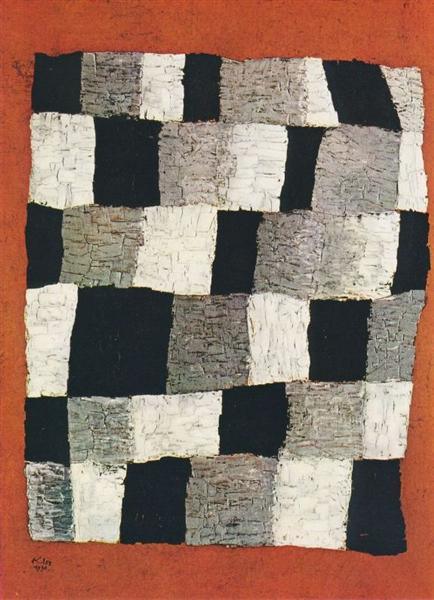
The painting presents a vertical abstract composition organized by an irregular grid of rectangular modules. Black, white or ivory and gray blocks are distributed in staggered rows within a central structure that occupies almost the entire surface. Around it a reddish terracotta field remains visible, acting as a border and a chromatic counterpoint. The shapes are not completely mechanical: some edges show irregularities, brushmarks and variations in the paint that give the geometric construction a tactile presence. Near the lower-left edge a small dark mark appears, discreetly integrated into the field of color.
Rhythmic belongs to the domain of geometric abstraction, where the work does not depend on a narrative scene or identifiable figures. Its content is articulated through the repetition and variation of visual units. Each module participates in a sequence, but none is identical in proportion, texture or relation to the others. The composition thus proposes an experience akin to music: there are pauses, accents, intervals and returns, constructed with shapes and contrasts instead of sounds. The title directs the viewer’s attention to that internal cadence and to the visual movement that runs across the surface from top to bottom.
The central grid organizes a sequence of units that preserves order without becoming rigid. The black blocks introduce decisive interruptions and areas of visual weight, while the lighter modules create luminous pauses between the dark masses. The grays soften the opposition and establish transitions, as well as providing a material richness that makes the sequence feel lived-in rather than purely calculated. The terracotta surrounding the structure functions as an enveloping field: it separates the grid from the surrounding space and, at the same time, links it through a warm tone that contrasts with the severity of black, off-white and gray. Repetition thus acquires a sense of cadence, balance and variation.
Formally, the eye first concentrates on the vertical mass of modules and then moves from one row to the next following their shifts. The changing proportions produce a syncopated rhythm: a wide element visually answers a narrow one, a dark surface to a light area, a straight edge to a broken texture. The horizontal lines and the craquelure marks visible in several modules introduce a surface vibration that alters the reading of the forms. Rather than presenting illusionistic depth, the work keeps attention on the plane and on the tension between structure, color and material. The controlled irregularity prevents monotony and turns the geometry into a dynamic experience.
The composition is related to a widely recognized aspect of Paul Klee’s work: the construction of abstract pieces through signs, geometric modules, linear rhythms and sensitive relationships of color and texture. In Rhythmic, that affinity is evident in the way an apparently simple organization acquires complexity through small differences. The graphic severity of the blocks is softened by their surfaces and by the warmth of the terracotta ground, while repetition maintains a steady pulse. Notice how each module contributes to the whole without losing its individual character: it is in that balance between order and variation that the painting’s visual power is concentrated.
Do you have questions about our hand-painted oil reproductions? See our frequently asked questions.