

Description
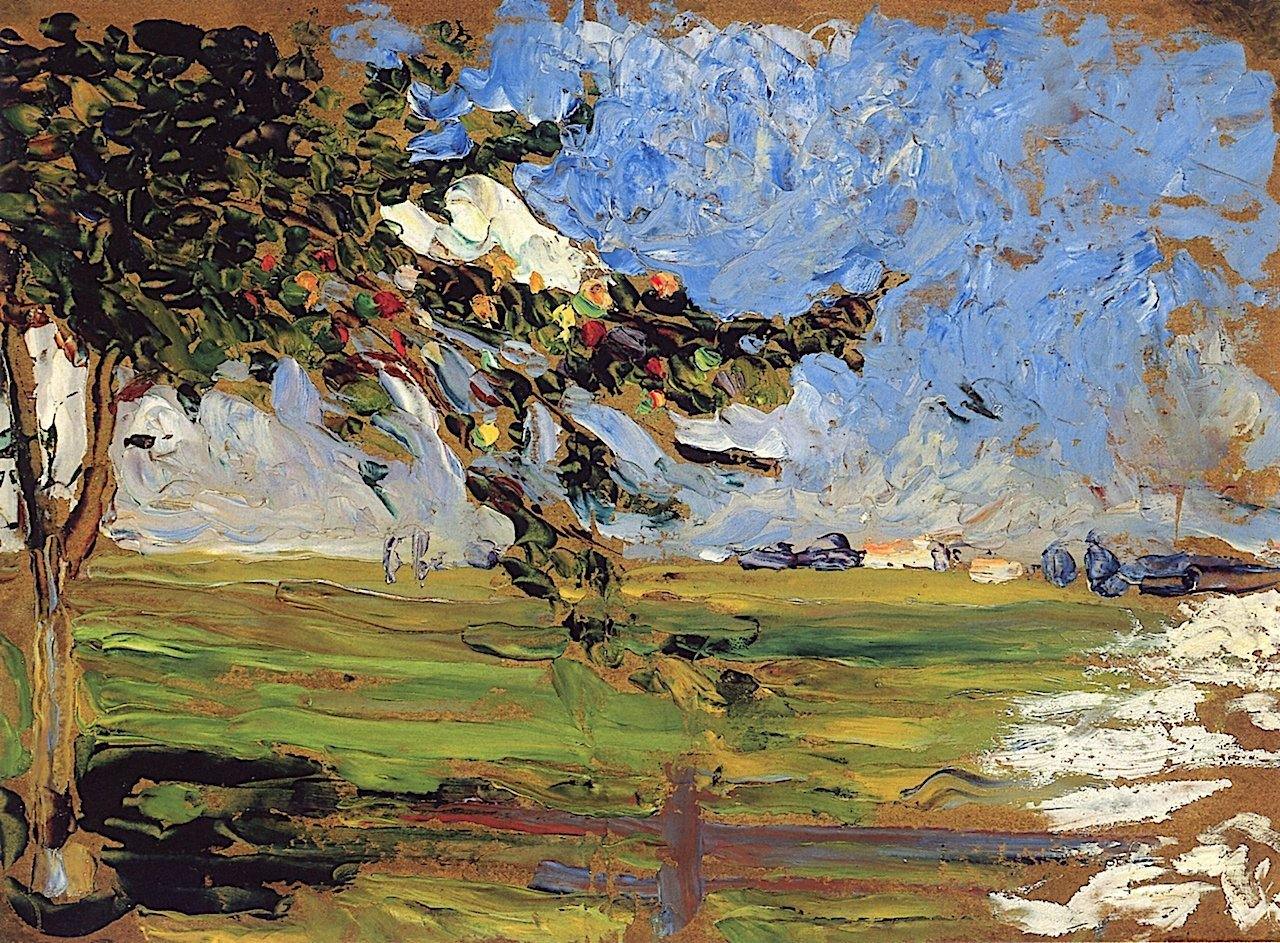
The painting depicts an expansive rural landscape, with an apple tree at the left edge extending its branches toward the center of the composition. Its broad, upright trunk supports a mass of dark foliage dotted with small blossoms and accents of red, yellow and white. Beyond the tree, a wide meadow stretches out in bands of green, ochre and brown, leading toward a range of blue-gray mountains. The luminous sky, partly covered by large white and gray clouds, completes the expansive scene. In the foreground, an elongated dark area heightens the sense of depth and contrast.
As a landscape, the work does not depend on a specific narrative episode, but rather on the relationship between a nearby natural subject and a far-reaching horizon. The apple tree serves as the principal element at the side of the composition and as a visual anchor against the meadow, slopes and open sky. The scene brings together recognizable features of the rural environment, but arranges them expressively, emphasizing the rhythm of forms, shifts in color and the sense of air in motion. In the context of Wassily Kandinsky’s work, this interest in landscape is linked to the gradual transformation of natural observation into a more forceful construction of color and form.
The tree evokes rootedness, fertility and seasonal renewal, although its presence functions above all as a landscape motif. Its flowering branches bring vitality to the upper-left part of the composition and create a dialogue with the open expanse of the field. The mountains and horizon heighten the sense of depth, placing the tree in a space that extends beyond its immediate scale. The sky also contributes to this reading: the shifting clouds and banded meadows suggest a living landscape, shaped by changes in light and wind. The concentration of dark foliage against the bright background turns nature into a structure of contrasts.
The horizontal composition is structured around a contrast between the trunk’s vertical weight and the branches’ diagonal movement. These lines lead the eye from the left edge toward the center, where the landscape opens up and the mountains establish the visual boundary. The dense foliage creates a thick foreground, while the bands of terrain and stepped slopes create a gradual sense of depth. The greens and browns of the meadow are balanced by the blues of the sky and mountainous background; against this foundation, the small patches of flowers serve as rhythmic accents. Light gathers in the clouds and open spaces, making the tree’s dark framework stand out strongly.
The work can be situated within Wassily Kandinsky’s early interest in landscape and in an expressive transformation of color and form. Here, the natural surroundings are organized through chromatic contrasts, dynamic masses, and brushwork that favors visual intensity over meticulous naturalism. The result does not abandon its reference to the countryside, but turns it into a rhythmic construction of depth, atmospheric movement, and balance. It is worth noting how the apple tree does more than frame the scene: its branches extend the energy of the terrain toward the horizon, while the mountains and clouds draw the eye back to the open space. The landscape’s strength lies in this tension between rootedness and expansion.
Have questions about our oil painting reproductions? See our frequently asked questions.