

Description
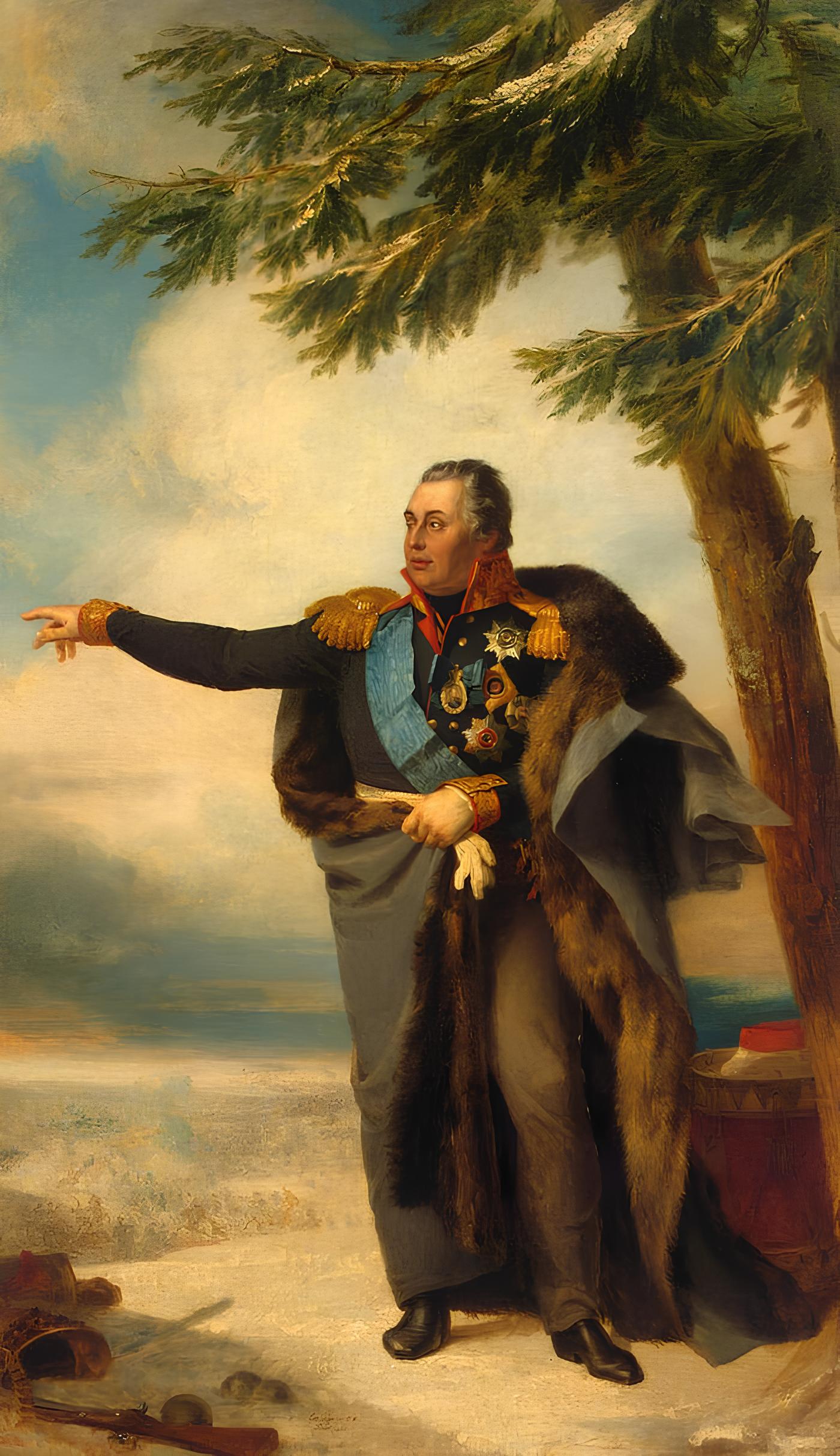
The painting “Portrait of Mikhail Kutuzov” by George Dawe is not just the image of a man, but a visual statement of power, resilience, and history in full motion. The artist captures the essence of the legendary Russian general in a pose that not only commands respect but also sparks curiosity. His outstretched arm seems to direct invisible troops, his expression is stern yet determined, and his entire bearing conveys the image of a strategist in action. This is not a conventional portrait, but a narrative scene that suggests leadership and a deep understanding of the weight of war.
The snowy, vast, and desolate background intensifies the drama of the composition. It is not just a landscape, but a symbol of the harsh Russian winter, the same one that became an ally of Russia during the Napoleonic invasion. The sky, painted with dynamic brushstrokes of blue and gold, gives an epic, almost celestial air that envelops Kutuzov's figure. His stance, firm in the snow, evokes a sense of inevitability, as if history itself were on his side.
The general's clothing is a play of contrasts. The opulence of his uniform, with golden epaulettes and a chest full of medals, speaks of his rank and his feats, while the heavy fur cloak that covers him recalls the harshness of war in the Russian steppes. He is not a distant or ceremonial leader, but a man who lives and breathes conflict, who is at the heart of the battlefield. His attire is not pristine: his gloves hang from his belt, his boots are covered in snow. It is these small details that reinforce his authenticity, showing a commander who, far from the luxuries of power, faces the same hardships as his soldiers.
Dawe, a British painter known for his portraits of Russian generals, masters the art of visual storytelling. On the ground, scattered around him, we find objects that speak of war: a drum, abandoned weapons, cannonballs. They are traces of the battle that has just been fought, and yet, Kutuzov shows no signs of exhaustion or despair. His gaze is fixed on the horizon, suggesting that his mind is already on the next move, the next strategy. The presence of the tree, tall and resilient by his side, is not a mere compositional device; it is a metaphor for strength and resilience, a reflection of the general himself and the nation he leads.
The theatricality of the scene, its dramatic lighting, and the emphasis on the heroic gesture of the protagonist reveal the strong influence of Romanticism in Dawe's work. This is not merely a documentary portrait, but a visual construction of myth. Kutuzov is not just a man of war; he is a symbol, a figure that transcends his time. His posture recalls the classical statues of great commanders, an idealized representation that seeks to inscribe his image in collective memory.
In this portrait, history and art intertwine. Dawe's brushstroke captures not only Kutuzov's physiognomy but also his legacy, his impact on Russian history, and his decisive role in the defeat of Napoleon. It is an image that is not limited to the past but continues to resonate powerfully, evoking the determination and sacrifice of those who shape the destiny of nations. The painting is not only a tribute to a hero but a work that encapsulates the spirit of an era, ensuring that the imposing presence of Kutuzov never fades into the mists of time.