

Description
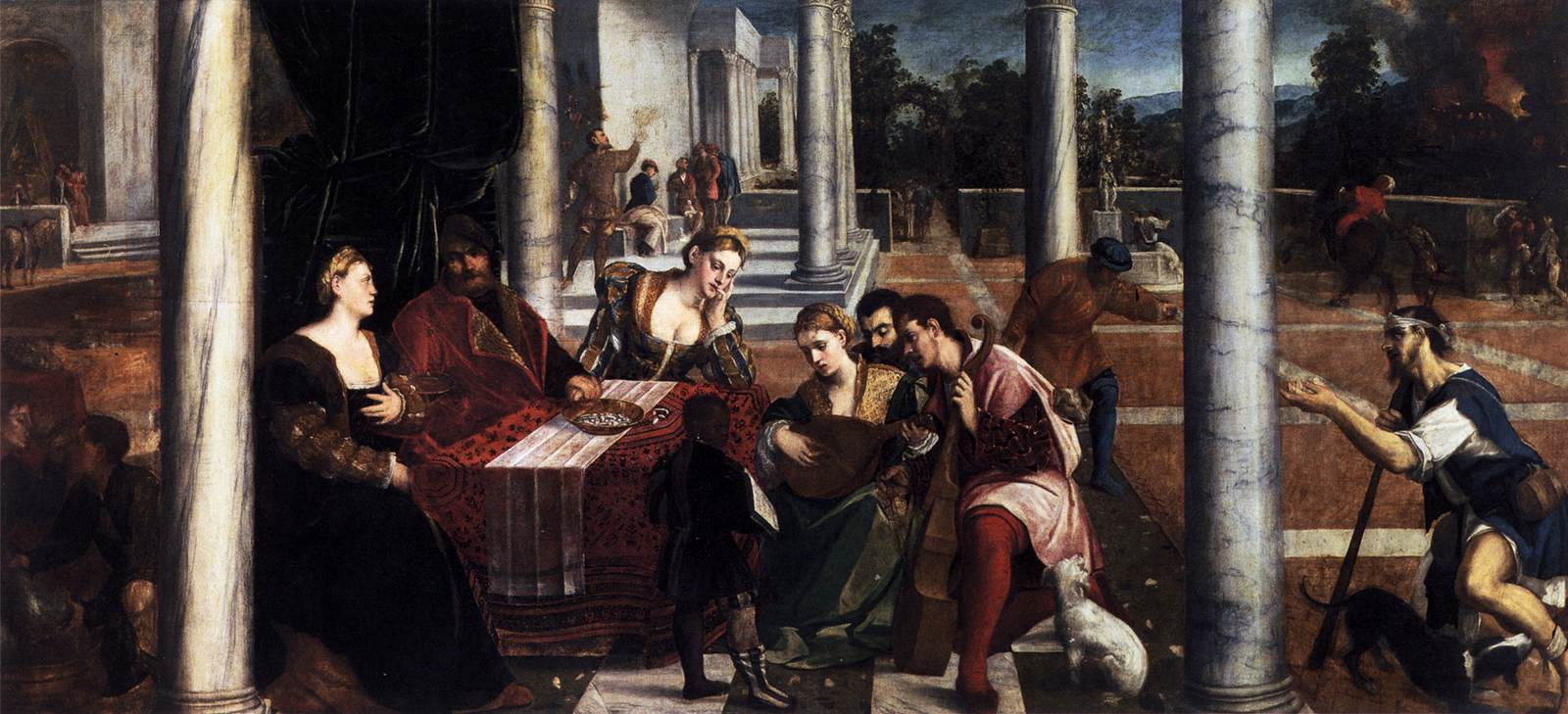
The painting depicts Dives and Lazarus as a spacious, bustling scene of sociability, abundance and public display. At the center, a rectangular table covered with a red cloth brings together several figures seated, leaning forward and conversing. The string instruments, dishes and papers arranged on the table heighten the impression of a feast and shared activity. A man in a rose-colored tunic occupies the foreground, while another figure at the far right gestures and holds a staff. A light-colored dog appears beside the group, accompanied by another partially visible animal. Monumental columns, galleries and staircases structure the courtyard, which opens onto trees, blue-hued hills and a distant sky.
The subject comes from the Gospel parable told in Luke. Dives is the rich man devoted to feasting and luxury, while Lazarus, poor and needy, remains at his gate. The story takes on its moral dimension after both men die, when their fates are reversed: Lazarus receives comfort, and the rich man suffers torment. The scene focuses above all on Dives’s privileged world, with its abundant table, companions and sumptuous architecture, but the presence of the dog keeps the plight of the excluded poor in view and recalls the social contrast at the heart of the story.
The red cloth serves as a visual focal point of wealth and theatricality. Its color and pattern set the table apart from the stony gray of the columns, making the group’s material comfort visible. The musicians and conversationalists turn the banquet into a collective, almost public experience, while the dog in the foreground introduces a note of vulnerability into a space dominated by abundance. The distance between the gathered figures and those scattered throughout the galleries broadens the parable into a reflection on who participates, who observes, and who is left on the margins. Thus, the animals, the table, and the architecture are not mere accessories: they articulate the contrast between immediate pleasure and moral responsibility.
The horizontal composition is organized around a powerful framework of verticals: the columns divide the space, frame the figures, and lead the eye toward the stairways in the background. The central group concentrates the gestural activity, while the depth unfolds gradually through the galleries, trees, and mountains. The dark red of the cloth and some garments creates warm accents against the blacks, browns, and grays of the architecture; the distant blues lighten the density of the foreground. The alternation between illuminated areas and deep shadows creates a theatrical rhythm, as if each section of the courtyard revealed a different part of the narrative.
In Bonifacio Veronese’s work, the Venetian sensibility of the Renaissance is evident in the richness of the palette, the theatrical spatial composition, and the integration of architecture, landscape, and numerous figures within a biblical narrative. The painting does not reduce the parable to an isolated encounter; it transforms it into an entire world, filled with music, conversation, luxury, and movement. It is worth noting how the red table serves as the material center of the scene, while the columns and galleries turn it into a moral stage. Between the celebration in the foreground and the open landscape in the background, Dives and Lazarus makes visible the tension between the abundance that brings people together and the poverty that this very gathering leaves outside.
Have questions about our oil painting reproductions? See our frequently asked questions.