The Divine and Earthly Spark: The Birth of a Revolutionary Genius
Michelangelo Merisi: a name for audacity
Born in Milan around 1571, Michelangelo Merisi adopted the name of his native town, Caravaggio, to distinguish himself in the bustling art world. From the outset, his vibrant personality and bold approach clashed with the academic conventions of the time. His early training, probably with Simone Peterzano, a follower of Titian, provided him with a solid foundation in drawing and color, but it was his later experience that forged his distinctive style. His rebellious nature and fascination with the real shaped his temperament, preparing him to challenge established norms and propose a radically new vision of art. This inclination toward the authentic and the visceral would lay the foundations for his later pictorial revolution.Rome, the crucible of his emerging career
Caravaggio’s arrival in Rome, probably in the early 1590s, marked a crucial turning point. The city, a nerve center of art and spirituality, offered both opportunities and challenges. It was in this environment that his talent began to be recognized, though not without controversy. His early works, often still lifes and genre scenes with single figures, already showed his exceptional ability to capture reality with palpable intensity. Patronage, although intermittent, was essential. Figures such as Cardinal Francesco Maria Del Monte opened the doors to more important commissions, allowing him to develop his technique and consolidate his fame. However, his conflictive character and disdain for artistic and ecclesiastical authority kept him in constant tension, foreshadowing the difficulties that would mark the rest of his life.The master of Black Light: Caravaggio and Tenebrism
The drama inherent in darkness
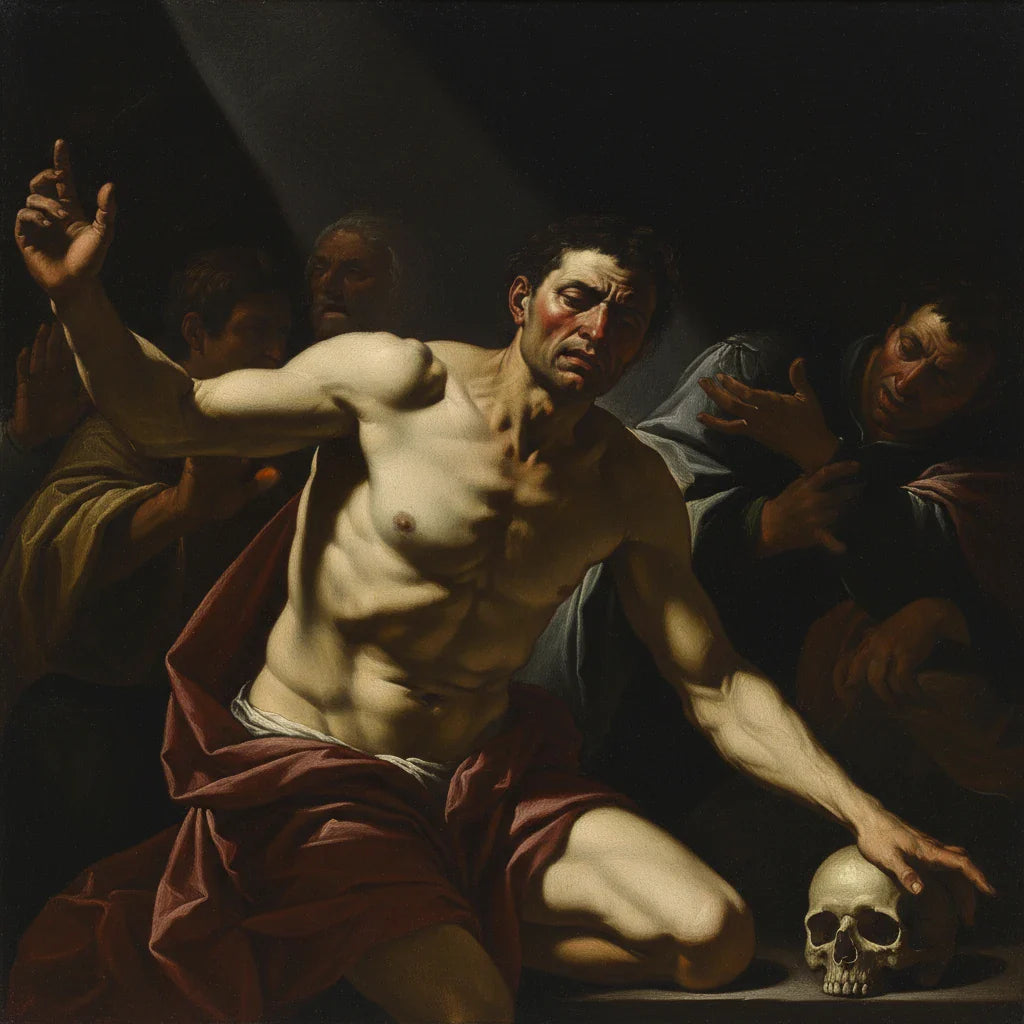
The most distinctive and revolutionary characteristic of Caravaggio’s art is, without doubt, his mastery of chiaroscuro, a style that would soon become known as tenebrism. This technique was not merely an application of luminous contrasts; it was the fundamental tool for infusing his works with a deep sense of drama and psychological tension . By bathing his figures in shafts of intense light emerging from near-total darkness, Caravaggio created atmospheres charged with mystery, emotion, and an intense earthly presence. Black was not the absence of color, but an active space that enveloped and defined the forms, accentuating the solidity of the bodies and the expressiveness of the faces. This visual narrative through light and shadow is what gives his paintings a striking and timeless power.Light as a narrative and emotional tool
In Caravaggio’s hands, light transcends its purely visual function to become a first-rate narrative and emotional agent. This is not a matter of uniform, diffuse lighting, but of dramatic and selective light sources that illuminate precisely what the artist wants to highlight: a face contorted by pain, a hand in a gesture of supplication, the detail of a wound. This focused light not only models the forms and gives the figures an almost sculptural volume, but also directs the viewer’s gaze and evokes deep emotions. The contrast between intense light and impenetrable shadow creates a theatrical dynamic, intensifying the sense of immediacy and the viewer’s participation in the scene. In Caravaggio, light is the storyteller itself, guiding interpretation and amplifying the emotional impact of each scene.Influence on the Baroque and beyond
Caravaggio’s radical stylistic innovation left an indelible mark on European art, especially in the development of the Baroque. His approach to chiaroscuro, emotional intensity, and raw realism influenced a generation of artists known as the "Caravaggists," who spread his style throughout Italy, Spain, France, and the Netherlands. Painters such as Artemisia Gentileschi, Orazio Gentileschi, Bartolomeo Manfredi, and later figures such as Rembrandt and Velázquez adopted and adapted his lighting techniques and naturalistic approach. This influence demonstrated the power of his artistic vision, which succeeded in revitalizing religious and secular painting, endowing it with new vitality and a power to connect with the public that resonated for centuries. The depth of his work continues to inspire artists and art lovers today, showing that his "black light" was, in reality, a light that illuminated the path to the future.Blood, Flesh, and Faith: Characters Brought to Life
The portrait of the human and the sacred
One of Caravaggio’s greatest contributions to art was his ability to strip religious figures of their ethereal idealization and present them with a heart-rending, palpable humanity. In his canvases, saints and martyrs cease to be distant figures and become flesh-and-blood beings, with expressions of pain, astonishment, or resignation that reflect deeply earthly experiences. This approach democratized the sacred, making it accessible and moving the viewer through identification with human fragility. The verisimilitude of his characters, with their wrinkles, humble clothing, and everyday gestures, broke with tradition and set a precedent for a more intimate representation of religious art, one connected to lived reality.Saints with faces from the street
Caravaggio dared to take ordinary people from the Roman streets and place them on the altars, granting them the dignity of divine figures. The result was a revolution in religious iconography. A paradigmatic example is the "Madonna of Loreto," where the Virgin Mary and the Child are depicted with touching simplicity, before two kneeling pilgrims whose dirty feet and tired faces speak of a devotion born of everyday experience. This decision to use everyday life models to embody sacred figures caused scandal among some contemporaries, accustomed to a more formal and stylized representation. However, it was precisely this realism that gave his works unprecedented emotional immediacy, inviting a more personal and profound contemplation of the mysteries of faith.The controversy surrounding his realism
Caravaggio's stark realism, although deeply innovative and emotive, was not free from criticism and controversy. His representations, often stripped of any hint of idealization, clashed head-on with the expectations of the Counter-Reformation, which sought an art capable of inspiring fervor and devotion through beauty and perfection. The inclusion of such everyday and sometimes unpleasant details, such as dirty fingernails or pronounced wrinkles, in figures meant to embody the divine, was seen by many as disrespectful and irreverent. The most famous incident was the rejection of "The Death of the Virgin," a work commissioned for a public chapel, due to the depiction of the Virgin as a woman with a swollen belly and twisted feet, apparently inspired by the body of a prostitute drowned in the Tiber. This resistance to convention, although it earned him ostracism at times, is precisely what we now celebrate as his boldness and genius.Behind the Canvas: Compositions and Masterful Brushstrokes
The power of the foreground and unusual perspective
Caravaggio possessed an extraordinary instinct for composition, masterfully using the space of the canvas to amplify the dramatic intensity of his scenes. His tendency to place the characters in a bold, close foreground, almost invading the viewer's space, creates a sense of immediacy and involvement. He often employs unusual perspectives, cutting figures off at the edges of the canvas or using downward or upward viewing angles that add unexpected dynamism. This deliberate break with the balanced, symmetrical compositions of the Renaissance served to focus the viewer's attention on the crucial moments of the narrative, intensifying the tension and emotional impact of each work. The result is a visual experience that feels much more direct and visceral.The bold use of color and texture
While light and shadow are his most recognizable tools, Caravaggio also demonstrated exceptional mastery of color and texture, using them to enhance the naturalism and emotional power of his works. His palettes, often dominated by earthy tones, deep reds, and intense blacks, accentuate the materiality of fabrics, the fleshiness of skin, and the opulence of garments, even in the humblest scenes. The treatment of textures, from the roughness of a wall to the softness of a cloth, is astonishingly detailed and contributes to a sense of tangible realism. The way he applies paint, sometimes with thick, impasto brushstrokes to emphasize volumes and at other times more finely for details, adds a tactile richness that invites close contemplation of each element, an approach also found in Flemish art.The pursuit of imperfection as beauty
Caravaggio's legacy goes beyond mere representation of reality; it lies in his deep appreciation of the beauty inherent in the imperfect and the human. Unlike his predecessors, who sought idealization, Caravaggio found truth and emotion in an old man's wrinkles, in the dirt on a pilgrim's feet, in the palpable anguish of a martyr. His art celebrates the uniqueness and authenticity of each being, recognizing that it is precisely in imperfection that the true essence of the human experience resides. This vision, revolutionary for its time, opened the door to a deeper and more honest artistic exploration of the human condition, influencing later artistic movements that sought to capture life in all its complexity and rawness, something that can also be appreciated in the expressive force of works such as Soutine's. KUADROS ©, a famous painting on your wall. Hand-made oil painting reproductions, with the quality of professional artists and the distinctive seal of KUADROS ©. paintings reproduction service with satisfaction guarantee. If you are not completely satisfied with the replica of your painting, we will refund 100% of your money.Masterpieces that Illuminate Art History
The Calling of Saint Matthew: a suspended moment
In the Contarelli Chapel of the Church of San Luigi dei Francesi in Rome, Caravaggio immortalized a dramatic instant that redefines religious narrative. The Calling of Saint Matthew is not just a painting, it is a revelation. We see a newly arrived Christ, accompanied by Peter, pointing with authority. His gesture, wrapped in divine light that bursts in from an unexpected angle, illuminates a group of tax collectors absorbed in their coins. Matthew, the protagonist, reacts with surprise, his hand suspended over the money, his eyes scrutinizing the celestial figure that breaks into his everyday life. Caravaggio chooses the precise moment when the divine call interrupts mundanity, freezing the tension between the earthly and the sacred. The use of chiaroscuro, his hallmark, is not merely a stylistic device, but a fundamental narrative element. The light, source of truth and spiritual illumination , highlights the faces and hands, guiding the viewer’s gaze through the scene and accentuating the psychological depth of the characters. The composition, bold and theatrical, breaks with Renaissance conventions, presenting a more intimate and human scene, despite its significance. The details of the clothing, the roughness of the faces, the atmosphere charged with anticipation, all contribute to creating a work of undeniable emotional impact.
David with the Head of Goliath: triumph and melancholy
The canvas of David with the Head of Goliath, housed in the Borghese Gallery in Rome, is one of Caravaggio’s most moving and enigmatic works. It presents a striking duality: the undeniable triumph of youth over brute force, and a profound melancholy that emanates from David’s own figure. The young hero, with an intense and compassionate gaze, holds the severed head of the giant Goliath. There is no boasting in his posture, but rather a serene solemnity, almost a sadness for the violence of the act. Light, as always in Caravaggio, plays a crucial role, sculpting David’s muscular forms and highlighting Goliath’s pale, lifeless face. The blood dripping from the giant’s head is a realistic and disturbing detail, underscoring the brutality of victory. It is speculated that Caravaggio may have used his own self-portrait in the figure of Goliath, a reflection of his own inner struggles and his awareness of mortality. The composition is simple yet powerful, focusing attention on the emotional interaction between David and the inert head. The psychological weight of this work turns it into a meditation on the nature of victory, loss, and the duality of the human being. It is a study of the cost of confrontation and the burden that success brings.
Judith and Holofernes: brutality and female determination
In Judith and Holofernes, Caravaggio explores a biblical episode with graphic violence and unprecedented female boldness. The scene shows the culminating moment in which Judith, with iron determination, beheads the Assyrian general Holofernes. Beside her, the maid Abra, with an expression of anticipation and perhaps revulsion, holds a bag to receive the head. Caravaggio does not dwell on delicacy; the brutality of the act is explicit: the stream of blood pouring from Holofernes’s neck is shocking, the general’s face twisted by pain and disbelief. However, the main focus falls on Judith. Her face, illuminated by intense light, shows a mixture of resolve, duty, and a unyielding determination. She is not a passive heroine, but an active agent of divine will. The chiaroscuro here accentuates the dramatic tension, separating the figures from an obscure and undefined background, and directing all attention toward the central action. The choice to portray Judith not only as beautiful but also as boldly strong challenged the expectations of the time and presented a powerful vision of female agency. The work is a testament to Caravaggio’s ability to infuse visceral realism and psychological depth into religious themes, forcing viewers to confront the raw reality of the narrative.
The Reflection of a Troubled Life: The Artist and His Demons
The volatile temper and the legends surrounding him
The life of Michelangelo Merisi da Caravaggio was marked as much by the intensity of his art as by his volatile temper and his frequent run-ins with the law. Legends about his impulsive nature, his tendency toward street fights, and his involvement in duels are as numerous as the chiaroscuro in his canvases. He is described as a proud man, strong-willed and often irascible, who did not hesitate to defend his honor or his convictions, whether in the studio or in Roman taverns. These anecdotes, recorded by his contemporary biographers such as Giovanni Baglione and Giovanni Pietro Bellori, although sometimes embellished, paint the portrait of a rebellious artist who lived outside the social and artistic conventions of his time. His refusal to adhere to academic ideals of beauty and his commitment to a raw and often disturbing realism won him both fervent admirers and bitter detractors. Caravaggio's figure became an archetype of the tormented artist, whose personal struggles merged inextricably with his creative genius, fueling an aura of mystery and fascination that endures to this day. This complex personality is inseparable from the force and honesty radiating from his work.
Flight and exile: Malta, Naples, and Sicily
Caravaggio's life was marked by constant flight, a shadow that followed him until the end of his days. After being sentenced to death for murder in Rome in 1606, he was forced into exile, seeking refuge in various cities in southern Italy and on the island of Malta. In Naples, he initially found protection and major commissions, such as the execution of the Virgin of the Rosary, but soon his presence was marked by violence. His subsequent move to Malta allowed him to join the Order of the Knights of St. John, thus seeking redemption and protection. There, he reached the rank of knight and painted masterpieces such as the Beheading of Saint John the Baptist. However, his combative temper led to his imprisonment after a fight, forcing him to flee once again. His final stage took place in Sicily, where, despite continuing to produce works of great caliber such as the Resurrection of Lazarus, the threat from his past and the persecution continued. The desire to return to Rome and obtain papal pardon drove him on his fateful final journey, a trek that took him to the coast of Tuscany, where he died under circumstances that are still not entirely clear, leaving behind an artistic legacy and a life marked by constant uncertainty and exile.
The constant search for forgiveness and recognition
Beyond the legends of his dissolute life, Caravaggio showed a deep need for forgiveness and recognition throughout his final years. His condition as a fugitive, sentenced to death in Rome, pushed him to relentlessly seek reconciliation with the Church and, ultimately, with the society that had marginalized him. The search to be pardoned by the Pope was an obsession that guided his movements and his artistic decisions. It is believed that many of his late works, such as the Flagellation of Christ or the Resurrection of Lazarus , reflect an introspection and a spiritual intensity born of his tormented life experience. The desire to bequeath an art that would redeem his name was evident. He tried to win the favor of influential cardinals and powerful patrons, appealing through his brush to compassion and understanding. His final letters and efforts suggest deep remorse and a genuine hope of returning to Rome, not only to paint, but to be reinstated. This struggle for absolution is intertwined with his artistic genius, giving his final creations an almost existential resonance, a silent cry for redemption through art.
Caravaggio in the Digital Age: His Legacy in the 21st Century
Exhibitions and retrospectives that revitalize his work
In the 21st century, interest in Caravaggio’s figure and work not only remains alive, but has been revitalized thanks to exhibitions and retrospectives of global reach. Prestigious museums and galleries dedicate ample space to analyzing his impact, bringing together in one place works scattered across the globe. These exhibitions, such as those held at the Royal Palace of Madrid or the National Gallery in London, not only allow visitors to admire the technical mastery and dramatic intensity of his original canvases, but also offer new perspectives on his creative process, his influences, and his legacy. Modern curatorship often explores unexpected connections, placing Caravaggio in dialogue with other artists, both of his time and contemporary ones, demonstrating his far-reaching influence. Access to these exhibitions, often supplemented with interactive digital resources and comprehensive catalogs, has made a deeper and more accessible understanding of his art possible for a global audience. The Caravaggio phenomenon continues to draw crowds, confirming his status as one of the fundamental pillars of the history of Western art.
The influence on contemporary photographers and filmmakers
Caravaggio’s impact transcends the boundaries of painting and resonates powerfully in the visual arts of the 21st century. His revolutionary use of chiaroscuro, tenebrism, and dramatic lighting has been an inexhaustible source of inspiration for generations of photographers and filmmakers. Directors such as Martin Scorsese, Francis Ford Coppola, and Ridley Scott have explicitly acknowledged Caravaggio’s influence on the visual aesthetics of their films, adopting compositions and lighting schemes that evoke the intensity and realism of his works. In photography, contemporary artists emulate his ability to capture raw emotion and psychological depth through the handling of light and shadow. The visual theater that Caravaggio managed to capture on his canvases, with its dynamic compositions and characters of everyday appearance immersed in moments of great significance, finds a direct echo in modern cinema. The way he approached visual narrative, endowing religious and mythological scenes with a palpable humanity, remains a key reference for those seeking to tell stories with strength and authenticity through striking images.
The accessibility of his works through high-quality reproductions
The digital age has democratized access to art, and Caravaggio’s works are no exception. Beyond museum visits, the possibility of acquiring Hand-made oil painting reproductions of high quality makes it possible for his art to reach homes around the world. Companies like KUADROS specialize in creating meticulous replicas that capture the essence and beauty of Caravaggio’s originals. These pieces, crafted by professional artists, are a testament to the enduring nature of his style and a bridge that allows the public to view up close the power of tenebrism and the depth of his compositions. The availability of replicas of paintings makes it possible to appreciate details that are often lost in digital images, offering a tangible experience of art. This is particularly valuable for works with the textures and light effects characteristic of Caravaggio. Thus, the public can collect art in a more personal way, integrating the genius of master into their everyday surroundings. Access to highly faithful reproductions of online paintings ensures that the magnificence of Caravaggio’s art continues to inspire and enrich lives.
The Enduring Power of an Icon: Why Caravaggio Continues to Fascinate
The universality of his themes: life, death, faith, passion
Caravaggio’s work transcends eras and geographies thanks to the universality of his themes. He approached the pillars of human experience with brutal honesty: life in all its harshness, the inevitability of death, the search for faith, and the intensity of passion. Whether depicting biblical, mythological, or everyday scenes, Caravaggio infused his characters with palpable humanity, giving them recognizable emotions and inner conflicts. His ability to portray fragility, suffering, doubt, and ecstasy in faces that could be those of our neighbors or even our own is what connects so deeply with the viewer. The dramatic intensity with which he captured moments of profound spirituality or extreme violence appeals to primal emotions, making his art resonate on a visceral level. This ability to explore the human condition in its rawest and most moving aspects ensures that his works remain relevant and powerful, regardless of historical or cultural context.
The technical mastery that transcends time
Caravaggio’s lasting influence is not limited to his themes or his storytelling ability; it also lies in his extraordinary technical mastery. His revolutionary use of chiaroscuro, or tenebrism, in which strong contrasts between light and shadow model the figures and create atmospheres charged with tension, defined a new visual language. This technique was not merely decorative, but a fundamental tool for guiding the narrative and evoking emotions. The boldness of his compositions, often off-center and with unusual viewpoints, broke with Renaissance symmetry and balance, giving his scenes surprising spontaneity and dynamism. In addition, his visceral realism , evident in the detailed representation of textures, anatomy, and the expression of the figures, brought an unprecedented sense of realism to his works. The way he applied paint, sometimes directly and energetically, contributed to the vividness and expressive power of his canvases. Caravaggio's technical legacy has been studied and admired for centuries, influencing countless artists and demonstrating that his pictorial genius transcends any era.
How Caravaggio's chiaroscuro resonates in our own lives
The impact of Caravaggio's chiaroscuro goes beyond artistic appreciation; it has a profound resonance in our own perception of the world. In a literal sense, the use of contrast between light and shadow in his works symbolizes the dualities inherent in life: good and evil, hope and despair, the sacred and the profane. Caravaggio teaches us that the most powerful light often emerges from the deepest darkness, and that even in the darkest scenes, there can be a glimmer of revelation or redemption. His focus on realism, showing beauty even in imperfection and harshness, invites us to embrace the full spectrum of human experience, with its personal chiaroscuro. By observing his paintings, we can reflect on our own moments of illumination and struggle, recognizing the complexity of our own lives. The way his figures, often humble or marginalized, are bathed in divine or earthly light reminds us of the dignity and the potential transcendence of each individual. Caravaggio's chiaroscuro, therefore, is not just a pictorial style, but a visual metaphor for our own existence.
KUADROS ©, a famous painting on your wall. Hand-made oil painting reproductions, with the quality of professional artists and the distinctive seal of KUADROS ©. paintings reproduction service with satisfaction guarantee. If you are not completely satisfied with your painting replica, we will refund 100% of your money.