

Description
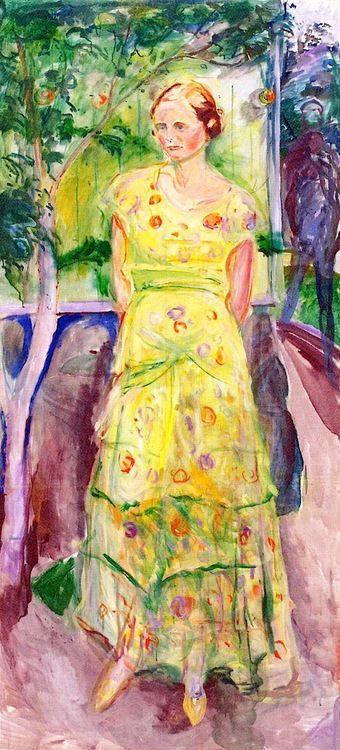
The painting depicts Henriette Olsen standing in a vertical, full-length composition, with the figure at the center, creating a serene, direct, and commanding presence. Her face is turned slightly to the left, while her auburn hair frames her head and her yellow dress falls to her ankles. The garment, covered in floral and botanical motifs, accounts for much of the painting’s visual richness. A dense backdrop of leaves and branches stretches around the sitter, punctuated by vertical and rectangular structures that suggest windows, glass doors, or garden frames. Beneath her feet, pink and violet tones extend the scene into a vibrant field of color.
As a portrait, the work does more than record a person’s features: it constructs Henriette Olsen’s identity through the relationship between figure, clothing, and setting. The sitter appears integrated into an ornamental space of vegetation and architecture, where the garden functions as an extension of her presence. The floral dress visually connects her body with the surrounding foliage, so that the figure is defined as much by her posture as by the chromatic atmosphere enveloping her. This approach places the painting within a modern portrait tradition in which the setting, colors, and spatial arrangement play an active role in characterizing the sitter.
The yellow dress introduces a luminous focal point and makes the clothing more than a merely descriptive element. Its flowers and botanical forms engage in a dialogue with the leaves in the background, creating continuity between the human figure and cultivated nature. The vegetation, concentrated around the sitter, acts as a compositional frame that separates her from the outside space while also incorporating her into it. The straight lines of the structure behind her provide an ordered counterpoint to the foliage’s organic spread. Taken together, these elements create an interpretation in which individual identity is shaped through a close relationship with the garden, color, and ornamentation.
Formally, the painting directs the viewer’s attention through a highly effective contrast: Henriette Olsen’s vertical, relatively stable silhouette stands out against a surface filled with rhythms, leaves, branches, and patches of color. The yellow of the dress serves as the optical center, surrounded by the greens in the background, while the pinks, violets, and blues in the lower area heighten the palette’s vibrancy. The visible brushwork brings movement to the vegetation and the dress motifs, although the frontal pose maintains a sense of stillness. The vertical structures introduce depth and geometry, organizing the space without diminishing its decorative intensity. The gaze thus moves between the face, the dress’s floral surface, and the network of foliage surrounding it.
The work can be placed within a characteristic strand of Edvard Munch’s art: portraits of intense psychological presence, in which color, brushwork, and surroundings all help create the atmosphere. In Henriette Olsen, this intensity does not depend on a dramatic gesture, but on the figure’s visual concentration and the chromatic energy surrounding her. The yellow turns the sitter into a luminous focal point; the foliage frames her, while the architectural lines lend stability to the scene. It is worth noting how the dress does more than simply clothe the figure: it connects her to the entire pictorial space. Much of the portrait’s power lies in this continuity between body, flowers, and garden.
Have questions about our oil painting reproductions? See our frequently asked questions.