

Description
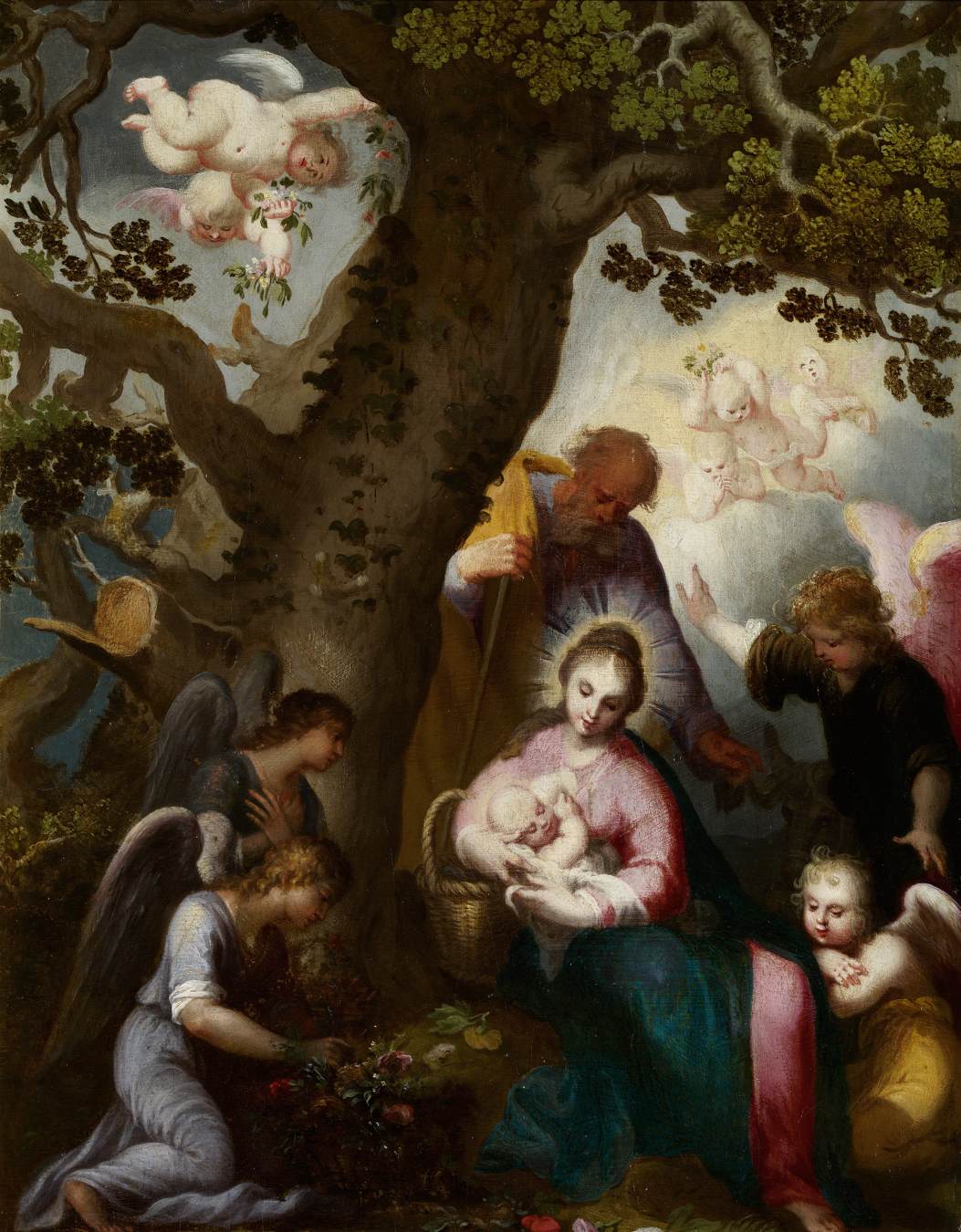
The painting presents the Flight into Egypt as an intimate pause amid a wooded landscape. A large tree with a broad, gnarled, dark trunk occupies the center and extends its branches toward the edges, organizing the composition. In the lower area, Mary sits with the Christ Child in her arms; the naked baby, reclining on her lap, draws the group’s attention. Behind her, Joseph leans forward as he holds a long staff, an attribute that introduces the theme of the journey. A wicker basket, flowers in the foreground, and abundant vegetation complete the setting of travel and rest. Winged figures gather on both sides, some close to the Holy Family and others suspended among luminous clouds.
The episode belongs to the accounts of Christ’s childhood. According to the Gospel of Matthew, Joseph takes Mary and the Child to Egypt to protect Jesus from Herod’s persecution. Christian tradition has portrayed this journey both as a passage and as a moment of rest, placing the Holy Family within natural landscapes. Here, Mary, Joseph, and the Child form the narrative core: she holds and protects him, the child embodies the vulnerability that must be safeguarded, and Joseph, positioned behind them with his staff, brings in the practical dimension of the journey. The scene does not depict an active procession but rather a stillness charged with meaning, in which the family’s closeness is a response to a situation of danger.
The iconography is enriched by the details surrounding the main figures. The basket and vegetation evoke the practical needs of a family on the road, while the flowers and colorful fabrics add a touch of everyday life. Above them, the winged child figures and bluish radiance introduce a celestial realm that envelops the earthly refuge with a sense of divine protection. The central tree serves as a sheltering axis: its branches form a visual canopy over the family and separate the luminous realm above from the denser space of the forest. The inclined gestures of the winged figures reinforce their devotional attention to Mary and the Child.
The vertical composition is structured through contrasts and diagonals. The trunk divides the pictorial field, but its branches connect the two groups of figures and lead the eye toward the lower center. The staff extends a diagonal linking Joseph with Mary, while the inclined bodies of the winged figures create a rhythm of attentive gestures around the baby. The dark browns and greens of the foliage establish an enveloping foundation, interrupted by the pink, red, blue-green, and yellow of the garments. In contrast to the density of the forest, the white and gray-blue clouds open up areas of light that highlight the figures and balance the mass of branches, leaves, and figures.
The work is consistent with features widely associated with Abraham Bloemaert and Northern Mannerism: a complex, densely populated composition, carefully drawn figures, contrasting colors, and a landscape that actively contributes to the religious narrative. The abundance of elements creates a visual network of protection around the mother and child. The tree functions simultaneously as a structure, a refuge, and a boundary between the earthly and the celestial. In this arrangement, the The Flight into Egypt takes the form of a vision of suspended passage: the danger is suggested by the necessity of the journey, while the light, gestures, and gathering of the figures turn the rest into an image of care and shelter.
Have questions about our oil painting reproductions? See our frequently asked questions.