

Description
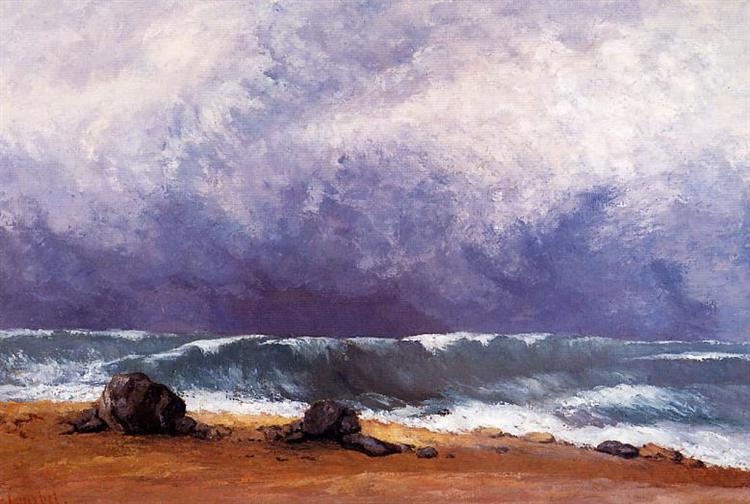
The "La Ola" painting by Gustave Coubet, created in 1871, is erected as a powerful testimony of the artist's mastery in the capture of nature and emotionality that it can evoke. Courbet, central figure of realism, takes advantage of its exceptional technical ability to take the marine landscape as a physical and symbolic scenario. This work stands out not only for its execution, but also for its ability to interact with the viewer at a visceral level.
Visually, "the wave" consists of an intense movement, where the waves rise in an almost dramatic deployment of energy and strength. The central wave, the protagonist of the work, is presented at a climax, breaking with a visual impact that catches the viewer's attention. This effect is achieved through careful contrast practice, where the foaming target of the wave contrasts with the darkest tones of the calm sea that surrounds it. This technique produces a dynamism that almost seems to transport the viewer to the edge of marine foam, suggesting the fragility of the balance between beauty and the danger that the ocean represents.
The color plays an essential role in the structure of the work. The various shades of blue, green and gray of the water combine in a spectrum that remembers the constant change of the sea. Courbet not only uses a rich and naturalist palette; Their chromatic choices feel emotionally resonant, evoking both the astonishment in the face of the greatness of nature and a reverent respect for its power. The texture is also fundamental, with brushstrokes that provide a sensation of immediacy that almost gives life to the waves.
As for the human figure, or her absence, it is significant that in "the wave" there are no visible characters. This approach allows attention to fully focus on the landscape and the natural phenomenon, an artistic decision that reflects a philosophy deeply rooted in realism. Courbet, through his choice not to include human figures, suggests that the individual is insignificant against the immensity of nature. Since the spectator is in the face of this magnitude, there is a reflection on the relationship between man and his surroundings, a recurring theme in Courbet's work.
Often "the wave" is considered a precursor of themes that would later be explored by other artists, as well as a work that represents the struggle between nature and man, something that would strongly resonate in impressionist art and in later movements . Courbet's influence on modern art is indisputable; His rejection of idealization and his inclination towards the honest representation of the natural world laid the basis for future generations of artists to venture to explore more abstract and emotional issues.
Courbet's work, particularly "the wave", is a reminder that nature is not only a scenario for human existence, but a powerful actor in the narrative of art and human experience. The ocean, in its indomitable greatness, becomes a mirror of human emotions, reflecting both its beauty and its danger. In this sense, "the wave" is not simply the representation of a moment in time, but a continuous dialogue between man and nature, an eternal reminder of the challenges we face before the majesty of the world that surrounds us.
KUADROS ©, a famous paint on your wall.
Hand-made oil painting reproductions, with the quality of professional artists and the distinctive seal of KUADROS ©.
Reproduction service paintings With a guarantee of satisfaction. If you are not completely satisfied with the replica of your painting, we refund your money 100%.