An artist’s journey is often as captivating as the works left behind. It is an odyssey of self-discovery, marked by internal battles, moments of epiphany, and the persistent search for a voice that resonates through time. In this intimate exploration, we delve into the soul of a creator, unraveling the layers that make up their artistic narrative.
Through their early works, their struggles to find their style, and the environment that shaped their perspective, we begin to understand the complexity behind each stroke. This analysis not only sheds light on the artist’s life, but also enriches our appreciation of their legacy, offering a window into the genesis of masterpieces and the alchemy of creativity.
The Canvas as a Refuge: First Strokes in an Uncertain World
From their earliest years, the canvas became a sanctuary, a space where the uncertainty of the outside world dissolved before the certainty of creation. The first attempts, often marked by imitation and experimentation, reveal a deep need for expression. The artist sought in color and form a language of their own, a way to make sense of the life experiences that surrounded them. Decisions such as using a somber or vibrant color palette in their early years could reflect moods or influences from emerging artistic movements, even if they were not yet fully aware of it. A common mistake when analyzing these periods is underestimating the importance of self-taught techniques; the artist was not merely copying, but breaking down and assimilating to build their own path. For example, their early portraits may have lacked the psychological depth that would characterize their later work, but the ability to capture physical features already pointed to latent talent. Fear of failure, lack of financial resources, or family disapproval are just some of the common obstacles faced by young artists, and our protagonist was no exception. Facing these adversities required unwavering resilience and deep faith in their calling. At this stage, the artist was learning not only about art, but about themselves, discovering the sources of their inspiration and the limits of their discipline. The need for a space of their own, whether a corner of a room or an improvised studio, became crucial for cultivating these early ideas and giving them physical form. Contact with masters or visits to exhibitions, even if limited, acted as catalysts, revealing possibilities and raising their aspirations.
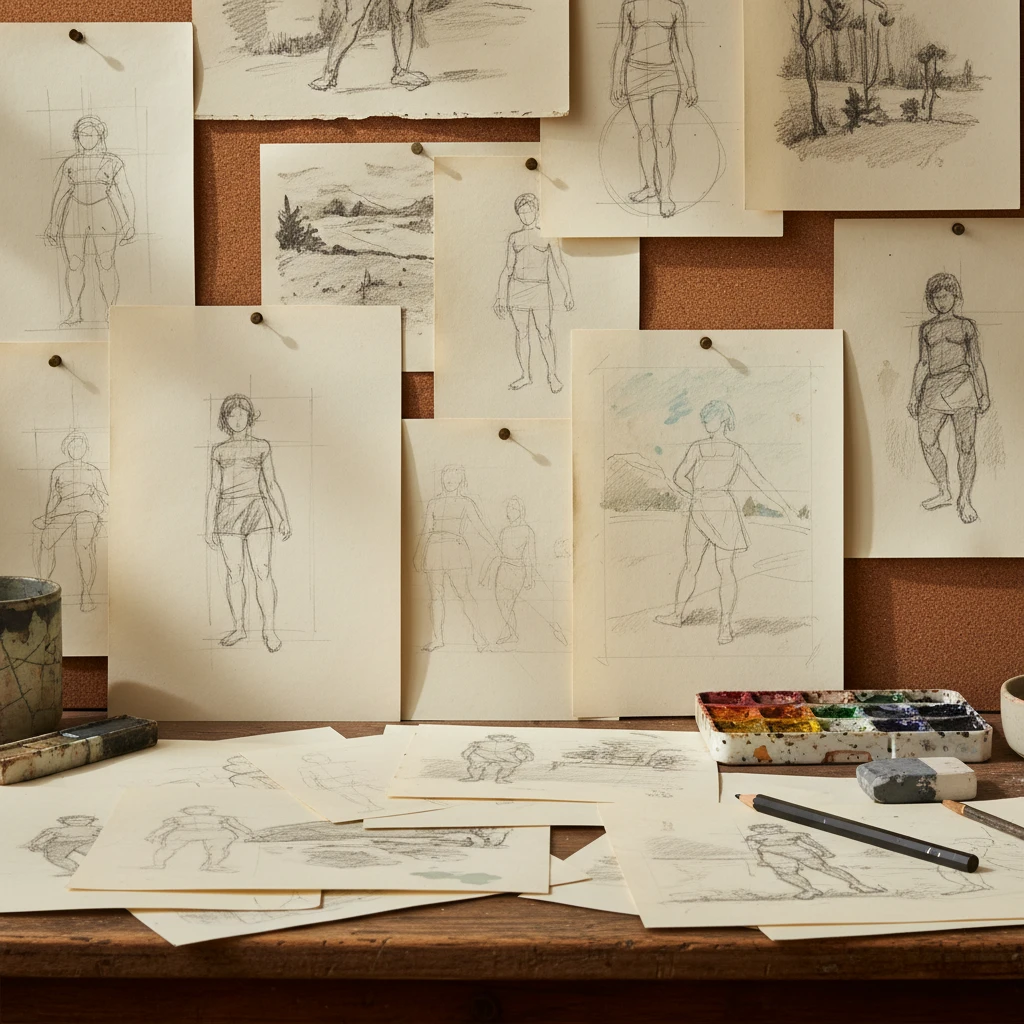
The decision to pursue art professionally is rarely linear. It involves weighing passion against stability, risk against reward. For this artist, the key moment came after a particularly defining experience, perhaps the contemplation of a work that moved them deeply or the recognition of a mentor. The first steps on this path often face criticism and skepticism, requiring exceptional willpower to move forward. Analyzing the evolution of their technique, from shaky strokes to the confidence of a steady line, allows us to trace their growth. For example, an early study by still life might show a struggle with perspective and lighting, while a later work would reveal mastery of these elements, demonstrating steady practice and active learning. The real challenge lies in transforming influence into identity, allowing the lessons learned to be integrated without losing uniqueness. If the artist devoted themselves to landscape painting, their first attempts might be imitations of masters landscape painters, while over time they would develop a unique vision of nature, perhaps focusing on the portrayal of changing atmosphere or the interaction of light with the terrain. Art, in its beginnings, is an act of courage and faith, a blank canvas that promises endless possibilities to whoever dares to fill it.
The Creative Spark: Discovering a Unique Artistic Voice
The transition of an artist from mere execution to true artistic expression is an alchemical process, where technique merges with emotion to give rise to an unmistakable voice. This discovery is usually not a single event, but a series of gradual epiphanies, driven by introspection and interaction with the world. The search for authenticity is a common thread; the artist begins to question conventions, to experiment with themes that resonate within them, and to develop a style that reflects their personal vision of the world. A fundamental criterion at this stage is the break with slavish imitation. While the study of the masters is essential, the true voice emerges when the artist learns to filter those influences through their own sensibility. For example, a painter may have admired the dramatic intensity of Caravaggio, but instead of replicating his chiaroscuro, they choose to infuse their own compositions with a subtler and more personal light, creating atmospheres of introspection rather than pure drama. The obstacles along this path include the fear of criticism, commercial pressure to conform to established tastes, and the artist's own doubts about the validity of their approach. Overcoming these fears involves a deep connection with one's own intuition and the conviction that their perspective is valuable. A hypothetical example could be an artist who, after receiving negative feedback on their color experimentation, decides to ignore it and continue exploring bold palettes, which eventually leads them to define their distinctive signature. The work of artists such as Modigliani, with their stylized and melancholic figures, exemplifies how a unique vision can challenge the aesthetic norms of its time and, in time, be acclaimed for its singularity.
The development of a unique artistic voice is also a constant dialogue with the cultural context and artistic trends of the time, but filtered through a personal lens. The artist may draw inspiration from movements such as the Renaissance, but infuse their works with a more modern sensibility, or reinterpret the use of color explored by abstract expressionism in unexpected ways. The actionable steps to cultivate this voice include deliberate practice, constant experimentation with materials and techniques, and critical reflection on one’s own work. A common exercise is the creation of a visual journal, where ideas are noted, quick sketches are made, and compositions are explored without censorship. Another crucial step is the honest confrontation with one’s own style: what themes obsess me? What emotions am I trying to evoke? What formal elements attract me most? One example of how this unique voice manifests could be the particular way an artist approaches portraiture: do they focus on precise anatomy, psychological expression, or the abstraction of form? Every choice, from the brushstroke gesture to the choice of subject, contributes to the artist’s personal narrative. Discovering this voice is, in essence, finding inner truth and having the courage to put it on the canvas, regardless of external conventions. This authenticity is what ultimately creates art that moves people and endures.
The Studio: Laboratory of Experiments and Revelations
An artist’s studio is more than a simple workspace; it is a sanctuary, a laboratory of experimentation, and often a reflection of the creative mind. This is where abstract ideas take physical form, where successes are celebrated and failures are analyzed as valuable lessons. The organization of the studio, or lack thereof, can reveal a great deal about the artist’s creative process. Some prefer a meticulously orderly environment, where every tool and material has its place, enabling a methodical approach. Others thrive in apparent chaos, finding inspiration in the spontaneous arrangement of canvases, pigments, and sketches. A key criterion for artistic development at this stage is a willingness to experiment. The studio becomes a testing ground for new techniques, unusual materials, and bold color combinations. The artist is not afraid to make mistakes; each "mistake" is an opportunity to learn. For example, an artist might experiment by mixing non-traditional mediums with their oils, or by trying alternative supports to canvas, seeking unprecedented textures and effects. The common pitfalls At this stage, these include analysis paralysis, where an overabundance of options or the pursuit of perfection inhibits action, or resistance to abandoning proven techniques in favor of exploration. An actionable step to counter this is to establish experimentation “rules,” such as dedicating one day a week to trying something completely new, without the pressure for the result to be a masterpiece. The legacy of masters as the great masters was often forged in vibrant workshops, where daily practice and technical problem-solving were just as important as initial inspiration.
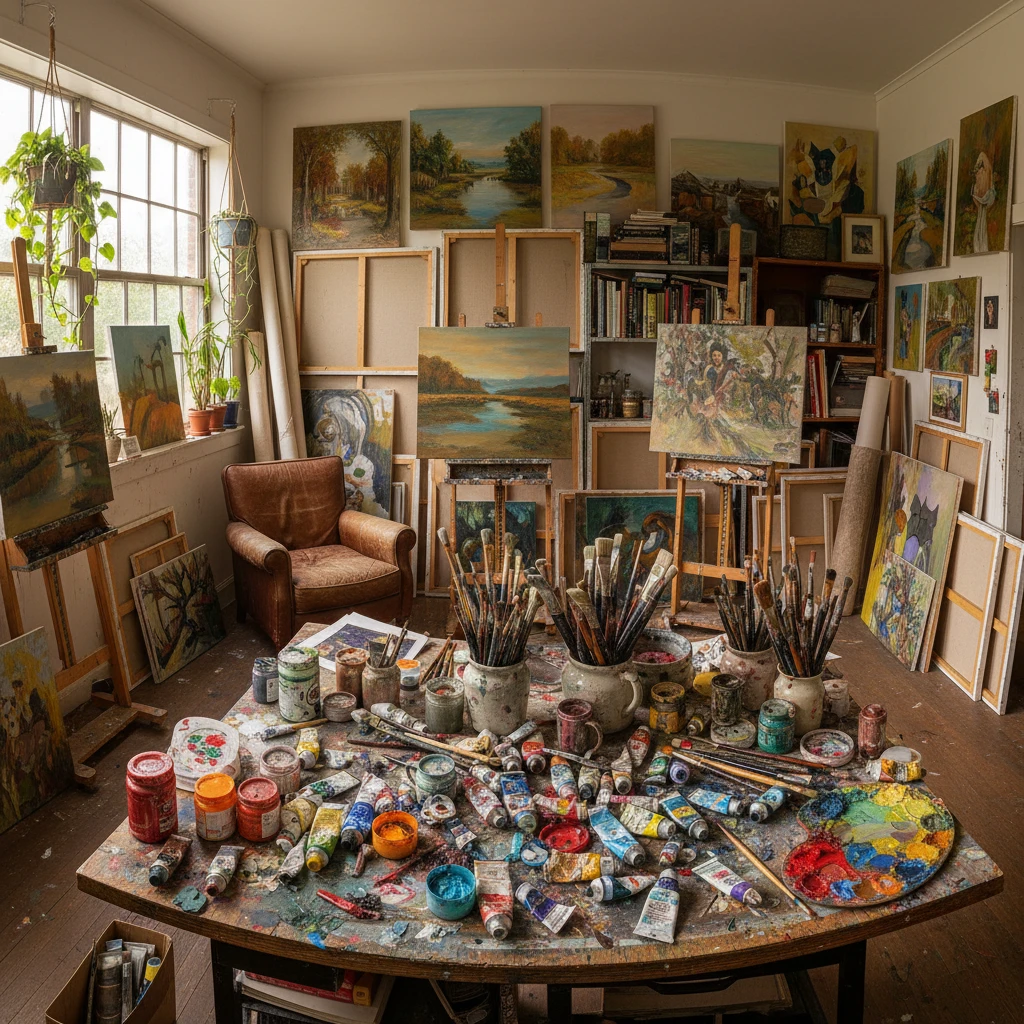
Within the workshop, the dialogue between the artist and their work is constant. Every brushstroke, every layer of paint, is a response to the previous stage. The process can be intuitive, but it often involves methodical problem-solving. How do you achieve the desired color transition? How do you build depth in a composition? The artist becomes a detective of their own creation, seeking the solutions that best serve their vision. One example of this process could be the way an artist approaches the representation of light. They might spend hours mixing pigments to capture the exact hue of a sunset, or experiment with translucent layers to simulate the refraction of light through an object. The influence of the material is also fundamental; the texture of the canvas, the viscosity of the oil, the opacity or transparency of a pigment, all dictate possibilities and limitations. An artist working with a fast-drying oil may take a more gestural and energetic approach, while one using a glazing technique might opt for a slower, more reflective pace. The workshop is not only a place of production, but also a space for continuous learning. It is where theory meets practice, and where the artist’s vision is shaped and refined through tangible action. The culmination of this process is often a work that not only satisfies the artist, but also communicates an emotion or an idea to the viewer, a testament to the alchemy that happens within the walls of their creative refuge.
The Influence of the Surroundings: Echoes of Their Time in Every Brushstroke
No artist creates in a vacuum; their work is an intrinsic reflection of the era, culture, and circumstances that surround them. The environment, whether physical, social, or political, permeates every brushstroke, every choice of subject, and every style adopted. To truly understand an artist, it is crucial to examine the echoes of their time resonating in their art. Key contextual factors include the prevailing artistic movements, technological developments, historical events, and philosophical and social currents. For example, an artist working during the height of the Baroque could have been influenced by the drama, intense emotion, and theatrical use of light characteristic of that period. Likewise, the emergence of new technologies such as photography may have pushed painters to explore territories the camera could not capture, leading to innovations such as Impressionism or Expressionism. Common interpretation errors when considering the influence of the environment are oversimplifying the connection, assuming the artist is merely a passive reflection of their time, or, conversely, completely ignoring these influences and attributing the entire work to isolated genius. One actionable step for a deeper analysis is to research the contemporary historical and cultural events surrounding the artist. What wars, revolutions, or scientific discoveries were taking place? What ideas were circulating in intellectual and artistic circles? An artist who lived during World War I, for example, could infuse their work with a sense of disillusionment or fragmentation, reflecting the turmoil of the era, much like Surrealism emerged as a response to the perceived irrationality of war and industrialization.
The relationship between the artist and their environment is dialectical; the artist is influenced, but can also influence. The artworks can capture the spirit of an era, act as social commentary, or even challenge established norms, becoming catalysts for change. The artist's lifestyle and social conditions also play a role. An artist who enjoys royal patronage or the wealth of the bourgeoisie may have the freedom to explore more ambitious themes and use high-quality materials, as seen in the courts of Spain under Velázquez. In contrast, an artist with limited resources may be forced to work with more modest materials or to address themes that resonate with the everyday life of the working classes. A hypothetical example: a 21st-century painter immersed in the digital age might incorporate elements of street art, references to internet memes, or explore the theme of online identity, subjects that did not exist for artists of previous centuries. Understanding the evolution of perspective in art, as studied in the Renaissance, not only changed the way three-dimensional space was represented, but also reflected a new conception of human beings as the center of the universe. Ultimately, every work of art is a time capsule that encapsulates the tensions, hopes, and worldviews of an artist and their era. Recognizing these connections greatly enriches our appreciation of the work, allowing us to see beyond the surface and understand the deep web of influences that bring artistic creation to life.
Color as Language: Chromatic Psychology and Artistic Decisions
The artist understood color not only as an aesthetic element, but as a fundamental vehicle for emotional and conceptual expression. His command of color psychology allowed him to evoke specific moods, create atmospheres, and guide the viewer’s perception. When selecting a palette, he thought not only about visual harmony, but also about the psychological resonance that each tone could generate. For example, the use of deep blues could convey melancholy or serenity, while intense reds often signaled passion, urgency, or danger. The way he combined these colors, whether through bold contrasts or subtle gradations, was a deliberate artistic decision to enrich the meaning of his works. This deep connection between color and emotion is a recurring theme in the study of masters, as can be seen in the analysis of the impact of light in Vermeer’s work, where the choice of pigments is crucial to the atmosphere of intimacy and contemplation. Investigating these chromatic choices reveals additional layers of interpretation and appreciation in his output.
Emotion palettes: how the artist conveyed feelings through colors.
The artist’s ability to translate complex moods into the language of color is one of the most distinctive features of his work. It was not a simple application of pigments, but a carefully orchestrated chromatic symphony. To convey joy and vitality, he turned to combinations of bright yellows, energetic oranges, and warm reds, applied with loose, luminous brushstrokes. In contrast, to evoke introspection, loneliness, or a feeling of spiritual transcendence, he preferred deep sky blues, enigmatic violets, and moss greens, often using glazing techniques to achieve an ethereal softness and depth. His focus on the correspondence between color and emotion aligns with the philosophy of artists like Mark Rothko, who saw color as a direct emotional portal, capable of bypassing the mind and speaking to the soul. Studies on color psychology confirm how certain hues trigger specific emotional responses, and the artist demonstrated exceptional instinct in harnessing these principles intuitively and masterfully. The choice of a particular tone, whether an intense crimson or a somber indigo, was not a whim, but a conscious tool for connecting with the viewer on a visceral level.
The hidden symbolism in unexpected color combinations.
Beyond direct emotional expression, the artist often used apparently discordant color combinations to build deeper, more symbolic meanings. He could, for example, juxtapose a vibrant emerald green with an earthy ochre to suggest the tension between the natural and the artificial, or between life and decay. The use of gold, not only as a luxurious accent but integrated into the very texture of the painting, could evoke the sacred, the ethereal, or the fleeting nature of glory. These chromatic choices did not follow conventional rules, but instead arose from a personal exploration of symbolism and from his own worldview. A hypothetical example could be a nighttime scene where, instead of the expected blues and blacks, the artist used touches of fuchsia and burnt orange to represent the latent energy and dreams lurking beneath the surface of apparent reality. This chromatic boldness invites the viewer to question their own color associations and to discover new layers of interpretation in the work. Such boldness resonates with the way other artists, such as the surrealists, used unexpected juxtaposition to unleash the subconscious, as can be seen in Dalí's Surrealism, where chromatic logic is distorted to explore the dreamlike.
The Masterpieces: Moments of Genius Captured in Oil
The masterpieces of this artist are not mere objects of beauty, but portals to moments of profound introspection and captured genius. Each canvas is the result of a meticulous process of conception and execution, where every brushstroke, every color choice, every compositional detail contributes to a powerful visual narrative. These pieces transcend their materiality to become testimonies to the artist's unique vision and his ability to transform the ephemeral into something lasting. They are the pinnacle of his career, where his style is consolidated and his message reaches its greatest resonance. The way the oil adheres to the canvas, the texture that emerges from the layering of coats, and the way light interacts with the painted surface are crucial to the experience of contemplating these works. The legacy of many great masters lies in the endurance of these creations, allowing us today to access them and marvel at their lasting impact; a topic explored in The Legacy of the Masters.
Anatomy of an iconic work: breaking down the key elements.
To understand the magnitude of an iconic work, it is essential to break it down into its fundamental components. This involves analyzing the overall composition, spatial structure, and arrangement of the elements that guide the viewer's gaze. The choice of focal point, the horizon line, or the way the characters interact within the frame are decisions that orchestrate the narrative. Lighting plays a crucial role; whether dramatic and high-contrast, as in Caravaggio's chiaroscuro, or soft and diffused, it directly influences the atmosphere. In addition, the treatment of textures, whether the velvety softness of a fabric or the roughness of a stone surface, adds a tactile dimension to the visual experience. Every figure, every object, every trace of brushstroke is charged with intention, and by examining these elements closely, we can appreciate the depth of the artist's thinking. For example, in many works, the symmetry or asymmetry of the composition can suggest order or chaos, balance or tension. Even the choice of support, the prepared canvas or the panel, can subtly affect how colors settle and how light is reflected, elements that enrich the appreciation of works such as those of Caravaggio.
The creative process behind his most celebrated pieces.
The path to a masterpiece is rarely linear; it is paved with sketches, preliminary studies, and, often, moments of doubt and discovery. The artist did not begin with a fully formed vision, but rather discovered and refined it through an iterative process. His sketchbooks, if they existed, would reveal countless variations of ideas, explorations of poses, studies of anatomy, and experiments with light and color. The preparatory studies, often done in charcoal, pastel, or watercolor, served as testing grounds for his final oil compositions. This groundwork was essential for solving technical and conceptual challenges before committing to the final canvas. On occasion, changes on the canvas were an integral part of the process, showing how the work evolved as the artist responded to the serendipities that arose during painting. Patience and perseverance were, therefore, virtues as important as innate talent. The way artists like Velázquez approached the representation of reality and the Spanish court also involved a careful process of observation and refinement, something that can be explored in the analysis of his work.
The Dialogue with Criticism and the Public: Reception and Recognition
The work of this artist, like that of many influential creators, did not exist in a vacuum; it was received, debated, and, ultimately, integrated into the artistic canon through a complex dialogue with critics, collectors, and the general public. The first exhibitions of his works may have generated mixed reactions: admiration for their boldness and originality, but also skepticism at his departure from established conventions. The critics of the time, with their own aesthetic and intellectual agendas, played a crucial role in shaping public perception of his art. Their writings, whether praising or disparaging, influenced the way the works were viewed and valued. Over time, and as the cultural context evolved, the artist's work found a broader audience and greater appreciation, leading to his recognition as a significant figure in art history. The way the public interacts with art, whether in museums, galleries, or reproductions, reveals a great deal about an artist's cultural impact and enduring resonance.
Stylistic Evolution: A Journey Through Decades of Creation
The artistic career of this painter was not static, but rather a dynamic journey of growth and transformation spanning several decades. From his earliest works, influenced by the currents of his time, to his more mature and personal explorations, each stage of his career reveals a conscious evolution and a constant search for new forms of expression . This stylistic metamorphosis was not an accident, but the result of deep reflection on art, life, and his own place in the world. Observing this progression allows us to understand not only the development of his techniques and visual language, but also the reflection of an inquisitive intellect that never stopped questioning and reinventing itself. The history of art is full of examples of artists who radically changed their approach, such as those who experimented with perspective during The Renaissance, demonstrating that evolution is a constant in creation. This stylistic journey is, in itself, a work of art.
From abstraction to realism: the key stages of his artistic development.
The artist went through various stylistic phases, each marked by a different approach to representation and technique. His beginnings may have been rooted in academic realism, where anatomical precision and fidelity to nature were paramount, perhaps influenced by masters of the Spanish Baroque such as Velázquez or the exponents of the Spanish Baroque. Later, he may have experimented with more avant-garde movements, delving into lyrical or geometric abstraction, where form and color were freed from the need to imitate reality in order to express pure ideas or emotions. Then, he might have returned to reinterpreted figuration, perhaps with an emphasis on the essence of forms or expressive distortion, similar to the way Modigliani explored the beauty of the incomplete. These transitions were not necessarily linear; an artist could revisit elements from earlier stages or fuse influences in unique ways. Flexibility and openness to new ideas allowed his work to remain fresh and relevant throughout his career, avoiding complacency and demonstrating a deep knowledge of art history and its possibilities.
How changes in his personal life were reflected in his art.
An artist's life is intrinsically linked to their output; personal experiences, joys, losses, and life milestones often left a discernible mark on their work. A period of happiness and personal stability could manifest in brighter palettes, serene compositions, and optimistic themes. Conversely, moments of hardship, grief, or existential crisis could translate into more somber tones, compositions charged with tension, or a deeper exploration of existential themes. For example, the death of a loved one could lead to a series of introspective portraits, or an inspiring trip could result in vibrant landscapes full of a new perspective. These transformations are not always explicit, but by examining the chronology of his life alongside the evolution of his style and themes, one can draw revealing parallels . The influence of personal events on artistic expression is a universal phenomenon, and in the case of this artist, their intimate experiences became deeply intertwined with their visual language, giving their work a unique authenticity and emotional resonance.
Craft Secrets: Techniques and Materials Revealed
An artist’s mastery resides not only in their vision, but also in their command of the tools and secrets that bring their creations to life. Every brushstroke, every layer of pigment, every material choice is a deliberate component in the architecture of a work. To truly understand an artist, we must step into their studio, observe their gestures, and decipher the chemistry between the creator and their instruments. The choice of canvas, for example, can vary dramatically; from the roughness of linen to the softness of cotton, each texture offers a different receptivity to paint, affecting how light is reflected and the depth that can be achieved. Artists with a penchant for meticulous detail, such as those influenced by the Renaissance, often prefer fine-grain canvases to allow for a more precise application of pigment, something that can be appreciated in the delicacy of the figures and architectures depicted in works like those that explore the odyssey of perspective.
The color palette is another battleground and field of experimentation. Pigments, derived from mineral, plant, or even synthetic sources, have unique qualities of opacity, transparency, permanence, and reaction with other compounds. An artist like Caravaggio, master of chiaroscuro, not only used light to create drama, but also selected pigments that allowed for deep and dark tonal transitions, achieving that highly characteristic emotional impact. Understanding how these pigments interact with binders (oil, tempera, watercolor) is essential for predicting the final result and the longevity of the work. The glazing technique, for example, which consists of applying thin, transparent layers of paint, requires exquisite control over the consistency of the binder and the opacity of the pigment to achieve subtle effects of light and depth, a technique that highlights depth in works such as Caravaggio’s chiaroscuro.
The study of the artist’s tools is equally revealing. The variety of brushes—round, flat, fan, cat’s tongue—and their different materials (hog bristle, sable, synthetic) offer different possibilities for application. A hard hog-bristle brush can be ideal for applying thick impasto and creating bold textures, while a fine-hair brush allows delicate strokes and precise details. The way an artist holds the brush, the pressure they apply, and the speed of their movement are intimate gestures that convey the energy and intention behind each mark. Even the choice of solvent or medium can alter the fluidity of the color and drying time, directly impacting the creative process and the final appearance of the work. For an artist seeking to recreate the textural richness of the great masters, understanding these interactions is paramount.
Beyond the Canvas: The Legacy and Lasting Influence
The true reach of an individual’s art transcends the walls of their studio and the galleries where it is exhibited. Their legacy is woven into the cultural tapestry, influencing generations of artists, collectors, and the general public. This impact is not limited to stylistic imitation; it often appears in the adoption of new perspectives, the exploration of previously uncharted themes, or the introduction of technical innovations that expand the boundaries of what is possible in art. Consider the quiet revolution brought about by the use of light in Vermeer’s work, an intimacy that resonated long after his time and continues to inspire creators seeking to capture atmosphere in their own compositions, as explored in the impact of light in Vermeer.
An artist’s influence can be both direct and indirect. A disciple may learn the techniques of their master and carry them forward, while an artist completely outside their circle may be inspired by an idea, a composition, or a thematic boldness that resonates with their own creative pursuit. The Renaissance, for example, was not only a period of unprecedented artistic flourishing, but also an era in which ideas and innovations spread rapidly, creating fertile ground for the development of styles and approaches that we still admire today, as detailed in the Renaissance and its silent cry. The way artists like Leonardo da Vinci or Michelangelo laid the foundations of anatomy, perspective, and human representation remains a fundamental pillar for many.
Evaluating an artist’s legacy means considering not only their best-known works, but also their contribution to the evolution of artistic movements, their role in social criticism, or their ability to evoke universal emotions. Artists such as Mark Rothko, with his focus on color as an emotional portal, showed how abstraction could reach a psychological depth comparable to figuration, opening paths for abstract expressionism and its exploration of the human condition through pure chromatic sensation. Influence is measured in the way their visions continue to resonate, inspiring dialogue and prompting new interpretations in the ever-changing artistic landscape. Understanding these connections helps us appreciate the breadth of the impact, often invisible yet omnipresent, that great artists have on our understanding of the world and of ourselves.
Alternatives for Bringing Art Home (and When to Choose Them)
The aspiration to own a piece of art that we deeply admire is a desire shared by many. Fortunately, today’s market offers various ways to bring artistic beauty into our surroundings, each with its own characteristics, benefits, and ideal moments for choosing it. From the precision of reproductions to the freshness of emerging works, the options allow different budgets and tastes to find their perfect match. The decision of which path to take will depend on whether we seek a historical connection with an iconic work, support for current talent, or an investment in the future potential of art.
painting replicas hand-painted oil paintings: the KUADROS way to authenticity.
For those who sigh before the magnificence of a Van Gogh or the serenity of a Monet, but find themselves beyond the reach of auction prices, hand-painted oil paintings painting replicas represent an exceptional solution. At KUADROS, we understand that appreciating a masterpiece should not be reserved for only a few. Our process focuses on faithfully recreating the textures, colors, and spirit of the original works using traditional techniques and high-quality materials. Each brushstroke is applied by professional artists who have dedicated years to mastering the craft, ensuring that the art reproduction is not merely a copy, but a work of art in itself, imbued with the same passion as the original. Choosing a handmade replica means opting for a piece that has depth, character, and a tangible quality that digital prints simply cannot replicate.
Digital prints and other reproductions: advantages and limitations.
Digital prints and other forms of mechanical reproduction offer unprecedented accessibility to artistic images. Their main advantage lies in color fidelity and the ability to capture fine details at a significantly lower cost than handmade pieces. They are ideal for decorating large spaces where the original work or a high-end replica might be excessive, or for those who want a faithful representation of a work for educational or study purposes. However, it is crucial to recognize their limitations. The absence of physical texture, the lack of the unique brushmark, and the dependence on technology for their creation mean they lack the emotional depth and presence that emanate from a hand-painted piece. While they are an excellent way to enjoy the aesthetics of a work, they do not replace the experience of interacting with a raised pictorial surface and the artist’s visible hand.
Original art by emerging artists: an investment in the future.
Acquiring original art by emerging artists represents an exciting opportunity for those who want to be at the forefront of the art world while making a potentially valuable investment. These artists, often passionate and in the midst of experimentation, are forging their voices and styles, creating fresh works full of potential. Supporting an emerging artist not only means obtaining a unique and distinctive piece that can add a very personal character to a space, but also directly contributing to the development of a creator’s career. The value of these works tends to grow as the artist gains recognition, making this option an attractive way to invest, as well as to collect meaningful art. It is a bet on contemporary creativity and the promise of what is to come in the art scene.
Art as Testimony: Final Reflections of the Artist
At the end of each creative day, after countless hours of reflection, experimentation, and execution, the artist leaves behind not only physical objects, but fragments of their soul, testaments to their worldview. Each work becomes a mirror, reflecting not only external reality, but also the creator’s inner landscape: their longings, their fears, their discoveries. Art, in its purest essence, is a continuous dialogue between the artist and the viewer, a bridge that transcends time and space, allowing ideas and emotions to resonate long after the final stroke has been applied. The durability of this message is astonishing, connecting eras and cultures through the universality of human expression.
KUADROS ©, a famous painting on your wall. Hand-made oil painting reproductions, with the quality of professional artists and the distinctive seal of KUADROS ©. paintings reproduction service with satisfaction guarantee. If you are not completely satisfied with the replica of your painting, we will refund 100% of your money.