

Description
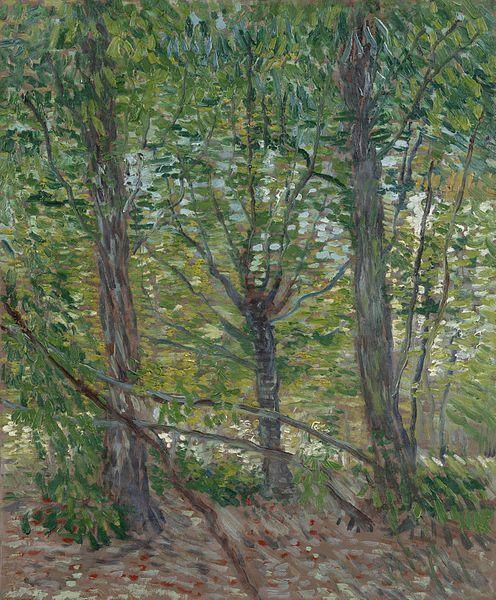
The painting depicts a dense forest landscape, viewed from within the forest itself. Several tall, dark trunks rise through the composition and branch out among a mass of abundant green leaves. On the left, a prominent tree anchors the overall visual weight; in the center, a thinner trunk spreads its branches toward the canopy, while another sturdy tree dominates the right third. Beneath them stretches an understory of shrubs, stems and undergrowth, over uneven ground covered with dry leaves, branches and earthy patches. Small patches of light filter through the foliage, revealing glimpses of the space beyond.
As a landscape, Trees and Undergrowth does not rely on an anecdote or a human figure to create interest. Its subject is the experience of venturing into abundant nature, where nearby vegetation limits the view while also opening corridors into deeper areas. This attention to landscape is connected to the expressive interpretation of nature associated with Vincent van Gogh: the forest ceases to be a merely descriptive backdrop and takes on an active, almost enveloping presence. The scene invites the eye to travel through its different layers, from the immediate foreground to the canopy closing off the upper part.
The trees organize perception as a sequence of overlapping planes. Their trunks function both as natural elements and as vertical lines that separate, frame and reveal fragments of the background. The undergrowth and forest floor reinforce the sense of organic abundance: nothing is entirely clear, and every space seems to extend into leaves, branches and stems. Patches of light introduce pauses within this density, like visual breaths that balance the mass of vegetation. Taken together, the landscape conveys serenity, but not an empty serenity: it is the active calm of a damp, fertile environment, rich in continuity.
The vertical composition focuses attention on the rhythm of the trunks, which alternate in thickness, angle, and branching. This rhythm guides the eye from the foreground toward the spaces between the trees and the lighter areas in the background. Color plays a decisive role in creating depth: the greens of the leaves relate to olive and bluish greens, while the browns, grays, and ochres of the ground provide a more restrained foundation. Light patches scattered among the foliage contrast with the shadowed areas, breaking the canopy into small points of light. The brushwork and chromatic intensity turn the vegetation into a vibrant structure, one that is felt rather than catalogued.
In general, Vincent van Gogh’s landscapes are associated with the prominence of color, the energy of the brushwork, and an intense construction of space; these characteristics help us understand the power of this woodland scene. Here, nature is shaped through subtle contrasts: verticality and uneven ground, density and openness, shadow and light, stillness and visual movement. It is worth observing how each trunk changes the relationship between what is visible and what is hidden, and how the undergrowth draws the eye farther inward. The result is a forest that does not simply depict a place, but makes the experience of being surrounded by vegetation the painting’s true subject.
Have questions about our oil painting reproductions? See our frequently asked questions.