

Description
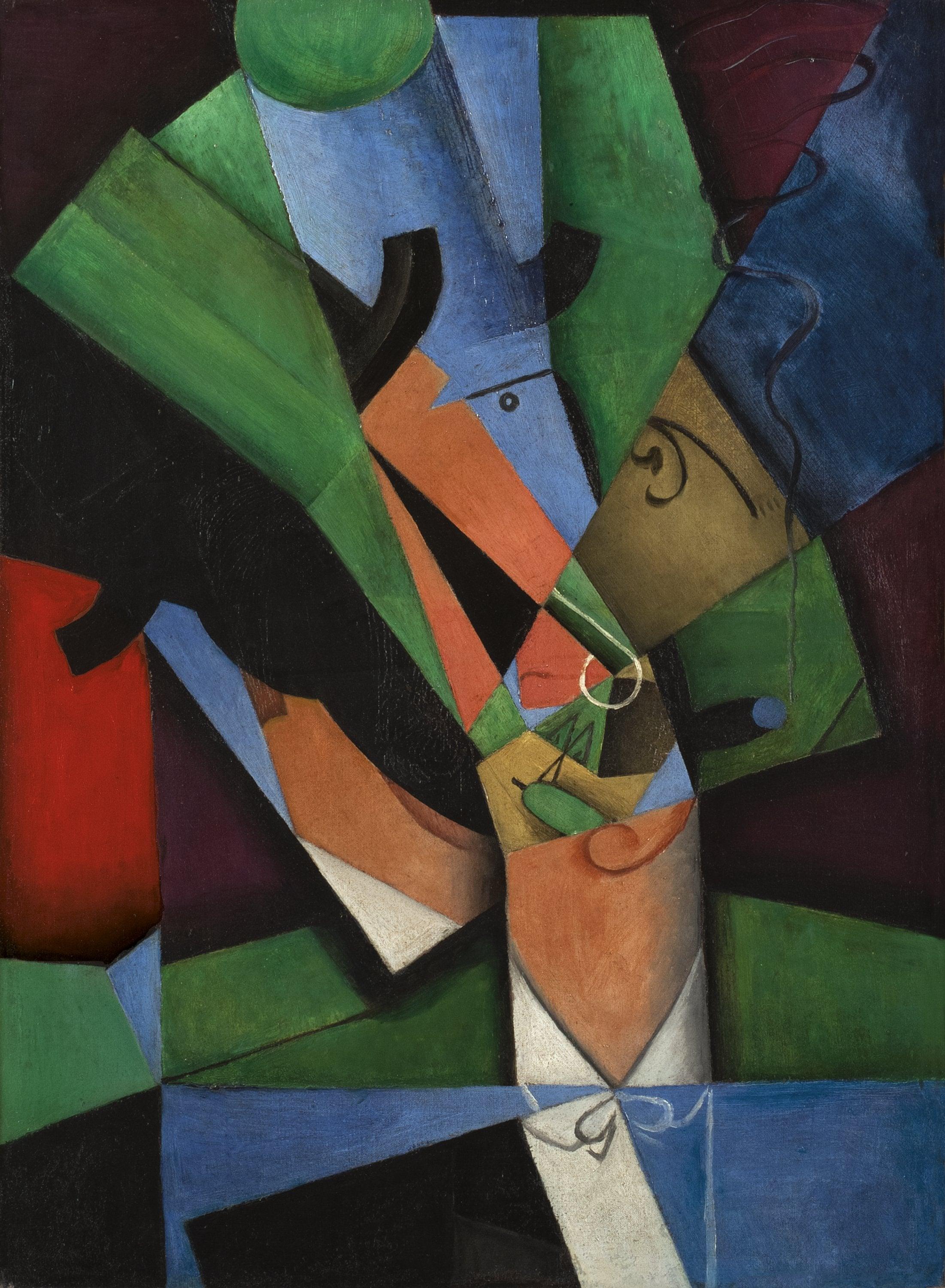
The painting depicts a smoker transformed into an arrangement of planes, contours, and fragments of color. The vertical composition is organized around a central structure in light and dark blue, crossed by angular bands that fan out toward the sides. Large green areas descend diagonally from the top, while black and burgundy masses separate the different fields of color. In the upper section, a green circle partially cut off by the edge stands out; lower down, there are rings, small circles, and planes in orange, terracotta, ochre, red, and cream. The elongated green motif integrated into the lower section adds an organic accent to this geometric assemblage.
The title centers the work on the figure of the smoker, but the scene is not presented as a naturalistic portrait or an anecdotal narrative. The subject is reconstructed through condensed visual signs, so that his identity is perceived through the relationships between forms. This approach belongs to the broader context of Cubism, a movement that fragments bodies and objects to present them through simultaneous planes. In Synthetic Cubism, simplified forms, color contrasts, and partial allusions take the place of painstaking description. In this way, The Smoker turns a recognizable presence into an active visual structure, closer to a construction than to a scene observed from a single viewpoint.
The circles and rings introduce a curved cadence that contrasts with the predominance of angles and rectilinear bands. They function as compositional signs that interrupt the rigidity of the planes and keep the eye moving through the center of the work. The contrast between the green and blue surfaces, the orange and terracotta segments, and the black areas heightens the sense of assembly. The forms do not appear in isolation: they overlap, are cropped, and interlock, as if each fragment retained part of the smoker’s identity. The subject is therefore recognized less by any specific attribute than by the way the composition brings scattered clues together in a complex unity.
Formally, the work concentrates its tension along the vertical axis and in the central area, where diagonals, circular contours, and planes of different scales converge. The larger green areas stabilize the upper and side edges, while the orange and cream segments draw attention toward the lower part. Black acts as a network of separation: it defines the pieces, deepens the background, and gives the colors an almost tactile presence. The alternation of broken lines and curves creates a dynamic visual rhythm without the need to depict literal movement. Depth arises from overlap and contrast, not from traditional perspective; space behaves like a field of forces in which each plane alters how the others are perceived.
In this work by Juan Gris, the Cubist language is evident in the geometric arrangement, the simplification of forms, and the suggestion of a subject through fragmented signs rather than naturalistic depiction. The artist emerges here as a builder of relationships between color, line, and structure: the smoker ceases to be merely a figure and becomes an arrangement of planes that the viewer mentally pieces together. Notice how the circles soften the severity of the diagonals, and how warm colors emerge among greens, blues, and blacks to keep the surface dynamic. The key to the painting lies in this balance: a figurative identity remains latent while the composition commands attention as an autonomous abstract architecture.
Have questions about our oil painting reproductions? See our frequently asked questions.