

Description
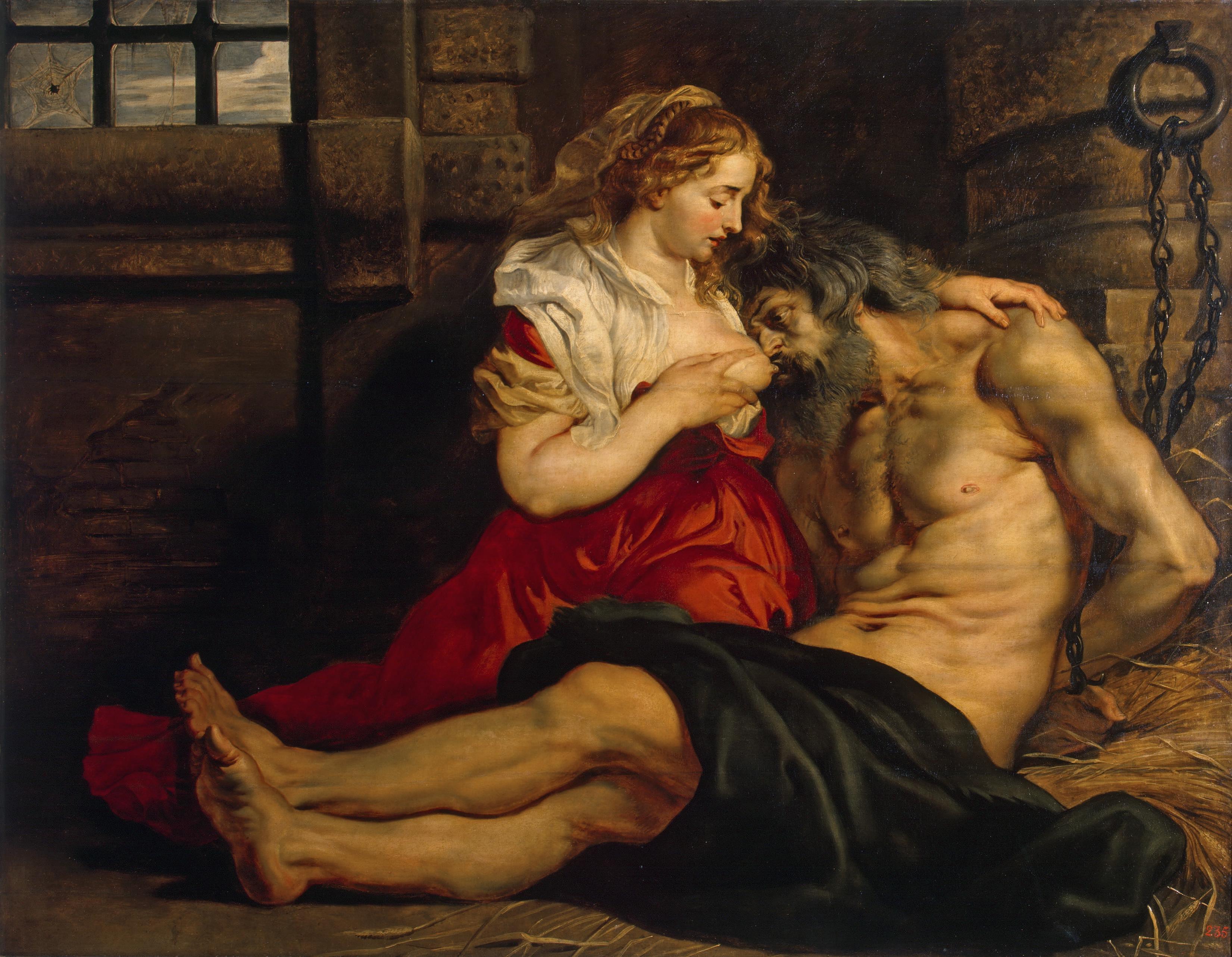
The painting depicts Roman Charity inside a dark prison. At the center of the composition, a fair-haired woman wearing a white blouse and red skirt leans toward a bearded, bare-chested man lying on a bed of straw. Their closeness heightens the narrative tension: the man's face approaches the woman's breast as their bodies intertwine in a gesture of care and need. Signs of confinement crowd the scene: walls of large stone blocks, a high window divided by thick bars, a cobweb with a small spider, and a heavy chain hanging beside a metal ring. A black cloth covers the man's lower body and accentuates the contrast between the illuminated skin, the red skirt, and the gloom of the dungeon.
The episode depicts Pero visiting her father Cimon in prison, where he has been condemned to die of hunger, and secretly feeding him with her own milk. The scene became an exemplary image of filial piety, compassion, and sacrifice within the tradition of moral tales from ancient Rome. The prison is more than a setting: it establishes the extreme circumstances in which the family bond becomes a source of life-sustaining aid. In the face of condemnation and deprivation, the woman offers her own body as a means of sustenance, making a radical form of familial love visible.
The elements of the setting reinforce this interpretation. The chain, ring, and stone make Cimon’s captivity tangible, while the straw scattered across the floor underscores the precariousness of his situation. By contrast, Pero’s red clothing draws the eye and makes her presence the scene’s chromatic focal point. The barred window, with its spiderweb, introduces an image of neglect and suspended time; the small animal caught in it deepens the sense of isolation. Thus, the intimacy of the gesture does not soften the harshness of the place but makes it more intense: the harsher the confinement, the greater the compassionate dimension of the bond between father and daughter.
The visual structure depends on a compact, intensely physical grouping. The legs extend diagonally toward the lower-left area, while the torsos and faces form an upward-reaching focal point in the center and on the right. The chain creates a vertical line that balances the weight of the figures and guides the eye from the upper part of the composition down to the floor. Warm light is concentrated on the skin, shirt, and skirt, allowing the walls and background to dissolve into browns and blacks. This contrast gives the bodies strong definition and makes the caring gesture emerge from the darkness as the principal event.
The work reflects traits widely associated with Peter Paul Rubens: a dramatic, densely grouped composition, figures with a powerful physical presence, warm, high-contrast light, and an intense interplay of gesture, color, and emotion. The characters’ physical energy does not contradict the moral nature of the story; it makes it immediate and tangible. As you look at it, consider the dialogue between the chain and the contact between the bodies, and between the prison stone and the vibrant red of the clothing. Through this opposition, the painting transforms an episode of filial piety into a scene in which compassion takes on an almost physical presence.
Have questions about our oil painting reproductions? See our frequently asked questions.