

Description
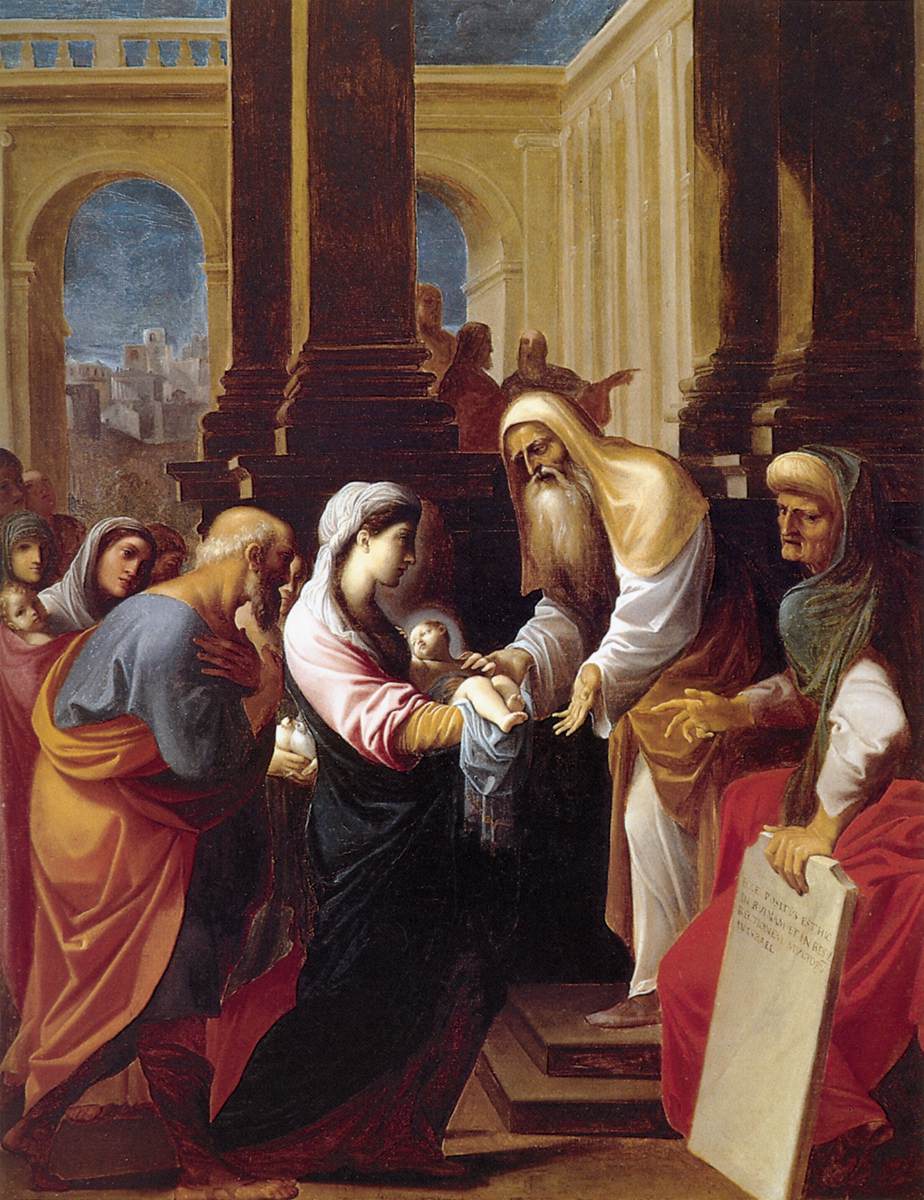
The painting depicts the Presentation in the Temple as a scene of encounter and recognition. In the lower center, a woman holds the naked baby in her arms, while a bearded old man leans toward him with outstretched hands. On the right, an older seated woman accompanies the gesture with an open hand; in the foreground, a bald man wrapped in a voluminous blue cloak watches the ceremony in profile. Other figures gather behind them, partially obscured within a monumental space of columns, arches, and moldings. A pale tablet bearing several lines of writing occupies the lower right and adds an air of authority and solemnity to the composition.
The episode depicts the Presentation of Jesus in the Temple, recounted in the Gospel of Luke. Mary and Joseph bring the child to the Temple in Jerusalem, where the elderly Simeon recognizes him and delivers a prophetic hymn of praise. The older woman on the right is traditionally associated with Anna, the prophetess connected with this event. Carracci thus transforms a scene from the life of the Holy Family into a public ceremony: the child, still fragile and naked, draws the attention of those around him, turning a family encounter into a moment of revelation.
The iconography is organized around the gesture of offering. The woman at the center presents the child to the sacred space, while Simeon leans toward him in a gesture that combines reverence, welcome, and recognition. Anna’s presence lends the episode a broader dimension of witness. The columns and arches are more than mere scenery: they frame the figures and make the solemnity of the Temple visible. The inscribed tablet suggests a setting associated with the law, the word, and religious authority, although its lines remain integrated as a visual sign. The opening onto the city establishes a contrast between the intimacy of the central gesture and the outside world.
The vertical composition is supported by a network of architectural lines that leads the eye toward the group in the foreground. The dark columns create intervals of shadow and act as theatrical wings; between them, the arch on the left opens onto a view of the distant city and a fortress-like structure. The golden, pink, blue, green, and crimson robes stand out against the brown and cream background, focusing the light on the hands, faces, and the baby’s body. The variety of poses—leaning, sitting, reaching out, and looking toward the center—creates an enveloping rhythm around the child. The contrast between the monumental scale of the architecture and the vulnerability of the infant’s body intensifies the work’s emotional core.
The scene is consistent with Lodovico Carracci’s Bolognese tradition, recognizable here in the combination of devotional imagery, human presence, and monumental construction. The warm lighting models the principal figures without entirely detaching them from the architectural space, while the shadowed areas add depth and gravity. The result unites theatricality and devotion: the temple becomes an open stage, and the architecture guides the viewer toward the moment when the child is received and recognized. It is worth noting how the hands, more than the gazes, shape the entire narrative: some hold, others offer, and still others reach out to receive.
Have questions about our oil painting reproductions? See our frequently asked questions.