


Description
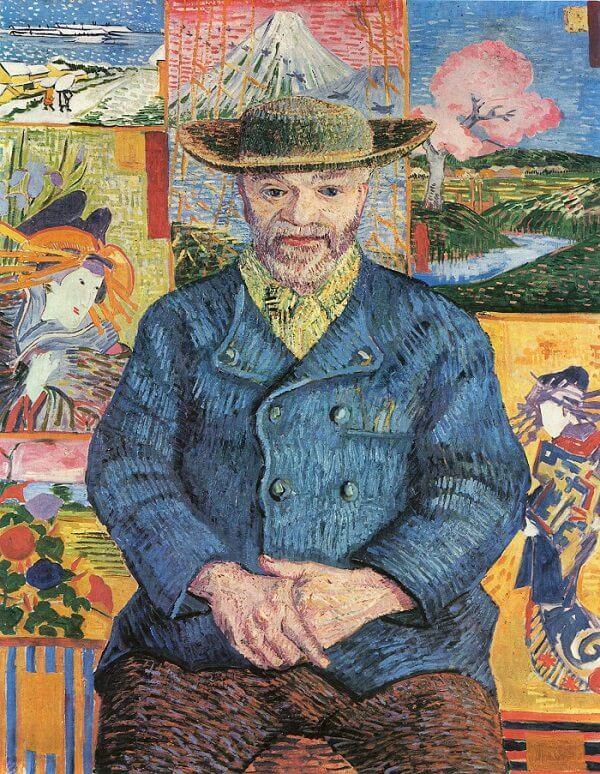
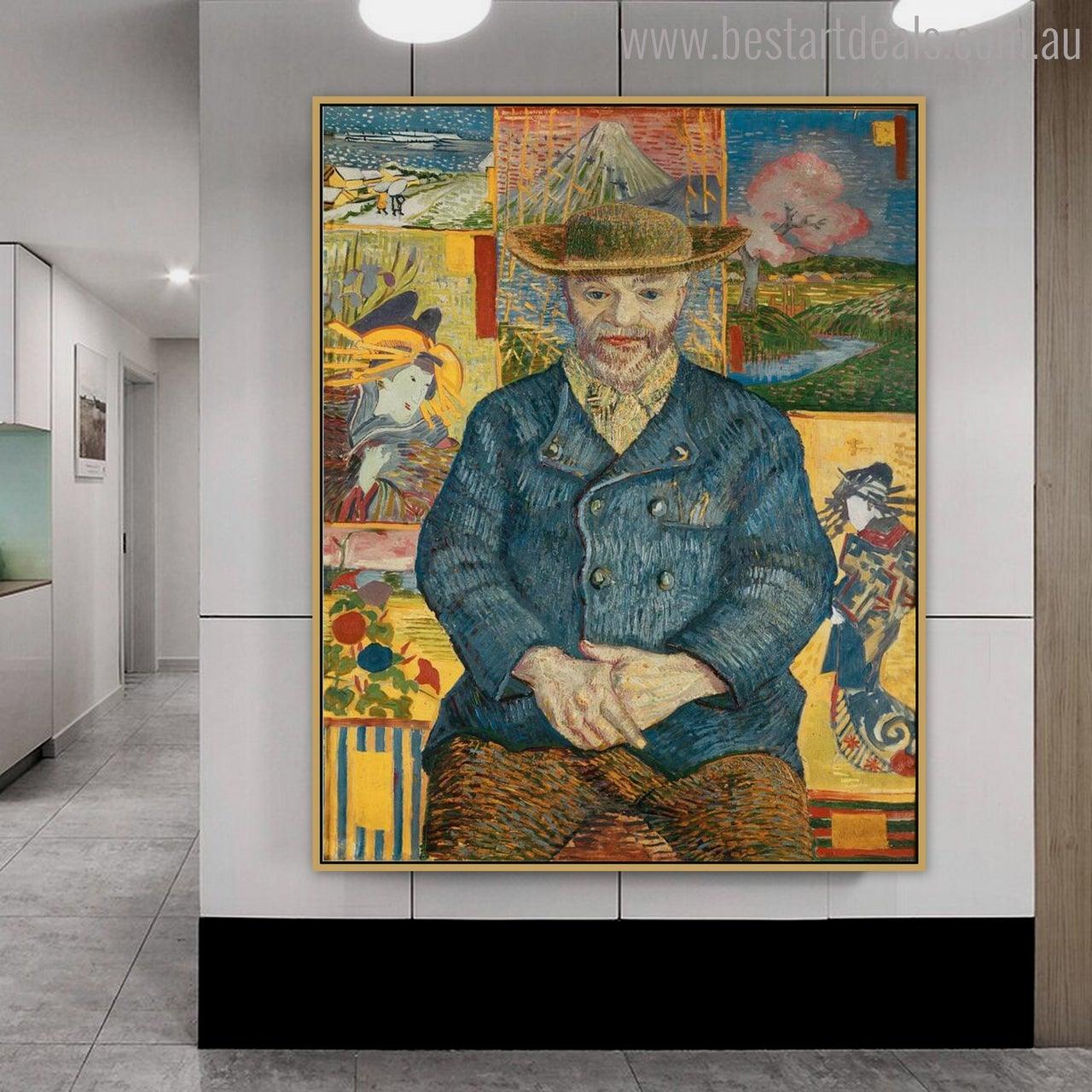
The painting shows Père Tanguy seated facing forward, looking toward the viewer with his hands clasped in his lap. His figure occupies the central axis of the composition: his beard and mustache, broad-brimmed hat, and blue double-breasted coat give him a solid presence. A field of colorful scenes unfolds around the sitter, with a snowy landscape and a boat, a mountain, a tree with pink blossoms, expanses of water, vegetation, and small human figures. In the lower left, flowers, leaves, and fruit-like shapes complete the visual frame, while a partially visible figure appears along the right edge.
The sitter was a Parisian art-supplies dealer and art seller who was connected with the Paris art world in the late 19th century. Vincent van Gogh painted portraits of Père Tanguy, making this figure from the art world more than just an individual model. The background brings together landscapes, flowers, and figurative scenes that evoke the circulation of images in modern culture and Van Gogh’s interest in Japanese art and its prints. In this way, the image connects the man’s identity with the creative and commercial milieu in which he took part.
The central figure serves as a point of stability within a vibrant, fragmented background. His frontal, restrained, and serene pose reinforces the character’s dignity, while the images around him broaden his significance: Père Tanguy is associated with a world of landscapes, natural motifs, and cultural references. The decorative arrangement transforms the portrait into a synthesis of individual presence and visual culture. The flowers and intense colors add vitality, while the distant scenes evoke an open gaze toward other places and artistic traditions.
The vertical composition focuses attention on the dark blue coat, which contrasts with the yellows, reds, greens, pinks, and ochres around it. The face and hands form the expressive core, reinforced by the frontal pose and the repetition of shapes throughout. The visible brushstrokes are dense, short, and directional; they build both the clothing and the landscapes through a rhythmic surface that is more expressive than descriptive. The different compartments in the background introduce depth without abandoning decorative flatness: the gaze moves from the sitter to the mountain, the water, the flowers, and the secondary figures, following a sequence of color contrasts.
This portrait reveals Vincent Van Gogh’s distinctive visual language: intense, contrasting color, energetic brushwork, and a construction of space that gives decorative expressiveness a decisive role. The background is not merely an accompaniment but a second field of attention that continually engages with the figure of Père Tanguy. The blue coat anchors the composition while the surrounding scenes expand it; the work’s particular strength lies in this tension between human stability and a proliferation of images.
Have questions about our oil painting reproductions? See our frequently asked questions.