

Description
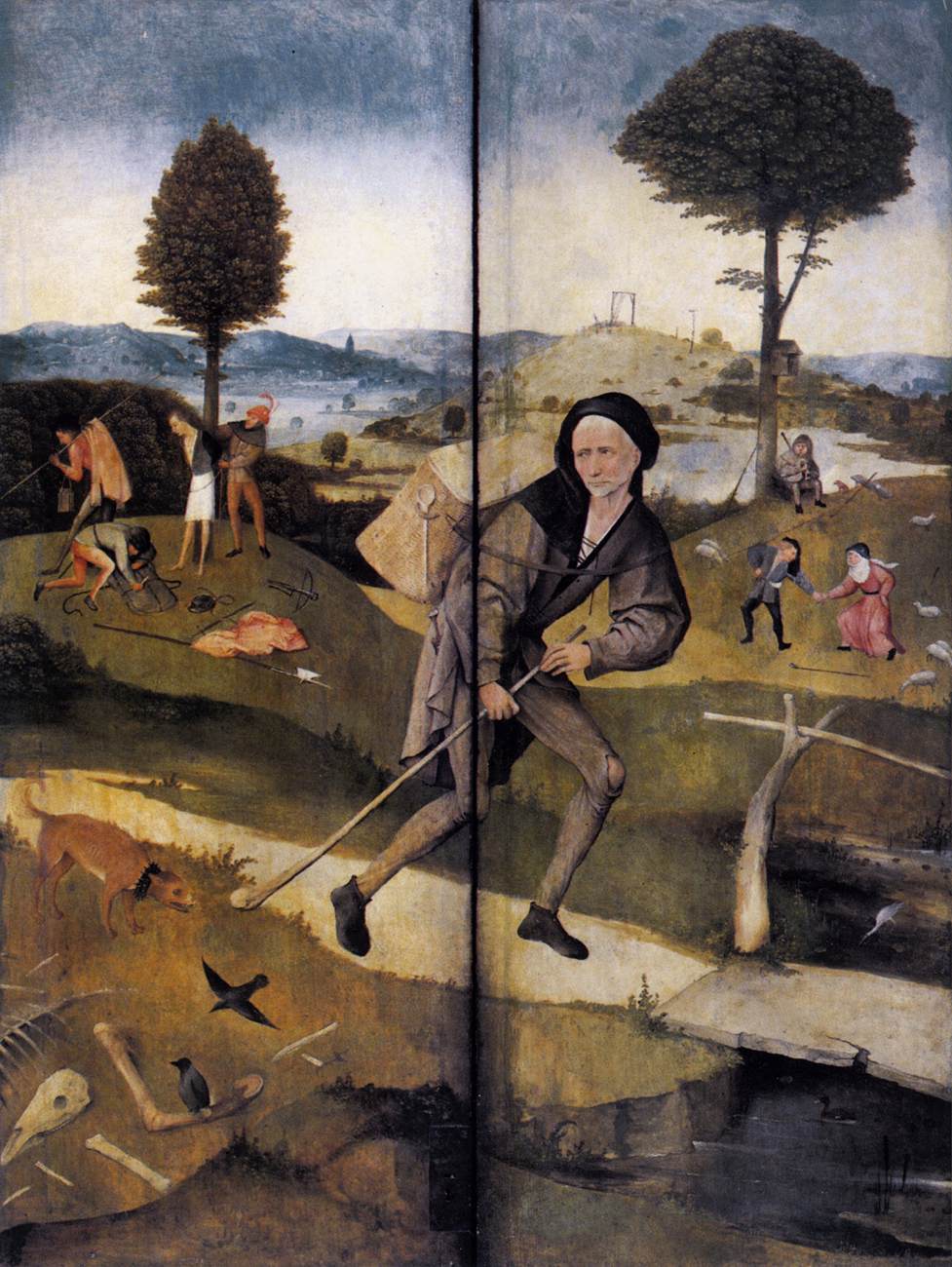
The painting shows a wayfarer making his way through a vast rural landscape densely populated with episodes. The central figure, dressed in dark and gray tones, holds a long staff that crosses the foreground diagonally and directs the viewer’s gaze toward the ground. Around him are workers bent over their tools, four-legged animals, birds, small figures traveling along the roads, and groups gathered on the hillsides. Two tall trees dominate the composition, while fields, fences, blue hills, a stretch of water, and a vertical architectural silhouette against the horizon unfold in the background. In the lower area, tools, skeletal remains, organic matter, and a bare tree trunk introduce a harsh note into the rural scene.
These are the exterior wings of the Haywain Triptych by Hieronymus Bosch, associated with the figure of a wayfarer or traveler crossing the world. Unlike the narrative scenes on the inside of the altarpiece, the haywain that gives the work its name does not appear here: the title refers to the complete structure and its moral program. The traveler moves through a landscape full of labor, distractions, encounters, and everyday dangers. In the broader context of the work, the haywain alludes to the earthly goods and desires pursued by humankind; this exterior view presents the human setting in which that allegory unfolds.
The path turns the landscape into a metaphor for the journey through life. The central figure moves forward without fully joining any of the small groups around him, passing through a world of activities, desires, and temptations. The bones and remains in the foreground evoke the vulnerability of the body and the precariousness of human pursuits, while the tools and animals connect spiritual existence with work and material survival. The fences, paths, and scattered figures shape a territory of continual choices: each episode opens up a different direction within a shared world. The vast horizon contrasts with the fragility of the figures and reinforces the moral reading of earthly life.
Formally, the work is organized around a dark vertical axis: the wayfarer, enlarged in relation to the secondary figures, draws the viewer’s attention before leading it along the diagonal of his staff. The two tall trees balance the upper sides and frame the landscape’s layered depth. Bosch alternates dense foregrounds filled with objects and activity with increasingly open bands of fields, water, and blue-gray hills. The olive greens, ochres, browns, and blacks of the terrain gradually cool toward the horizon, creating a sense of distance without interrupting the narrative continuity. The diffuse light unifies the episodes and guides the eye from the wayfarer to the tools, from the remains to the distant groups, and finally to the landscape that encompasses them.
The scene reflects a feature widely associated with Bosch: the combination of open landscapes, meticulously populated, with human episodes that invite moral interpretation. His visual imagination transforms everyday life into a web of relationships between work, desire, vulnerability, and movement. The strength of these outer wings lies in turning a country road into a setting for reflection: the traveler moves among animals, fences, remnants, and scattered activities, while the panorama expands each gesture until it becomes part of a meditation on the human condition. The staff links the figure to the foreground, and the paths extend his journey toward the hills, making visible the union of narrative, symbol, and pictorial structure.
Have questions about our oil painting reproductions? See our frequently asked questions.