

Description
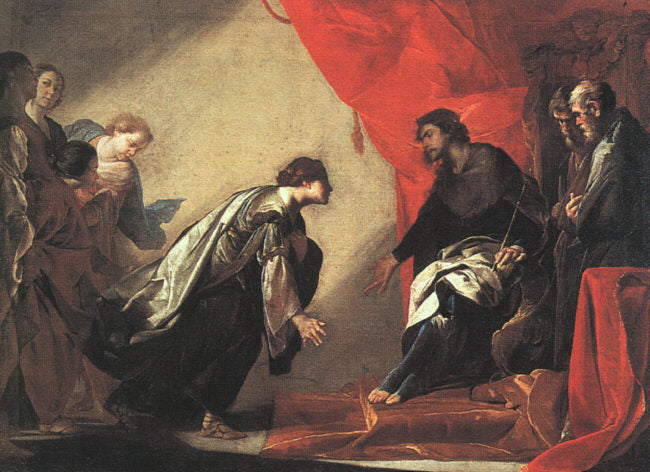
The painting shows Esther and Ahasuerus at a tense audience. Six figures gather around a male figure reclining or sitting in the lower center, on a raised surface. Esther, kneeling in the foreground, leans toward him in a pleading or intercessory pose. Around her, two women stand on the left, while two bearded men watch from the right; one extends his arm toward the heart of the scene, while the other, older in appearance, holds a vertical staff. The dark garments, light fabrics, and large red curtain place the encounter in a courtly setting of intense theatricality.
The episode refers to the biblical story of Esther, a Jewish woman who becomes queen of Persia. Ahasuerus is the ruler before whom she appears, and the scene centers on the decisive moment when she risks her position to intercede for her people. The narrative background includes the threat Haman poses to the Jews, so this audience is not a simple ceremonial presentation: it involves danger, responsibility, and the possibility of changing the fate of a community. Esther’s posture conveys this pleading dimension visually, while the king’s central position organizes the scene around his authority and response.
The iconography relies on both the gestures and the arrangement of the figures. The kneeling woman creates a diagonal that guides the eye toward the sovereign figure, while the outstretched arm of the man behind her reinforces the sense of reception or response during a public audience. The crimson drapery serves as a sign of courtly solemnity and as a powerful visual mass framing the encounter. In contrast, the dark areas of the garments and background make the faces, hands, and light-colored fabrics stand out more vividly. The scene thus transforms an act of intercession into an image of power, vulnerability, and decision.
The formal composition depends on a balance between concentration and expansion. The group of figures is arranged around a low center, while the large red fabric hangs heavily over the upper and right portions, partially enclosing the space and heightening the sense of theatrical intimacy. Esther’s diagonal pose disrupts the stability of the composition and creates movement toward the center; the vertical figures of the attendants, by contrast, establish a measured, ceremonial rhythm. The reds, ochres, and browns form a warm palette, interrupted by ivory whites and a small touch of blue-gray. The lighting is concentrated on the central group, leaving broad areas in shadow and guiding attention from Esther’s gesture toward the authority figure receiving her.
In Bernardo Cavallino’s work, this Neapolitan Baroque sensibility is evident in the theatrical composition, pronounced chiaroscuro, and rich warm tones applied to biblical or historical subjects. The painting does not depict the audience as a static scene, but as a moment suspended between the request and the response. It is worth observing how the drapery, light, and gazes bring all the figures together around this exchange: the visual architecture of power is set against Esther’s inclination, and the drama arises precisely from the relationship between a figure who pleads and a sovereign who holds the decision.
Have questions about our oil painting reproductions? See our frequently asked questions.