

Description
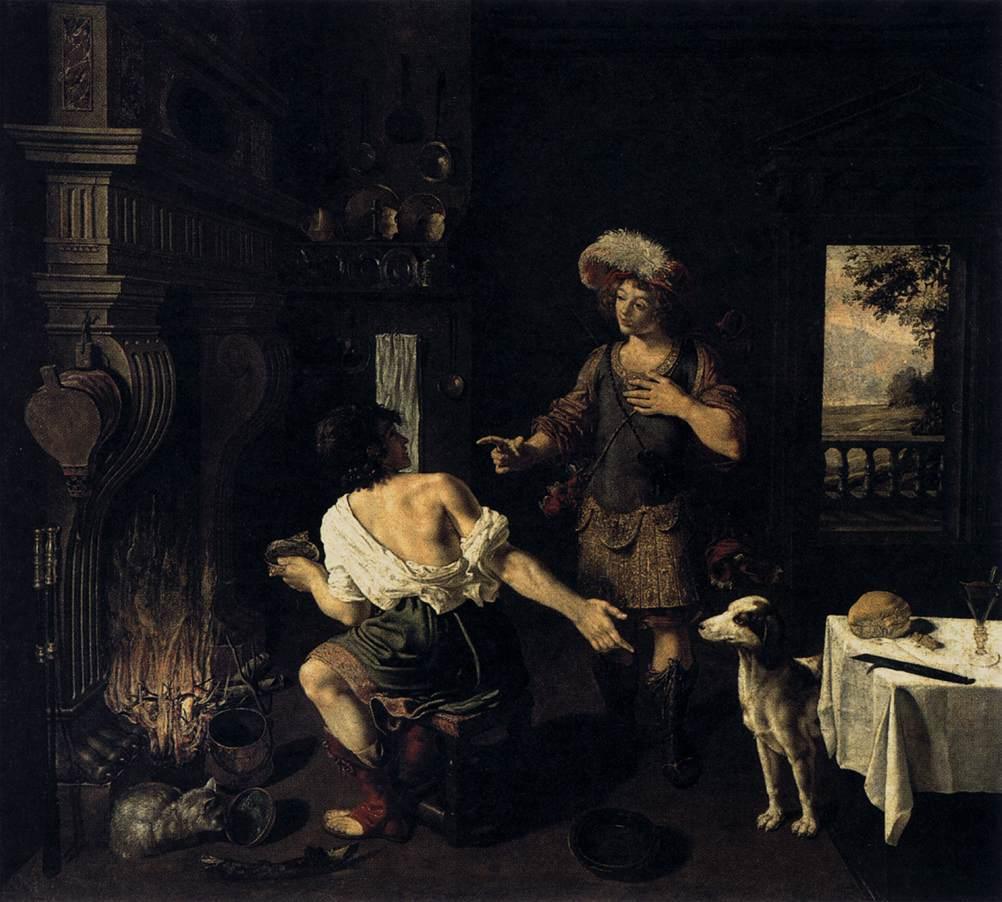
The painting presents Esau and Jacob inside a home, in a scene charged with narrative detail. Two human figures occupy the center of the composition: one is seated or kneeling, seen mainly from behind, with his torso bare and a white shirt draped around his arms; the other stands behind him, dressed in dark and brown tones, wearing a feather-adorned hat and extending one hand in an emphatic gesture. On the right, a dog stands beside a rectangular table covered with a white cloth, on which bread and vessels rest. On the left rises a monumental fireplace with a fire burning, surrounded by pots, utensils, and architectural features. In the background, an opening reveals trees, sky, and a bright landscape that contrasts with the domestic gloom.
The scene is connected with the biblical story of Esau and Jacob, the sons of Isaac and Rebekah. According to the Book of Genesis, Esau, the elder brother, gives up his birthright to Jacob in exchange for food when he returns hungry. The set table and bread thus focus attention on the conflict between an immediate need and an inheritance of great importance to the family. The painting places this decision in an everyday setting, amid the fire, utensils, and preparation of food, making the tension of the story tangible. A decisive choice arises in the midst of an ordinary room, where material actions have far-reaching consequences for the family.
The bread and vessels on the table form the material core of the exchange, while the standing figure’s gesture introduces persuasion and confrontation. The contrast between one brother’s upright posture and the other’s lower position shapes a visual relationship of pressure, expectation, and vulnerability. The dog, alert in the foreground, heightens the everyday quality of the scene and brings the episode closer to the tangible world of the home. The fireplace and utensils reinforce its domestic character; the fire concentrates warmth, sustenance, and urgency. The opening onto the landscape extends the narrative beyond the room, although the drama remains gathered around the two brothers.
The composition is built on a strong contrast between areas of shadow and points of light. The architecture, moldings, and fireplace carry weight on the left side, forming a vertical, almost theatrical structure that encloses the space. At the center, the figures establish the main axis of attention; the outstretched arm, the bent back, and the fall of the white garment create movement within a densely populated interior. The light-colored tablecloth and the landscape in the background serve as areas of brightness against the dominant browns, blacks, and ochres. Depth emerges in layers: objects and fire in the foreground, figures at the dramatic core, and the open exterior in the background. The light picks out gestures and textures, directing the eye toward the exchange between the two figures.
Michel Corneille the Elder turns a biblical episode about hunger, inheritance, and fraternal power into a scene of restrained theatricality. The abundance of objects, the architecture, and the contrast of light and shadow make the interior function as both home and stage, while the table transforms a physical need into the focal point of an irreversible decision. The bread, the fire, and the figures’ postures form a visual chain of nourishment, urgency, and negotiation. The painting’s meaning arises from this union of the everyday and the transcendent: a particular room contains a family conflict whose consequences extend far beyond its walls.
Have questions about our oil painting reproductions? See our frequently asked questions.