To speak of Salvador Dalí is to enter a territory where logic dissolves like a soft watch under the sun, where time loses consistency and reality fractures into impossible images that, nevertheless, feel deeply familiar. Dalí did not simply paint paintings: he built mental universes, landscapes of the subconscious where desire, fear, memory, and the divine coexisted without hierarchy.
This tour brings together fifteen of his most iconic works, presented in the proposed visual order, to explore not only their aesthetic impact, but also the obsessions, symbols, and revelations that run through them. Each of these paintings is a doorway into a brilliant, unsettling, and deeply human mind.
1. Soft Construction with Boiled Beans (Premonition of Civil War) (1936)

In this work, Dalí seems to anticipate the horror that was about to break out in Spain. A monstrous, torn, and tense body twists in on itself as if at war with itself. There is no external enemy: the conflict is internal, visceral, inevitable.
The soft, almost organic forms evoke living flesh, while the boiled beans —an apparently banal detail— introduce a domestic, everyday dimension, brutally contrasting with the violence of the scene. Dalí himself explained that the beans symbolized the inability to understand tragedy rationally.
It is a painting that is not simply viewed: it is endured. And in that suffering, it reveals the self-destructive nature of humanity.
2. Christ of Saint John of the Cross (1951)

Here Dalí offers one of the most radical visions of the crucifixion. There are no visible nails, no blood, no explicit pain. Instead, Christ floats in an impossible perspective, seen from above, as if the viewer occupied God's place.
The composition is geometric, almost mathematical, and yet deeply spiritual. Christ's body is suspended over a serene landscape, creating a tension between the divine and the earthly.
Dalí does not represent suffering, but mystery. This work marks his transition toward what he called “nuclear mysticism,” where science and religion merge into a new vision of the universe.
3. Dream Caused by the Flight of a Bee Around a Pomegranate a Second Before Awakening (1944)

This long, precise title already places us in the realm of the subconscious. The scene shows Gala floating nude above the sea, while a series of images —tigers, a rifle, a fish— emerge in a dreamlike sequence triggered by the buzz of a bee.
Dalí explores here the exact moment when an external stimulus turns into a complex narrative within a dream. It is a visual representation of the sleeping mind at work.
The almost photographic precision contrasts with the absurdity of the scene, generating an unsettling sensation of altered reality.
4. Galatea of the Spheres (1952)

In this work, Gala's face breaks apart into a constellation of spheres suspended in space. Dalí, fascinated by nuclear physics, tries to represent matter as something fragmented, dynamic, and constantly reorganizing itself.
It is a portrait, but also a theory of the universe. Each sphere seems to vibrate, as if the face were not a solid surface, but a structure in precarious balance.
Dalí turns Gala into a cosmic entity, a symbol of the interconnection between the human and the infinite.
5. The Enigma of Desire (My Mother, My Mother, My Mother) (1929)

One of Dalí's most intimate and disturbing works. The central figure, amorphous and eroded, is covered with cavities that obsessively repeat the phrase “my mother”.
The painting is an exploration of desire, loss, and memory. Dalí's mother had died years earlier, and her absence left a profound mark on his psyche.
The barren and desolate landscape reinforces the sense of emotional emptiness, while the soft forms suggest an identity in dissolution.
6. The Disintegration of the Persistence of Memory (1952–1954)

Here Dalí revisits his most famous work and subjects it to a radical transformation. The soft watches are still present, but now the world seems to fragment into suspended blocks.
It is a vision influenced by quantum physics, where reality is no longer continuous, but discontinuous. Time, which once melted, now falls apart.
The painting is a reflection on the instability of everything we consider real.
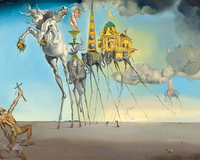
7. The Temptation of Saint Anthony (1946)

A procession of impossible creatures advances on extremely long, fragile legs. Elephants carrying monumental structures, symbols of desire and temptation.
Saint Anthony, tiny, tries to resist with a cross. The scene is a metaphor for the struggle between the spiritual and the carnal.
Dalí turns temptation into something elegant, almost sublime, which makes it even more dangerous.
8. Swans Reflecting Elephants (1937)

One of the clearest works in its use of optical illusions. Three swans reflected in the water are transformed into elephants.
Dalí plays with perception, showing that reality depends on the point of view. What we see is not what it is, but what we interpret.
It is a visual lesson in the relativity of perception.
9. The Persistence of Memory (1931)

Perhaps the most iconic work of Surrealism. The soft watches melt in a desert landscape, suggesting that time is not rigid, but malleable.
Dalí turns an abstract concept into a tangible, almost tactile image.
The painting is silent, yet deeply unsettling. It forces us to question our relationship with time.
10. The Great Masturbator (1929)

A deeply autobiographical work. The central, distorted figure represents Dalí himself and his conflicts with desire and sexuality.
The images surrounding it—faces, insects, fragmented bodies—form a collage of obsessions.
It is an uncomfortable painting, but an honest one. Dalí hides nothing: he lays his mind bare.
11. The Elephants (1948)

Elephants with extremely long legs carry obelisks on their backs. The image is majestic and absurd at the same time.
Dalí combines weight and lightness, stability and instability. The elephants seem on the verge of collapsing, but they keep moving forward.
It is a reflection on power and its fragility.
12. Metamorphosis of Narcissus (1937)

Dalí depicts the myth of Narcissus through a double image: the young man's body transforms into a hand holding an egg from which a flower emerges.
The painting is a meditation on identity, transformation, and rebirth.
Dalí accompanies the work with a poem, reinforcing its conceptual character.
13. The Burning Giraffe (1937)

Female figures with drawers open in their bodies, as if they were pieces of furniture. In the background, a giraffe burns in flames.
Dalí explores the human subconscious as a space full of hidden compartments.
The giraffe, distant yet present, adds an apocalyptic dimension.
14. The Ghost of Vermeer of Delft Which Can Be Used as a Table (1934)

Dalí pays homage to Vermeer, but transforms him into a ghostly, elongated, functional figure.
It is a reflection on art history and its reinterpretation.
Dalí does not copy: he reimagines.
15. The Face of War (1940)

A cadaverous face floats in a desolate landscape, with its mouth and eyes open… and inside them, other identical faces, repeating to infinity. The image is hypnotic and deeply disturbing.
Dalí painted this work at the start of World War II, and it is perceived as a meditation on the cyclical horror of human violence. There is no escape: inside the face there is more face, inside fear there is more fear.
The snakes surrounding the head reinforce the sense of anguish and constant threat. Everything in the painting points to a disturbing truth: war is not just an external event, but a mental state that reproduces itself endlessly.
It is one of Dalí's most direct works, less ironic, more brutal. Here surrealism stops being a game and becomes a warning.
Exploring Dalí means accepting that reality is not a stable territory, but a field in constant transformation. His paintings offer no answers: they raise questions. And in that game between the visible and the invisible, between the rational and the dreamlike, we find one of the most intense experiences art can offer.
KUADROS ©, a famous painting on your wall.
Hand-made oil painting reproductions, with the quality of professional artists and the distinctive seal of KUADROS ©.
Art reproduction service with satisfaction guarantee. If you are not completely satisfied with the replica of your painting, we will refund 100% of your money.