

Description
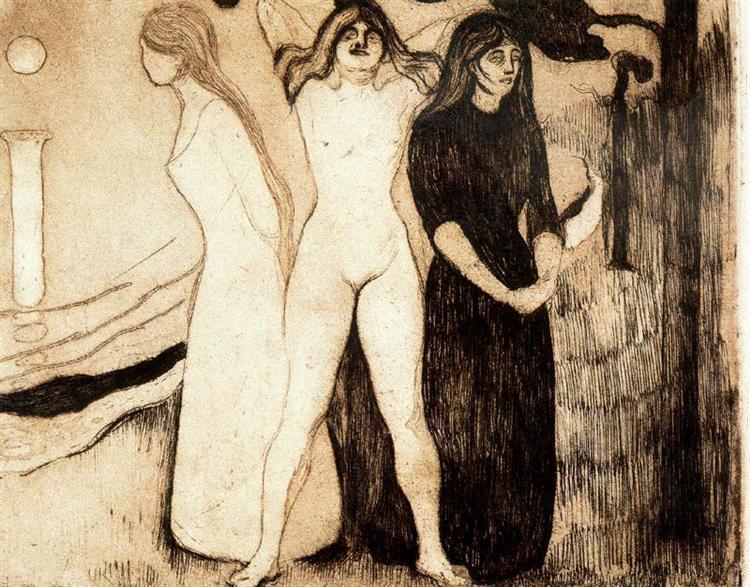
The painting The Women, by Edvard Munch, depicts three female figures standing in a vertically oriented, densely composed scene. At the center, a nude woman raises both arms, drawing the eye with an open, exposed and commanding pose. To her left, another figure is shown from behind, covered by a long, light-colored garment, while on the right, a woman dressed in dark clothing holds her hands together in front of her body. The three figures relate to one another without forming a literal narrative scene: they seem to be gathered in a shared space, yet each retains her own attitude and visual intensity.
The title presents the figures as a group, rather than as characters identified with a specific story. The work thus occupies the realm of the symbolic and psychological scene, where the arrangement of the bodies matters as much as their individuality. The central figure, nude and facing forward, contrasts with the two clothed figures at the sides, creating a comparison between different female presences. The image needs no precise anecdote to sustain its power: as a whole, it serves as a visual meditation on gathering, difference and the tension between bodily exposure and reserve.
The meaning takes shape through visible contrasts. The central nudity can be read as vulnerable and, at the same time, assertive; the raised arms broaden her silhouette and make her the group’s focal point. On either side, the long garments create different kinds of emotional distance: the light-clad figure, turned away, suggests withdrawal, while the dark-clad figure concentrates weight and solemnity at the far right. The background of vertical strokes, masses of foliage and enveloping shadows heightens the sense of isolation, turning the setting into an extension of the scene’s psychological state.
The composition draws the eye from the central figure toward the two figures at the sides through a rhythm of contrasts. Beige and sepia shape the illuminated areas, while deep browns and blacks define the silhouettes and lend density to the surrounding space. The vertical lines on the right create a sense of confinement or structure, in contrast to the curved bands in the lower-left background, which introduce a more undulating movement. A pale disc in the upper left balances the dark mass of the scene and provides a moment of visual pause. Depth is not created through naturalistic perspective, but through layers of hatching, overlapping forms, and tonal contrast.
This expressive simplification and preference for psychological intensity over naturalistic description link the work to Edvard Munch’s artistic sensibility. The line does more than define the bodies: it establishes relationships of tension between them and makes the background seem to vibrate around their silhouettes. The result is a theatrical, restrained, and enigmatic scene in which the group of women becomes a structure of contrasts: nudity and clothing, light and darkness, openness and reserve. When viewing the painting, it is worth following the progression among the three figures and observing how each pose changes the meaning of the others.
Have questions about our oil painting reproductions? See our frequently asked questions.