

Description
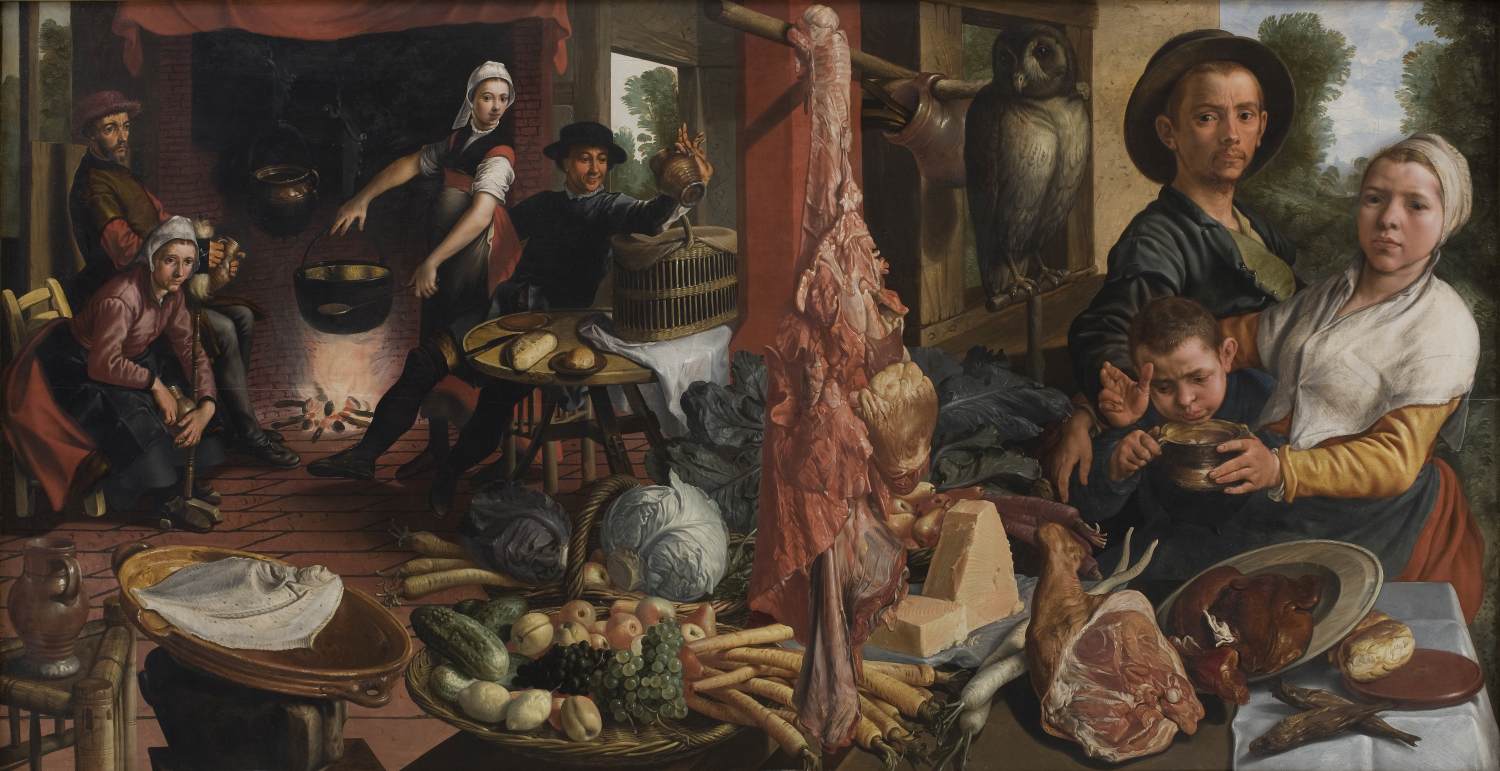
The painting depicts a busy, inhabited kitchen transformed into a scene of extraordinary abundance. Seven human figures are spread from the hearth at the far left to the group gathered on the right: a man works by the fire, several women handle vessels and food, and a child holds a bowl and a spoon. At the center, a man lifts a jug while a large cut of meat hangs vertically, dividing the composition. An owl perches on a raised structure, watching the activity in the room. The foreground is filled with an almost overwhelming array of fish, poultry, cuts of meat, bread, cheese, grapes, fruit, and vegetables.
The work belongs to the tradition of kitchen and market scenes associated with Pieter Aertsen. It does not depict a specific historical or religious episode, but rather a domestic scene in which culinary labor, social interaction, and material culture share the same space. Instead of relegating food to a secondary detail, the painting makes it the principal visual event. Everyday life thus takes on a broader dimension, connected to the preparation, consumption, and display of available goods.
The title, The Fat Kitchen: An Allegory, draws its force from the accumulation of materials and textures. The abundance of meat, fish, fruit, vegetables, bread, and cheese suggests material prosperity, but also introduces an idea of sensory excess. The hearth, pots, and vessels are a reminder that this wealth depends on labor, preparation, and cooperation. The central table brings together the everyday gestures of serving and arranging food, while the owl serves as an observant detail that heightens the sense of a scene frozen in mid-action.
The composition is built in depth through a carefully defined contrast. The dense, horizontal lower band concentrates the visual weight in the food; above it, the figures form a rhythmic sequence of bodies, arms, hats, and caps. The beams, dark walls, and rectangular openings structure the background, while the windows open onto views of a wooded landscape beneath a bright sky. The browns, blacks, and earthy reds of the interior set off the leafy greens, the silvery tones of the fish, and the creamy whites of the bread and cheeses. The suspended piece of meat introduces a vertical line that connects the upper area to the foreground and guides the eye between the two levels.
This arrangement reflects a feature widely associated with Pieter Aertsen: the combination of a monumental still life with a deeper genre scene. The food’s richness of colour and texture deliberately competes with the human activity, while remaining part of it. When viewing the work, it is worth following the scene from the hearth to the table and then returning to the abundance in the foreground: this movement reveals how domestic labour sustains the spectacle of plenty. The kitchen is not merely a place of preparation, but a visual theatre in which materiality, conviviality, and excess are brought together in a single scene.
Have questions about our oil painting reproductions? See our frequently asked questions.